Air Purifier Maintenance and Ownership Guide
Air purifier maintenance and ownership — The Complete Guide: check an air purifier filter every 30 days, and replace it when airflow drops, the indicator…
Hands removing a round car air filter
Last updated: November 26, 2026
Quick Answer: check an air purifier filter every 30 days, and replace it when airflow drops, the indicator says so, or the maker’s guidance says to do it. Air purifier maintenance and ownership is mostly about changing filters on time, keeping the intake clear, and matching the machine to the room. If the unit is sized correctly and cared for on a simple schedule, it should keep moving air through the filter instead of slowing down, getting loud, or turning into a dusty box. If you are unsure about filter timing or placement, consult the owner’s manual or a qualified indoor-air professional.
Key takeaways
- Therefore, a purifier only works as well as its airflow path, so a dirty prefilter or clogged main filter can do real damage to performance.
- In particular, the right purchase matters as much as upkeep. A unit with strong CADR and a filter rated for the room is easier to live with than an undersized bargain model.
- Specifically, HEPA means 99.97% capture at 0.3 microns, but that does not mean you can ignore the filter or skip routine checks.
- So ownership costs are not just the sticker price. Filters, electricity, and the time spent cleaning the unit all count.
- Overall, the least maintenance-heavy setup is a purifier with an easy-to-remove prefilter and clear filter-change access.
What does air purifier maintenance actually include?
Air purifier maintenance means keeping airflow high enough that the machine can do its job, and the basics are simple: clean the exterior, clear the intake, watch the filter indicator, and replace the filter when the maker says to. The U.S. Environmental Protection Agency has a plain-language guide to portable air cleaners, and the Association of Home Appliance Manufacturers explains CADR, the rating that helps match a purifier to a room.
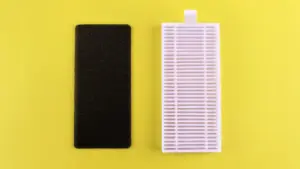
A generic article usually stops at “change the filter.” That leaves out the part that matters most: dust builds up before the filter looks obviously dirty, and performance can fall before a casual glance catches it. A prefilter can catch hair and lint; the main filter then has less to handle, which is why the small pieces of maintenance often matter more than the expensive cartridge.
A good owner should think in three layers. First is the intake path, which must stay open. Second is the filter media itself, which traps particles from smoke, dust, and pollen. Third is the room around the purifier, because a machine placed behind a sofa or in a corner with poor circulation will not perform like the box suggests, even with a strong CADR rating.
The useful question is not “Can I ignore maintenance for a year?” It is “What will keep this unit working like a 24/7 appliance instead of a noisy fan with a clogged filter?” That answer depends on the filter type, the room size, and how much dust the home makes.
How often should you change the filter?
You should check the filter every month and replace it when the maker’s indicator, your nose, or visible buildup says airflow has dropped. There is no honest single schedule for every purifier because a machine in a dusty home, near a litter box, or in a smoke-heavy room can load up much faster than one in a low-dust bedroom.
The biggest mistake is treating filter life as a fixed calendar promise, so it is safer to treat the printed interval as a guide and confirm with the manufacturer’s manual or a qualified professional when the room conditions are unusual. A purifier with a carbon stage for odor control can lose usefulness before the HEPA layer looks fully spent, because the carbon fills up first. A household with pets, cooking fumes, or a lot of open-window dust can shorten the useful life of a filter well before the box’s ordinary replacement window.
A second mistake is waiting for the filter to look gray all the way through. That often means the machine has already spent a long time working harder than it should. If the airflow feels weak, the fan sounds strained, or the unit still smells stale after cleaning, the filter path may be restricted even if the indicator has not lit up.
I would treat any printed replacement interval as a starting point, not a commandment, and if the unit is being used in a high-dust or smoke-heavy space, it is wise to check with the maker or a qualified professional before stretching the schedule. If the unit has a washable prefilter, clean that piece on its own schedule so the main filter is not doing all the work. If the purifier uses a sealed cartridge, follow the maker’s filter indicator and keep a spare on hand before the old one reaches the end of useful life.
Washable prefilter or replaceable HEPA filter?
A washable prefilter wins for ease of ownership, but a replaceable HEPA filter is often the simpler path for people who want predictable particle capture. That is the cleanest split in air purifier maintenance because the first option lowers day-to-day fuss, while the second usually gives better consistency if the whole filter assembly is well made.
| Criteria | Washable prefilter + replaceable main filter | Replaceable HEPA filter with little or no washable stage | Winner for which condition |
|---|---|---|---|
| Day-to-day cleaning | Hair and lint can be removed from the prefilter before they clog the main stage | Less to clean on the surface, but the main filter takes the full load | Washable prefilter for dusty homes |
| Maintenance effort | More frequent small cleanups, often easier than full filter swaps | Fewer small tasks, but each filter replacement matters more | Replaceable HEPA for busy owners |
| Airflow protection | Better chance of keeping airflow open if prefilter is cleaned regularly | Airflow can drop faster when the main filter loads up | Washable prefilter for pet owners |
| Odor control | Depends on whether the carbon stage is separate and replaceable | Often better if the odor stage is a dedicated cartridge | Replaceable HEPA for smoke and odor control |
| Replacement cost pattern | Main filter may last longer when the prefilter catches large debris | Replacement is more straightforward but can happen more often in dirty rooms | Washable prefilter for long-term use |
| Cleaning mess | You handle the prefilter dust yourself | Less handling of loose debris, more sealed replacement | Replaceable HEPA for dust-sensitive users |
| Failure risk | A neglected prefilter can make the whole unit seem weak | Fewer user steps, but no extra buffer against large debris | Replaceable HEPA for low-maintenance users |
| Best fit | Homes with pets, lint, or visible dust | Bedrooms, offices, and users who want simple routines | Depends on the room |
| Who should skip it | People who will never rinse or vacuum the prefilter | People who want the cheapest ongoing upkeep | Depends on the owner |
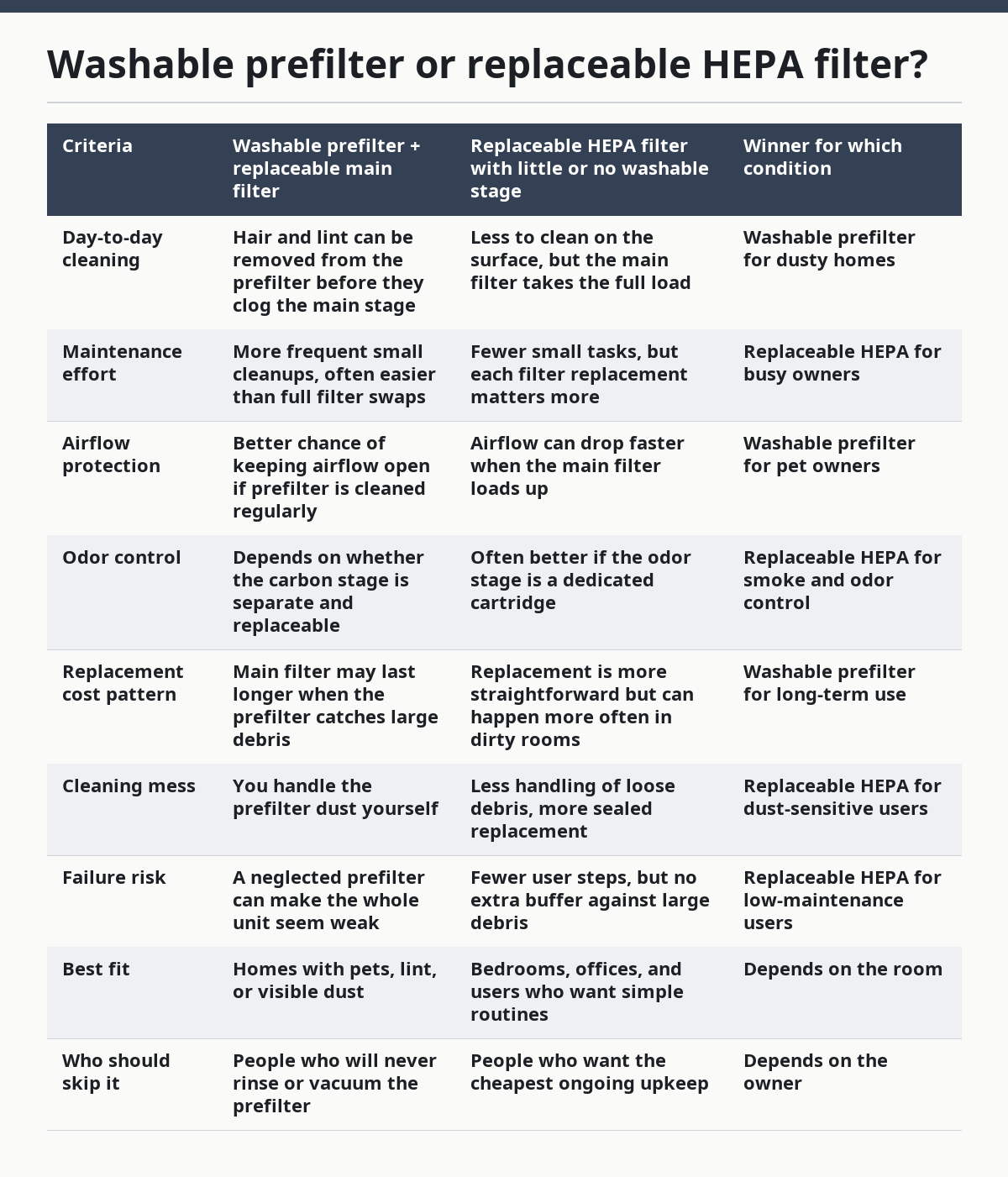
Therefore, the washable prefilter side wins when the home sheds a lot of visible debris. Pet hair, dust bunnies, and lint are easier to deal with before they reach the expensive filter stage. That matters because a clogged surface layer can cut airflow and make the whole unit sound louder and work harder, which defeats the point of owning it.
The weak side of the washable prefilter is obvious: it asks for regular attention. If the owner hates pulling panels off, rinsing them, drying them, and putting everything back correctly, the prefilter becomes a chore instead of a help. A neglected washable layer can also hold grime and odors, so “washable” is not the same as “maintenance-free.”
Meanwhile, the replaceable HEPA side wins when simplicity matters most. A bedroom purifier or office unit that only needs periodic cartridge changes is easier to live with if the owner prefers one clean task instead of several small ones. The downside is cost and disposal; the whole cartridge becomes the replacement item, and a dirty room can shorten its useful life.
The right choice depends on the mess in the room and the patience of the owner. A person with a shedding dog and a willingness to rinse a prefilter every few weeks will usually be happier with the washable setup. A person who wants the lowest-friction routine, and who will actually replace filters on time, usually does better with the sealed HEPA style. For model comparisons, see our air purifier buying guide.
How much work does ownership really take?
Ownership takes less work than most people fear, but it is not zero, and the first 15 minutes after unpacking the unit matter more than most buyers think. The useful routine is simple: place it with clear space around the intake, run it on a setting that can move air without screaming, and check the filter path on a fixed schedule.
The setup mistake to avoid is treating placement like decoration, so if the intake is pressed against a wall or blocked by furniture, the purifier cannot pull enough air through the filter. A unit with a strong CADR still needs room to breathe, and the EPA notes that portable air cleaners work best when they are matched to room size and used correctly. If placement is unclear, consult the manual or a qualified indoor-air professional.
A second job is noise management. A purifier that is too loud will get turned down or shut off, which makes the filter care pointless. A machine that owners can tolerate at night or during work will get used more often, and steady use is usually better than occasional high-speed bursts.
A third job is dust control around the machine. The outside cabinet, the vents, and the floor near the unit will collect grime over time. If that dust is left alone, it can get sucked back toward the intake or make the unit look dirty long before the filter itself fails.
The good news is that ownership is boring when it is done right. A purifier should not need constant fiddling. If it does, the problem may be the model, the room, or the filter type, not the owner’s routine.
Which purifier is easiest to live with long term?
A purifier with a strong CADR, a visible filter indicator, and an easy-access prefilter is easiest to live with long term because it tells the owner what to do before performance falls off a cliff. CADR, or Clean Air Delivery Rate, is the figure AHAM uses to show how much filtered air the machine can deliver for smoke, dust, and pollen, which is why it matters more than glossy claims on the box.
The easiest unit is often the one with the fewest confusing steps, not the one with the most features. A sealed design with a simple front panel can be easier to maintain than a complicated app-heavy model with extra modes no one uses. If the filter is simple to remove, the indicator is trustworthy enough to follow, and the room match is correct, ownership becomes a quick habit rather than a monthly puzzle.
A generic article often forgets to mention the parts that are annoying in real life. Some units make the filter swap awkward because the access panel is tight or the cartridge is oddly shaped. Some add carbon, ionizer, or smart features that look useful on the shelf but do nothing to reduce the chore of cleaning dust off the inlet.
The best long-term choice is often the plain one that does the main job well, especially for buyers who want predictable upkeep rather than a feature list. A model rated for the room, built around a standard HEPA filter, and designed for easy access will usually stay in use longer than a unit that depends on complicated controls or a special-order filter path. For many buyers, that is more valuable than a long feature list.
When does ownership cost too much?
Ownership costs too much when the filter changes, the electricity use, the noise, and the hassle are high enough that the purifier stops getting used. That can happen even when the unit still “works,” because a machine nobody runs is not improving indoor air.
The obvious cost is the replacement filter. The less obvious costs are the time spent cleaning the prefilter, the annoyance of a loud fan, and the chance that a poorly sized unit will be asked to do too much. A small purifier in a large room may run on a higher setting all the time, which usually means more noise, more wear, and faster owner fatigue.
This is where the room size question matters more than most people think. A purifier designed for a bedroom will often feel inadequate in an open-plan living area, even if the product page sounds impressive. AHAM’s CADR system exists because “bigger-looking” is not the same as “moves enough clean air for the room.”
If the unit needs constant attention, the real cost is convenience loss. A machine that is hard to open, awkward to clean, or stubborn about filter resets starts to look like a bad purchase even if the first month was fine. That is why ownership questions belong in the buying decision, not after it.
What problems mean the purifier should be replaced?
The purifier should be replaced when the unit can no longer move air properly, the filter system is no longer supported, or the cost and noise are higher than the air-cleaning benefit. A worn-out purifier is usually not dramatic; it just gets less useful, one complaint at a time.
A common sign is weak airflow even after a fresh filter. Another is a filter indicator that seems to stay lit no matter what the owner does. If the machine rattles, smells burnt, or has a broken latch or cracked housing, the practical value drops fast because the filter system depends on a tight seal and a working fan.
Age by itself is not the main reason to replace a purifier. Some units stay usable for years if the filters are available and the fan holds up. The better question is whether the machine still matches the room and still costs less, in hassle and money, than replacing it with a newer model that fits the space.
A unit should also be replaced if the filter is hard to source. If the maker stops supporting the cartridge, the owner can end up with a shell that looks fine but cannot do its main job. That is a maintenance problem, not just a parts problem.
The honest side-by-side
A well-designed purifier with simple upkeep wins for most homes, but a low-maintenance product is not always the same thing as a low-cost one. The right choice depends on how much dust the room makes, how much noise the owner tolerates, and whether the owner will actually perform the routine.
| Criteria | Better-maintained simple purifier | Feature-heavy purifier | Winner for which condition |
|---|---|---|---|
| Ease of filter care | Fewer parts, easier access, less confusion | More parts and controls to manage | Simple purifier for most owners |
| Setup clarity | Usually straightforward placement and operation | More modes, app steps, and settings | Simple purifier for quick start |
| Long-term habit | Easier to keep running every day | More likely to be underused if complicated | Simple purifier for steady use |
| Indoor air coverage | Good if CADR matches the room | Can be strong, but only if sized correctly | Depends on room size |
| Noise tolerance | Often easier to predict and manage | Can have more fan modes and more noise variability | Simple purifier for bedrooms |
| Maintenance burden | Lower if the filter path is simple | Higher if there are extra features to keep track of | Simple purifier for low-effort ownership |
| Replacement complexity | Usually easier to source and swap parts | May require specific cartridges or settings | Simple purifier for long-term reliability |
| Best use case | Bedrooms, offices, daily run time | Users who want extra controls and will use them | Depends on the user |
The simple purifier wins because maintenance failure is the most common failure. A unit with an understandable filter path is more likely to get cleaned, more likely to stay quiet, and more likely to keep moving air. That matters more than a long feature list for most people searching this topic.
The feature-heavy purifier is not wrong, but it is less forgiving. If the owner likes timers, air-quality displays, or app control, those extras may improve use. If the owner wants the purifier to disappear into the background, the extras can become clutter that gets ignored.
What should a new owner do in the first 30 days?
A new owner should spend the first 30 days learning the purifier’s real behavior, not just its box claims. The goal is to figure out how often the filter gets dirty, which fan setting is tolerable, and whether the room placement is helping or hurting the unit.
Start by placing the purifier where air can move freely around it. Keep it away from curtains, furniture, and walls that block the intake. Then use the machine often enough to learn its normal sound and airflow, because a change in those two things is usually the first sign that maintenance is due.
Use the first month to inspect the filter path at least once. This is the time to notice whether dust is collecting on the prefilter, whether the intake grill is clogging, and whether the filter indicator behaves in a way that seems believable. A machine that looks clean on day 1 can need attention much sooner than expected in a dusty house.
The owner also learns whether the purifier is the right size for the space. If the room still feels stuffy, if the fan must stay on high all day, or if the unit is too loud to leave running, the problem may be the room match rather than the filter. That is the moment to rethink placement or capacity, not just routine.
When to reconsider the whole purchase
The whole purchase should be reconsidered when the unit is too loud, too hard to clean, or too small for the room to make ownership feel worth it. A purifier that gets turned off every day is a bad purifier for that household, no matter how good the spec sheet looked.
The clearest warning sign is repeated maintenance avoidance. If the filter is hard to access, the parts are awkward, or the owner keeps forgetting the routine because the machine is annoying, the design is wrong for the user. A simpler model with a standard HEPA setup and easier access will often solve the problem faster than another round of hoping.
A second warning sign is mismatch. A purifier that was fine in a bedroom may not belong in a big living room. A tiny unit asked to serve a large space will usually run harder, sound worse, and feel less effective, which creates a bad ownership experience even if the filter itself is decent.
The third warning sign is support. If filters are hard to find or the model is no longer supported, maintenance becomes a scavenger hunt. That is the point where replacing the unit is usually smarter than trying to stretch a fading machine longer.
What matters most for maintenance and ownership?
The most important thing is matching the purifier to the room and choosing a design that you will actually maintain. A unit rated for the space, with a straightforward filter path and a real maintenance schedule, is the one that earns a place in the home.
That is the clearest lesson in air purifier ownership. The best purifier is not the one with the most claims; it is the one that keeps moving clean air after 3 months, 6 months, and a full heating season. HEPA ratings, CADR, and carbon stages all matter, but only if the owner can keep the machine clean, quiet enough, and easy enough to use.
A generic buyer often starts with price and ends with regret. The better path is to ask a simpler question: will this unit be easy to live with on a normal Tuesday night, not just impressive on day one? If the answer is yes, maintenance becomes a routine. If the answer is no, the purifier will probably become furniture.
FAQ
How often should I check an air purifier filter?
You should check it about once a month, even if the indicator has not turned on. A dusty home, a pet, or a room with smoke and cooking odors can shorten the useful life of the filter, so the schedule should follow the room, not just the box.
Can I wash a HEPA filter?
No, a standard HEPA filter is not meant to be washed unless the maker specifically says it is washable. Washing the wrong filter can damage the media and reduce capture, so the label and manual matter more than guesswork.
Do I need to run my purifier all day?
You do not need to run it all day, but steady use is usually better than short bursts. If the room has ongoing dust, smoke, or pollen, a purifier that runs regularly will keep the air more consistent than one that is turned on only when the room already feels bad.
Why does my purifier still smell after cleaning?
A lingering smell usually points to a loaded carbon stage, trapped grime in the intake path, or a room source the purifier cannot fix on its own. Cooking grease, pet odors, or smoke can overwhelm a small unit, which is why room match matters as much as filter care.
When is it time to buy a new one instead of another filter?
It is time to replace the unit when airflow stays weak after a fresh filter, the housing or latch is damaged, or the filter is no longer easy to find. A purifier that cannot move air through a sealed path is no longer doing its main job, even if the fan still turns on.
Drafted with AI; not yet reviewed by a person.