Do You Need a HEPA Air Purifier?
Do You Need a HEPA Air Purifier for Smoke, Dust, or Allergies?: if your main problem is smoke particles, dust, or airborne allergy triggers, a HEPA air…
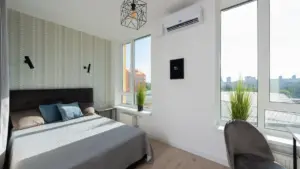
Minimal living room with a tall air purifier beside a sofa
Last updated: November 26, 2026
Quick answer: if your main problem is smoke particles, dust, or airborne allergy triggers, a HEPA air purifier is often the right choice for a room you use for about 8 hours a day. It is not the right fix for every indoor air problem, and it will not solve odors or gases by itself, but for particles in the air, HEPA is usually the first thing to consider. If you are dealing with severe or persistent symptoms, a health professional can help sort out the cause and the safest next step.
Key takeaways
- HEPA is aimed at particles, not smells or gases.
- It makes the most sense for wildfire smoke, dust, and common allergy triggers that float in air.
- A HEPA air purifier is less useful if your main complaint is odor, chemical fumes, or a source that keeps making particles nonstop.
- Room size, filter type, and how long the unit runs matter more than flashy features.
- If you fix the source and still need cleaner air, HEPA is often the next step.
What does HEPA actually do?
HEPA captures tiny airborne particles as air passes through the filter, which is why it helps with smoke, dust, and many allergens. It is a particle filter, not a magic box for every indoor air problem, and that difference matters more than most ads admit.
The U.S. Environmental Protection Agency has a useful overview of indoor air cleaners and filters on its page about air cleaners and air filters in the home. The key idea is simple: if the nuisance is in the air as a particle, HEPA can help; if the nuisance is a gas or vapor, HEPA alone is not the answer.
Therefore, a HEPA air purifier fits some rooms better than others. A bedroom with dust and seasonal allergies is a classic case. A kitchen smell problem is not. A garage paint-fume problem is not. A smoky living room from wildfire drift is often a strong case.
A reader can think of HEPA as a fine net for airborne particles. It does not collect everything in a room, and it does not stop particles from coming in through open windows, gaps, or a smoker standing nearby. It works best when the air has time to pass through the machine many times.
Do you need one for smoke?
A HEPA air purifier is one of the most useful tools for smoke particles, especially from wildfire smoke, because smoke includes fine airborne particles that a HEPA filter can capture. That makes it a strong buy for a room where smoke is the main complaint.
The CDC has guidance on wildfire smoke and indoor air on its wildfire smoke page. The practical takeaway is that indoor protection is about reducing particle exposure, closing out outdoor smoke when possible, and cleaning the air inside.
However, this is where a lot of generic advice goes wrong: it treats smoke like a smell problem. Smell is part of it, but smoke is also a particle problem. A HEPA air purifier helps with the particle part. It does not remove every smoky odor from the room, and it does not fix the source if smoke keeps leaking in; if smoke exposure is severe or symptoms are persistent, consult a health professional.
If smoke is the issue, look for the purifier to run in the room you actually use for several hours, not just when the smell is strongest. A bedroom at night or a living room during the day matters more than a unit tucked in a hallway. If you have to choose one room, pick the room where you spend about 8 hours.
Here is the plain version: for wildfire smoke, yes, HEPA is usually worth it. For brief kitchen smoke from cooking, a purifier can help after the fact, but an exhaust fan and source control matter more. For cigarette smoke, a HEPA unit can help with particles, but smoke from tobacco also includes gases and odor that HEPA cannot handle on its own.
Do you need one for dust?
A HEPA air purifier can help with dust, but only if the dust is floating in the air long enough to reach the filter. It is useful for dust that keeps resettling after you clean, not for dust that is already caked on shelves, vents, or floors.
This is the mistake many buyers make: they expect a purifier to replace cleaning. A HEPA unit can reduce airborne dust, but it cannot stop a dusty ceiling fan from shedding, a dirty HVAC filter from dumping debris, or a carpet from holding old particles. The source still matters.
For dust, the most useful setup is simple: clean the source, then let the purifier catch what stays airborne. That means vacuuming dust with the right tools, dusting, and changing filters as needed. If a room has a lot of fabric, carpet, or traffic, dust will keep returning, so the purifier needs to run regularly, not just once in a while.
A HEPA air purifier is most worth it when dust makes your nose, eyes, or throat miserable after cleaning. It is less useful if the room is mostly a storage space or if dust is not your real complaint. A purifier is not a broom. It is the second pass, not the first.
Do you need one for allergies?
A HEPA air purifier is often worth it for allergies when the triggers are airborne particles such as pollen, pet dander, and similar irritants. That is the use case where HEPA earns its place.
Because allergy advice gets vague fast, people often hear “allergies” and think one device fixes everything. It does not. If your symptoms come from a trigger on furniture, bedding, or clothing, a purifier can help only after those particles get stirred into the air. If your trigger is dust mites in bedding, the bed itself matters more than the purifier.
A room purifier is most helpful where you breathe for long stretches, especially a bedroom. If allergies hit hardest at night or on waking, that is a sign the air in the sleep space deserves attention. If the symptoms are all over the home, one small unit in one room may not feel like enough.
So a HEPA model is usually the right choice when the problem is clearly particle-based and repeated. It is less useful if your symptoms are mostly due to odors, cleaning chemicals, or humidity problems. Those are different jobs.
Which problem points to HEPA?
HEPA is the right first guess for smoke, dust, and many allergies, but it is not the same fit for every indoor problem. The table below shows the usual HEPA call for smoke, dust, and allergies.
| Problem | Is HEPA a good fit? | Why it helps | Where it falls short |
|---|---|---|---|
| Wildfire smoke | Yes | Captures smoke particles | Does not handle gases or odor well |
| Household dust | Often | Removes floating dust | Does not clean settled dust |
| Allergies from airborne particles | Often | Catches pollen and dander | Not useful for every allergy trigger |
| Cooking odor | Usually no | May catch some particles | Odor can remain |
| Chemical fumes | Usually no | Limited help | Gas/vapor problem, not a particle problem |
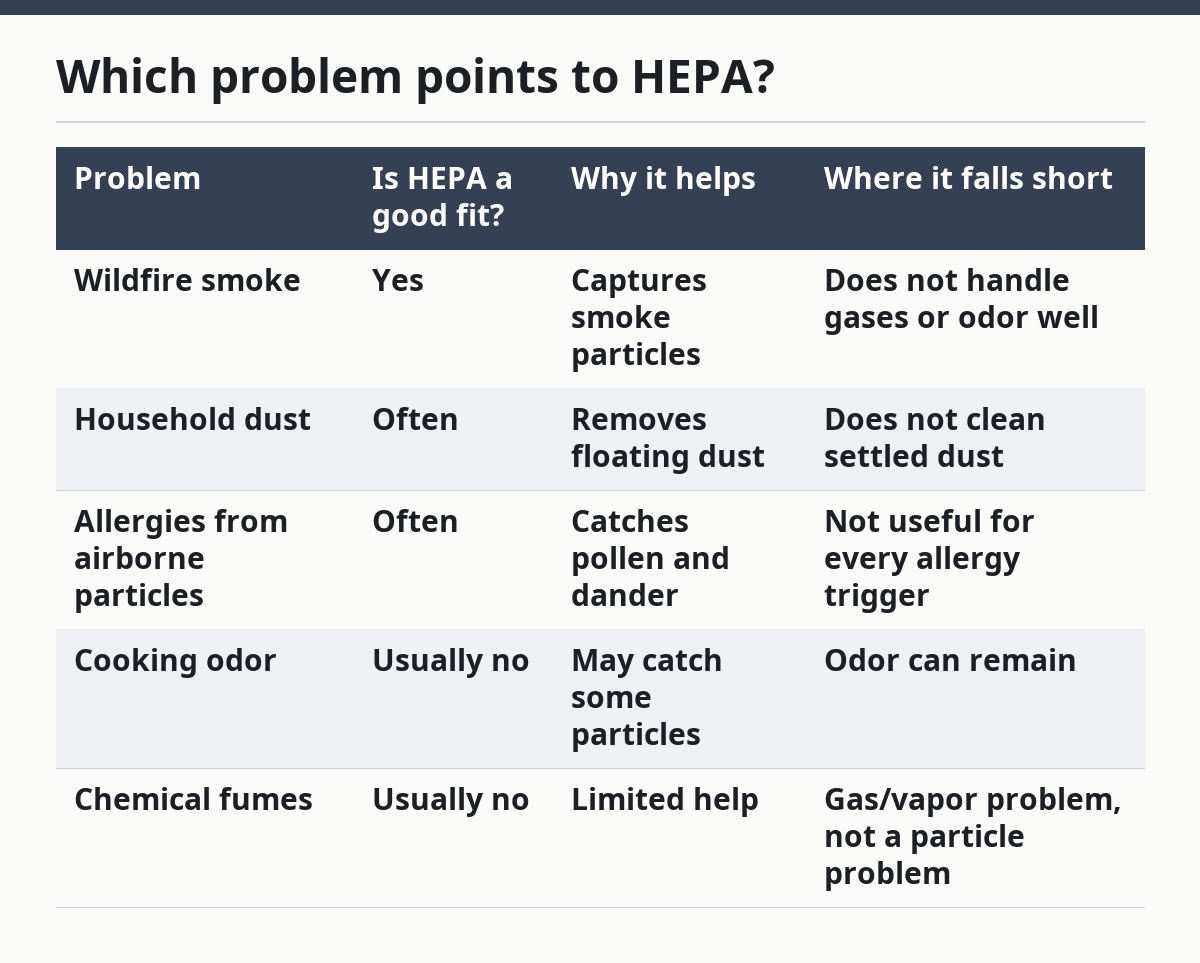
If your issue sits in the left column, HEPA is probably worth serious attention. If your issue lives in the right column, another tool may matter more, or the purifier may need a different filter setup. The EPA guidance above is useful here because it draws the same line: particles are one job, gases are another.
The biggest buying mistake is to treat HEPA like a universal fix, so it is worth checking the cause before you spend money. Another mistake is to buy it for a room problem when the real problem is a whole-house source. If smoke is entering from outside, a purifier can still help in one room, but it will not seal the home. If dust keeps coming from an old filter or a dirty vent, the purifier is only doing part of the work.
What should you check before buying?
A HEPA air purifier is worth buying only if the machine matches the room and the problem. A small unit in a large room can disappoint, even if the filter is good.
So, start with the room you want to improve. A bedroom needs a different setup than a large open living room. If the purifier is too small for the space, it may never cycle enough air to make a clear difference. Quiet operation matters too, because a unit that sounds like a fan on high may stay off when you need it most.
Because the buying decision is easy to rush, run it this way:
- Name the main problem: smoke, dust, or allergies.
- Decide whether the problem is airborne particles or something else.
- Pick the room where you spend the most time, often 8 hours in a bedroom.
- Choose a unit that is meant for that room size.
- Run it consistently, not just during bad days.
That simple order matters because the purifier is only one part of the fix. If you skip the room size, the unit may be too weak. If you skip the problem type, you may buy the wrong filter. If you only turn it on when the air already feels bad, you are using it too late.
Ultimately, a HEPA air purifier is usually a good buy for a person who wants cleaner air from particles and is willing to use it like a real tool, not a decoration. It is not the answer for every indoor air complaint, and that honesty saves money.
When is HEPA not enough?
HEPA is not enough when the problem is mostly odor, gas, or a strong source that keeps creating particles faster than one room purifier can catch them. In those cases, the purifier can help, but it is not the whole answer.
That matters for situations that people often lump together. A smoke smell after cooking is not the same as wildfire smoke drifting indoors. A chemical smell from paint is not the same as dust from a couch. A purifier may reduce some particles in each case, but the main problem may live elsewhere.
If the air problem is tied to a source you can remove, remove it first. If the problem is outside air coming in, reduce the entry path and use the purifier in the room that matters most. If the issue is medical and symptoms are severe or persistent, a health professional can help sort out the trigger and the safest next step.
In short, if smoke, dust, or allergies are your main issue, HEPA is often the right kind of purifier. If the real issue is odor, gas, or source control, HEPA alone will not be enough.
Is a HEPA air purifier worth it for allergies?
Yes, a HEPA air purifier is often worth it for allergies when the trigger is an airborne particle such as pollen, pet dander, or similar material. It works best in the room where you spend the most time, especially a bedroom. It will not fix every allergy trigger, so the source still matters.
Does HEPA help with smoke?
Yes, HEPA helps with smoke particles, including wildfire smoke, because smoke contains fine airborne particles that a HEPA filter can trap. It does not remove odor or gases by itself, so the room may still smell smoky even when the air is cleaner.
Can HEPA remove dust from the air?
Yes, HEPA can remove dust from the air if the dust is floating long enough to pass through the filter. It will not clean dust that has already settled on furniture, floors, or vents, so regular cleaning still matters.
Drafted with AI; not yet reviewed by a person.