Are Air Purifiers Safe to Leave on Overnight?
Yes — an air purifier is generally safe to leave on overnight for 6 to 8 hours if it is in good condition, set up correctly, and used as directed by the…
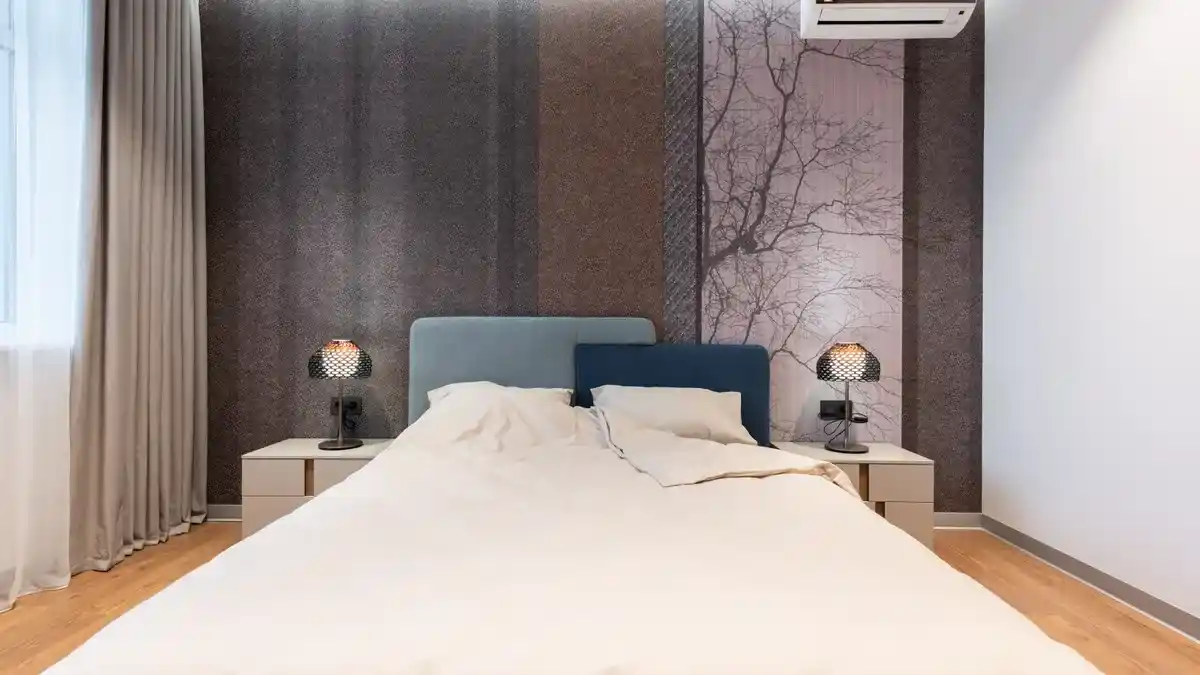
Bedroom with a wall-mounted air conditioner above the bed
Last updated: November 26, 2026
Quick Answer: Yes — an air purifier is generally safe to leave on overnight for 6 to 8 hours if it is in good condition, set up correctly, and used as directed by the maker. If you are asking, “Are Air Purifiers Safe to Leave on Overnight?” the short answer is usually yes, with the same basic checks you would use for any small appliance: clear airflow, a clean filter, and no sign of damage. The real questions are noise, heat, and whether the unit is sized and maintained well enough to run while you sleep.
Key takeaways
- Overnight use is usually fine for a working air purifier with a clean filter and clear airflow.
- A purifier should sit with space around the intake and outlet so the motor does not work harder than it should.
- Sleep comfort matters too: if the sound keeps waking you, the unit may be safe but still a poor fit for the room.
- Heat from the cabinet should stay mild, not hot to the touch. Any burnt smell, sparking, or odd smell is a stop sign.
- The safer habit is to check the manual, keep the filter on schedule, and use a normal setting unless the maker says otherwise.
Is it safe to leave an air purifier on overnight?
Yes — an air purifier is usually safe to leave on overnight if it is placed correctly, kept clean, and not showing signs of damage. That is the short answer most people need before they go to bed.
The main safety concerns are mechanical, not mysterious. A purifier has a motor, a fan, and a filter that can trap dust. If the intake is blocked by a wall, curtain, blanket, or stack of clothes, the motor can run hotter than it should. If the filter is clogged, airflow drops and the unit works harder. A healthy purifier should run quietly in the background, not make the room feel warm or smell odd.
The usual overnight use case is simple: one unit runs for 6 to 8 hours while you sleep. That is normal continuous use for many home air purifiers, especially those meant to clean a bedroom or small living space. The important part is not the clock alone; it is whether the machine is in good shape before you leave it alone.
One practical benchmark is the maker’s manual. If the manual allows continuous operation, sleep use, or a timer, follow that guidance first. If the manual warns against covering vents, using the wrong adapter, or placing the purifier near fabric, consult the manufacturer or a qualified appliance professional before using it overnight, and treat that warning as a real safety rule. The U.S. Environmental Protection Agency’s guide to home air cleaners and filters and ENERGY STAR’s room air cleaner guidance both stress proper placement and maintenance. See the EPA at https://www.epa.gov/indoor-air-quality-iaq/home-air-cleaners-and-filters and ENERGY STAR at https://www.energystar.gov/products/heating_cooling/air_purifiers.
For background on air cleaner basics, the Environmental Protection Agency has guidance on home air cleaners and filters, and ENERGY STAR has guidance on room air cleaners. Those sources are useful for understanding how these machines are meant to work.
What makes overnight use safer?
Overnight use is safer when airflow stays open, the filter is clean, and the unit is placed on a firm surface. Those three details do more for safety than any fancy setting on the control panel.
Use this simple routine before bed:
-
Set the purifier on a hard, level floor or table.
This keeps the fan steady and reduces the chance that fabric blocks the vents. -
Leave clear space around the unit.
A gap of several inches is a practical rule of thumb; the goal is to keep the intake and outlet open so air can move freely. -
Choose a normal or sleep setting if the unit has one.
A sleep mode or low fan setting often lowers noise and keeps the motor from working as hard as it would on a high setting. -
Check the filter status.
If the filter is visibly packed with dust or the unit has a filter indicator, handle that before a long night of use. -
Look and smell once before lights out.
The result you want is boring: no buzzing, no burning smell, no hot cabinet, no rattling fan. -
Keep cords away from foot traffic and bedding.
A cord pulled loose during the night can stop the purifier or create a hazard that did not exist when you fell asleep.
The mistake people make is assuming that “left on” equals “ignored.” A purifier is a small appliance with moving parts. It can run all night safely, but only if the air can move through it and the machine is not visibly damaged.
If the unit came with a timer, that can help when you only want it to run part of the night. A timer is not required for safety, but it gives you a way to limit run time if you prefer the machine off after a few hours. For more on safe appliance placement, an appliance safety page or the maker’s support page can be a useful reference before bedtime.
What about heat, noise, and sleep comfort?
Heat, noise, and sleep comfort are the main reasons an overnight purifier can feel wrong even when it is technically safe. A unit that is safe on paper can still be a bad fit if it hums too loudly or feels warm beside the bed.
Start with heat. A purifier should not feel hot in normal use. Mild warmth near the motor housing can happen, but the cabinet should not be scorching, and the air coming out should not feel like it is heating the room. If you notice a hot smell, a plastic smell, or the unit becomes unusually warm after a few hours, stop using it and inspect the filter and vents.
Noise matters because sleep is sensitive to sudden changes, not just volume. A steady fan sound is easier to ignore than a clicking motor or a rattle that starts and stops. If the purifier has a sleep mode, that setting often exists for overnight use. It lowers fan speed and usually cuts down on light from the display as well.
Here is the trade-off: lower speed usually means lower airflow. If you turn the purifier down too far, it may clean less air over the night. If you run it on a higher setting, it may move more air but be harder to sleep through. The quietest setting that still feels tolerable and keeps the unit out of the way is often the best practical compromise.
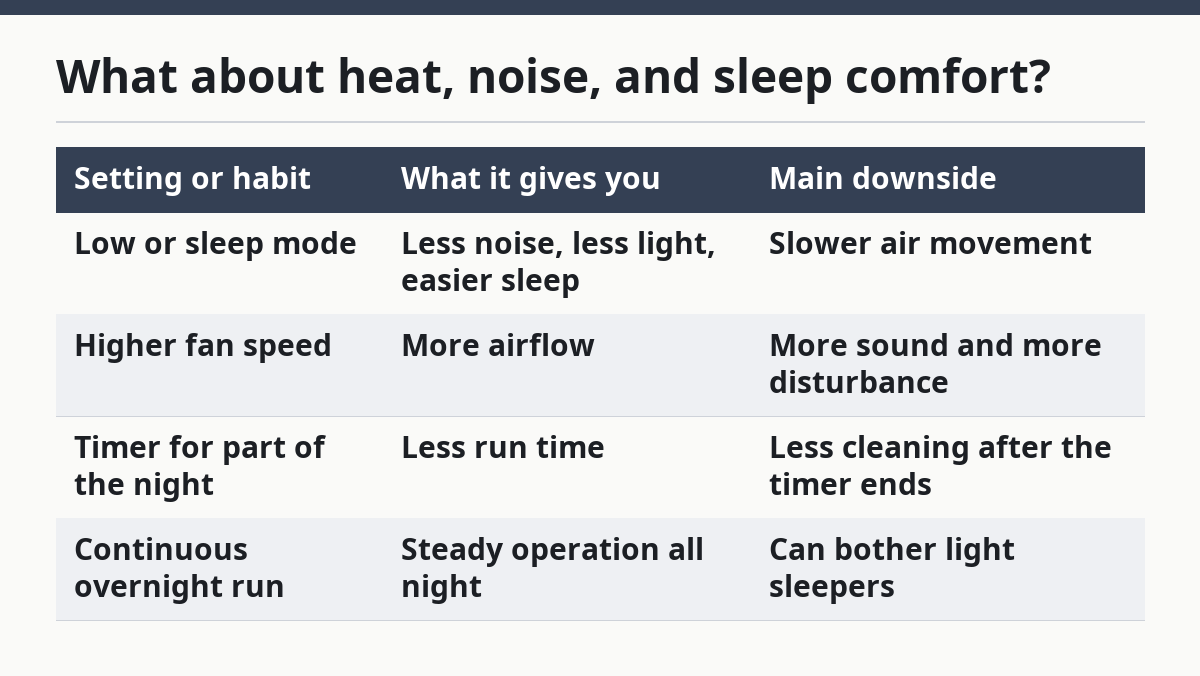
This is where a simple comparison helps:
| Setting or habit | What it gives you | Main downside |
|---|---|---|
| Low or sleep mode | Less noise, less light, easier sleep | Slower air movement |
| Higher fan speed | More airflow | More sound and more disturbance |
| Timer for part of the night | Less run time | Less cleaning after the timer ends |
| Continuous overnight run | Steady operation all night | Can bother light sleepers |
If you are a light sleeper, the purifier may be safe but still not worth keeping near the bed. That does not make the machine unsafe. It means your sleep matters more than forcing the appliance into the wrong spot.
When should you not leave it on?
You should not leave an air purifier on overnight if it shows damage, smells burnt, sparks, or runs in a way that seems abnormal. Those signs point to a problem with the motor, cord, or filter path, and overnight use is not the time to gamble.
Watch for these red flags:
- A cord that is cracked, pinched, or warm
- A buzzing, grinding, or scraping sound that was not there before
- A hot plastic smell or any burnt odor
- A filter that is visibly clogged and overdue for replacement
- An intake or outlet blocked by bedding, curtains, or a wall
- A unit that shuts itself off and on in a strange pattern
The cost of ignoring those signs is not just worse air. It can mean extra heat, poor airflow, and more wear on the motor. In the worst case, a damaged appliance can fail without obvious warning while it is left running. That is why a simple pre-bed check is worth the minute it takes.
This is also the point where common sense beats habit. If a purifier has sat in a dusty corner for months, do not put it straight into overnight duty without checking the filter and cleaning the outside. Dust around the vents can make the motor work harder than it should.
A purifier that has a stable base, intact cord, and clean filter is one thing. A purifier that rattles, smells wrong, or runs hot is another. The first can usually stay on overnight; the second should not.
How do I use an air purifier overnight without trouble?
You use an air purifier overnight without trouble by treating it like a small machine that needs room to breathe. The goal is steady airflow, not max power.
A practical overnight setup looks like this:
- Put the purifier at least several inches from walls or drapes.
- Keep the intake and outlet free of socks, blankets, books, and cords.
- Use the lowest setting that still feels useful for the room.
- Check the filter on a regular schedule, especially if dust builds up fast.
- Make sure any indicator lights will not keep you awake.
- If the unit has a timer, test it on a normal night before relying on it.
One useful rule is to make the purifier part of the room, not part of the bed. It should not be pushed under a tablecloth, tucked into a shelf, or pressed into a corner where air can barely move. That kind of placement can raise heat and make the fan work harder.
The filter matters here more than most people think. A clean filter helps airflow stay steady. A dirty one can make the machine louder and less effective, which defeats the point of running it overnight in the first place. If the manual says the filter must be replaced on a schedule and that schedule has been missed by a wide margin, consult the manufacturer or a qualified appliance professional before using the unit overnight.
Do not use an air purifier as a reason to ignore room cleanup. Vacuuming, dusting, and keeping vents open still matter. The purifier is one tool, not a substitute for basic maintenance.
For broader standards and product guidance, the EPA and ENERGY STAR pages on home and room air cleaners are worth a look. If you want a related overview, see the EPA guidance above and the ENERGY STAR room air cleaner page.
Who should be extra careful?
People with very old, damaged, or poorly maintained units should be extra careful, and so should anyone who notices burning smells, unusual heat, or unstable operation. Overnight use is not the problem; the condition of the machine is.
That warning matters most for units that have been stored for a long time, moved across rooms, or run with a neglected filter. A purifier that is visibly dusty on the outside may be fine after cleaning, but a purifier with a cracked plug, damaged cord, or warped plastic needs more caution. If the manual says the filter must be replaced on a schedule and that schedule has been missed by a wide margin, treat that as a maintenance problem before you treat it as a sleep aid.
This is also the right place for a plain truth: an air purifier is not a fix for every indoor air problem. If smoke, mold, or chemical odor is the reason you want it on all night, the source of the problem still needs attention. A purifier can help with particles, but it does not make the underlying issue disappear.
If the appliance itself seems wrong, do not force an overnight run because it “usually works.” The safer move is to stop using it, inspect the filter and cord, and consult the manufacturer’s guidance or a qualified appliance repair professional if needed.
What is the bottom line?
The bottom line is that leaving an air purifier on overnight is usually safe, and for many people it is the normal way to use one. The unit needs room to breathe, a clean filter, a sound cord, and a setting that will not disturb sleep.
It is a poor idea only when the machine is damaged, overheats, smells wrong, or is blocked by fabric or clutter. That is the real line between safe and unsafe: not the fact that it is running for 8 hours, but the condition it is running in.
If you want one sentence to remember, use this: a well-kept air purifier can usually stay on overnight; a neglected one should not.
For the site’s broader safety coverage, see the hub on air purifier safety and standards.
Can an air purifier run all night?
Yes — an air purifier can usually run all night if the maker allows continuous use and the unit is in good condition. The main checks are airflow, filter condition, and heat. If the purifier sits clear of fabric and does not smell hot or act strangely, overnight use is normally fine.
Is it safe to sleep with an air purifier on?
Yes — it is generally safe to sleep with an air purifier on when the appliance is set up correctly and maintained well. The sound may bother some people, but noise is a comfort issue, not usually a safety issue. If the machine buzzes, rattles, or gives off a burnt smell, stop using it.
Do air purifiers overheat if left on?
Not usually, if they are working properly and have clear airflow. A purifier can feel slightly warm near the motor, but it should not become hot to the touch or smell burnt. A clogged filter, blocked vent, or damaged cord changes that picture and should be checked before overnight use.
Drafted with AI; not yet reviewed by a person.

1 thought on “Are Air Purifiers Safe to Leave on Overnight?”