How Loud Is Too Loud? Air Purifier Noise Levels Explained
A whisper measures about 30 dB and a vacuum cleaner about 70-80 dB. See where air purifier noise specs fall, and what counts as quiet for a bedroom.
Image: Pexels via Pixabay
There’s no official “quiet” decibel (dB) cutoff for air purifiers. As a practical anchor, a whisper measures about 30 dB and normal conversation about 60 dB (NIOSH/CDC). Many purifiers run in the mid-20s to low-30s dB on their lowest speed and climb into the 40s or 50s dB on high.
- There’s no regulated “quiet” threshold for air purifiers — compare the exact dB number on a spec sheet to familiar reference sounds instead of trusting words like “whisper-quiet.”
- A whisper measures about 30 dB and normal conversation about 60 dB, according to a NIOSH/CDC noise reference chart — useful anchors for reading any air purifier’s noise spec.
- The World Health Organization recommends keeping continuous bedroom noise under 30 dB(A) at night for good sleep quality, which matters if a purifier runs overnight.
- Manufacturers commonly publish one combined noise range (for example, 24-50 dB) rather than a separate number for each fan speed — the low end is usually Sleep or Low, the high end is the fastest setting.
- For how placement changes how hard a unit’s fan has to work (and how loud it gets), see our guide on where not to place an air purifier.
Why does an air purifier’s decibel number matter?
“Whisper-quiet,” “ultra-quiet,” and “silent operation” are marketing phrases, not measurements. None of them is defined by any standards body, so two products both labeled “whisper-quiet” can sound noticeably different running side by side. The one number on a listing that actually means something consistent is the decibel (dB) figure itself — as long as you have something familiar to compare it to.
That’s the problem this guide solves. A spec sheet that says “32 dB” or “52 dB” doesn’t mean much on its own unless you know what everyday sounds land in that same range. Once you have a few fixed reference points — a whisper, a normal conversation, a running vacuum cleaner — any air purifier’s dB number becomes something you can actually judge before buying, instead of a word a brand chose to print on the box.
How loud is 30 dB, 60 dB, and 80 dB in everyday terms?
The table below lines up a handful of verified reference points against one real air purifier’s published noise spec, so you can see where “quiet” and “loud” actually sit on the same scale.
| Reference point | Typical level | Source |
|---|---|---|
| A whisper | ~30 dB | NIOSH / CDC noise reference chart |
| WHO night-time bedroom guideline (continuous background noise) | under 30 dB(A) | World Health Organization |
| Normal conversation | ~60 dB; separately, ~65 dB(A) at 1 meter for “nominal vocal effort” | NIOSH / CDC; U.S. EPA |
| Vacuum cleaner, canister type, measured at 3 feet | ~70-80 dB(A) | U.S. EPA |
| Vacuum cleaner, upright type, measured at 3 feet | ~75-85 dB(A) | U.S. EPA |
| Example: one widely sold air purifier’s full published spec range (Sleep/Low through High fan speed) | 24-50 dB | Levoit Core 300 owner’s manual (one example model, not a recommendation) |
A couple of these figures come from different measurement setups, which is worth being upfront about rather than smoothing over. NIOSH/CDC’s reference chart lists normal conversation at about 60 dB as a simple, rounded figure for general comparison. The EPA’s separate 1971 survey of home appliance and equipment noise measured “nominal vocal effort” at about 65 dB(A), specifically at a distance of one meter. Both describe the same everyday sound; they just used different test conditions, which is normal for acoustic measurements and not a contradiction.
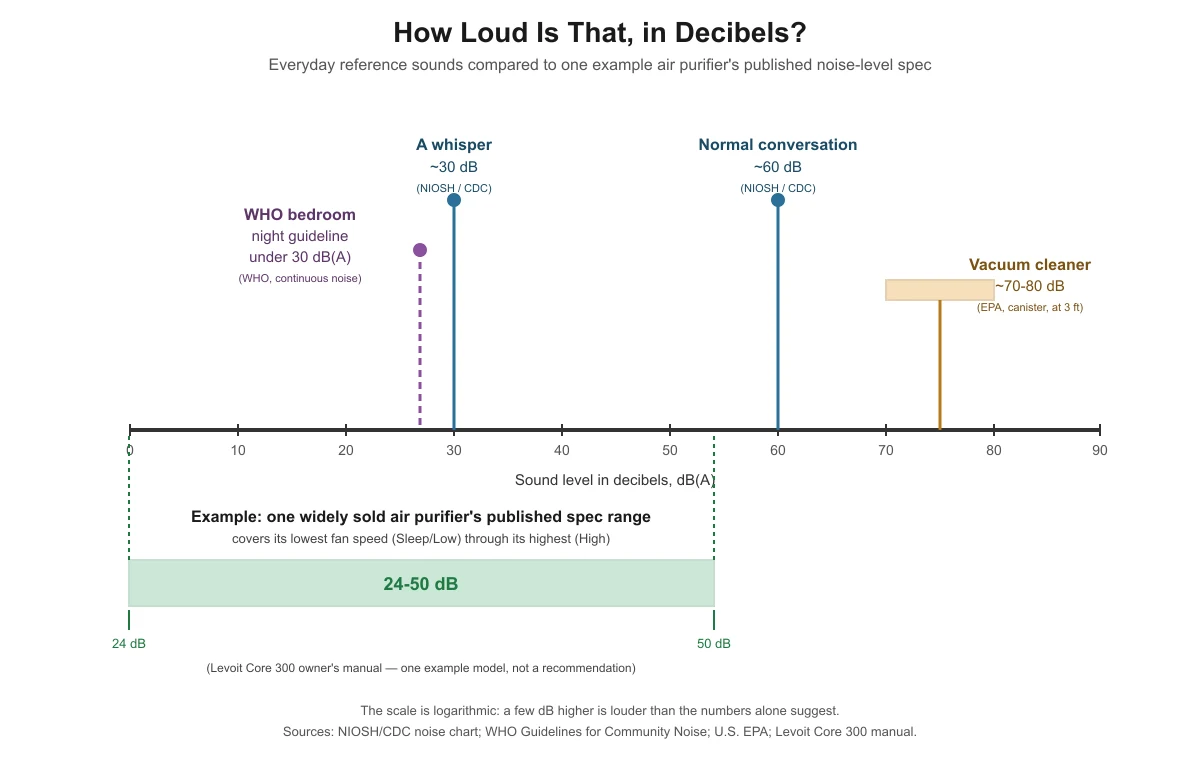
Placed on this scale, the example unit’s quietest setting (24 dB) sits just below a whisper, and even its loudest setting (50 dB) sits well below a running vacuum cleaner. That gap is exactly why the single word “quiet” on a box doesn’t tell you much — in this example, low and high speed are 26 dB apart, and the decibel scale is logarithmic, so that gap sounds considerably bigger than the plain numbers suggest.
What dB range should you expect at low, medium, and high fan speed?
The published spec sheets reviewed for this guide don’t break the noise rating down by fan speed. Instead, they publish one combined range that spans the unit’s quietest setting to its loudest. The Levoit Core 300’s own user manual is one example: its specifications table lists “Noise Level: 24-50dB” as a single line item, with no separate number given for Sleep Mode, Low, Medium, or High individually. Always check whether a specific listing you’re comparing does the same before assuming its range works like this example.
The same manual does describe what each setting does, even without a matching dB figure for each one. Sleep Mode is described as running the fan at its lowest possible speed, which is why the bottom of that 24-50 dB range corresponds to Sleep Mode or Low. The fan speed button then cycles through three levels — Low, Medium, and High — and the manual notes plainly that “fan speed III [High] is the loudest, but cleans air the quickest.” That’s the general shape to expect across brands: the low end of a published range is the quiet setting, the high end is the fast, loud one, and most manufacturers don’t publish the individual steps in between.
| Setting | What it typically does | Where it falls in this example model’s published range |
|---|---|---|
| Sleep Mode / Low | Uses the lowest possible fan speed | Bottom of the range — near 24 dB in this example |
| Medium | A middle fan speed between Low and High | Somewhere in between — this manufacturer does not publish a separate figure for it |
| High | Fastest fan speed; moves the most air but is the loudest setting | Top of the range — near 50 dB in this example |
Because the step-by-step numbers usually aren’t published, the practical move when comparing two listings is to look at both ends of the range, not just one. A unit advertised as “as low as 22 dB” that tops out at 58 dB on high is a different product to live with than one that runs 28-45 dB — even though the first one’s marketing headline sounds quieter.
Is a quieter air purifier actually necessary for a bedroom at night?
The World Health Organization’s community noise guidance recommends keeping continuous background noise in a bedroom under 30 dB(A) at night for good sleep quality, and separately recommends an annual average night noise level under 40 dB(A) outside the bedroom to avoid broader adverse health effects. Measured against the reference points above, that WHO bedroom figure sits right around a whisper — noticeably quieter than where most air purifiers land once they’re running above their lowest setting.
In practice, that means a purifier’s Sleep Mode or Low setting (often in the mid-20s to low-30s dB, based on the example spec above) can land close to that WHO guideline, while Medium or High speed, in the 40s or 50s dB, sits above it. None of this is a claim that running a purifier louder than 30 dB is unsafe — the WHO figure is a sleep-quality guideline, not a hazard threshold. It’s simply a useful number to weigh if continuous overnight noise is a priority alongside air cleaning speed.
Does a quieter setting mean weaker air cleaning?
Generally, yes, there’s a real trade-off, not just a marketing one. A unit’s top CADR (Clean Air Delivery Rate) figure is measured at its highest fan speed — the same setting that produces its loudest dB reading. Running at Sleep Mode or Low keeps noise down but moves less air per minute, which means slower particle removal in that same room. Neither setting is wrong; it depends on whether quiet overnight operation or faster clearing (for example, right after cooking or during a smoke event) matters more at that moment.
Where the unit sits in the room factors in here too — a model forced to work harder because it’s tucked in a corner or blocked by furniture may need a higher, louder fan speed to deliver the same clean air as one placed in an open spot.
Keep reading: related guides on this site
For the full spec-sheet checklist — CADR, filter type, certifications, noise, and running cost in one place — see our air purifier buying guide. If you’re trying to get the most airflow out of a unit at a lower, quieter fan speed, our guide on where not to place an air purifier covers the placement mistakes that force a unit to run louder than it needs to.
Frequently asked questions
What does “Sleep Mode” actually mean on an air purifier’s spec sheet?
Based on manufacturer documentation, Sleep Mode typically locks the fan to its lowest possible speed, which is also the quietest point on the unit’s published dB range. It trades air-cleaning speed for quiet, continuous overnight operation. Check your own unit’s manual for whether Sleep Mode also dims the display or changes how the unit responds to its air quality sensor.
Is 50 dB too loud for a bedroom overnight?
It’s above the WHO’s recommended under-30 dB(A) guideline for continuous bedroom noise at night, so it’s louder than that specific sleep-quality target. Whether it’s “too loud” in practice depends on the person and the room — some people sleep fine with a steady fan-like sound at that level, while others are more sensitive to continuous background noise. There’s no single universal cutoff.
Why do some air purifiers list one dB number and others a wide range like 24-50 dB?
A wide range usually means the manufacturer is reporting the full span from the quietest setting (Sleep Mode or Low) to the loudest (High), rather than a single fixed figure. A listing that shows only one number may be reporting just one setting, often the quietest one, which can make a unit look quieter overall than it is once you turn the fan speed up.
Does a quieter air purifier clean air more slowly?
Generally yes. A unit’s top-rated CADR is measured at its highest, loudest fan speed, so running it on a lower, quieter setting moves less air per minute and clears particles from the room more slowly. That’s a genuine trade-off between noise and air-cleaning speed, not just a marketing distinction — though for steady, ongoing maintenance in an already-clean room, a lower speed may be all that’s needed.
Can I trust a listing that says “whisper-quiet”?
Not as a standalone claim. “Whisper-quiet” has no fixed definition, so it can be applied to units with meaningfully different dB ratings. Look past the phrase to the actual decibel figure on the spec sheet, and check whether it’s a single number or a range — then compare that number to known reference points like a whisper (~30 dB) or normal conversation (~60 dB) to judge it for yourself.
Sources
- World Health Organization (WHO/Europe), Noise fact sheet — read November 2026
- U.S. CDC / NIOSH, Noise Levels by Decibels (NIOSH Noise Meter and Power Tools Database, via CPWR) — read November 2026
- U.S. EPA, Noise from Construction Equipment and Operations, Building Equipment, and Home Appliances — read November 2026
- Levoit (Arovast Corporation), True HEPA Air Purifier Core 300 / Core 300-RAC User Manual — read November 2026
airpurifierspace.com Editorial Team. Last updated: November 12, 2026.


1 thought on “How Loud Is Too Loud? Air Purifier Noise Levels Explained”