Are Ozone Generators Safe as Air Purifiers? CARB & EPA
No. CARB advises against ozone generators indoors, and no U.S. agency approves them. See the CARB and EPA guidance, plus a label-reading checklist.

Image: Mint_Foto via Pixabay
No. The California Air Resources Board (CARB) advises against using ozone generators in any space occupied by people or animals, and no U.S. federal agency has approved them for that use. Checked against CARB and EPA guidance as of November 12, 2026: both agencies agree these devices risk lung irritation and clean air poorly.
- CARB advises against ozone generators in any occupied space. No federal agency has approved them for that use, according to the EPA.
- Ozone is a lung irritant. CARB links it to coughing, chest tightness, and shortness of breath, and warns that heavy exposure can cause permanent lung damage.
- At the low concentrations safe to breathe, EPA’s assessment found ozone does little to remove dust, pollen, viruses, bacteria or mold from indoor air.
- Some sellers avoid the word “ozone,” using terms like “activated oxygen,” “super-oxygenated air,” or “energized oxygen” — CARB has flagged these as the same gas.
- Use the label-reading checklist below, and check CARB’s certified device list, before buying any electronic air cleaner.
What do CARB and EPA say about ozone generator safety?
Two government bodies have looked at ozone-generating air cleaners directly, and both land in the same place. CARB states plainly: “CARB strongly advises against the use of ozone generators in spaces occupied by people or animals.” The U.S. Environmental Protection Agency goes further on the approval question: “No agency of the federal government has approved these devices for use in occupied spaces.” Neither statement is about one bad brand or model — it covers the entire product category, regardless of what any individual label claims.
That’s a notably stronger verdict than for most air-cleaning technologies this site covers, such as the marketing language around true HEPA vs. “HEPA-type” filters, where the concern is mainly about mislabeling rather than the technology itself. With ozone generators, the agencies’ concern is the ozone output itself, however accurately or inaccurately it’s labeled.
Why is breathing ozone risky?
CARB’s guidance explains that this gas damages the airway tissue it comes into contact with, triggering coughing, chest tightness, and shortness of breath. CARB names children, older adults, and people with asthma or other respiratory disease as more vulnerable to these effects, and warns that elevated exposure can cause permanent lung damage.
The EPA’s own assessment describes a similar set of effects — chest pain, coughing, shortness of breath, and throat irritation from inhaling ozone — and adds a detail worth knowing if you exercise indoors near one of these devices: physical activity increases the amount of ozone inhaled, which raises the risk of harmful respiratory effects. This is general safety information from CARB and EPA, not medical advice. If you have asthma, COPD, or another respiratory condition, talk with your doctor about indoor air quality steps that fit your situation.
Does ozone actually clean the air?
Separately from the safety question, the evidence on effectiveness doesn’t support these devices either. EPA’s assessment states that ozone does not remove particles — including dust and pollen, the particles that cause most allergies — from the air at all. At concentrations that stay within public health standards, the same assessment found that ozone does not effectively remove viruses, bacteria, mold, or other biological pollutants.
CARB adds a separate concern: ozone released indoors can react with existing chemicals already in the air, forming additional toxic pollutants as a byproduct. In other words, running one of these devices doesn’t just fail to clean the air in many cases — depending on what else is in the room, it can add a new pollution source on top of the ozone itself.
What does CARB certification actually require?
Since 2008, California has required indoor air cleaners sold in the state — including ones sold online to California residents — to be CARB certified. For electronic air cleaners, certification means independent testing confirms the device stays at or below an ozone emission limit of 0.050 parts per million (50 ppb). Certified devices are expected to carry a label stating they meet California’s ozone emissions limit, alongside a relevant ANSI/UL safety standard mark.
Certification tells you a device’s ozone output has been checked against that 0.050 ppm limit — it is not the same as CARB endorsing ozone generators generally. CARB’s own guidance still advises against using ozone generators in occupied spaces at all, limit or no limit. The clearest way to avoid the question entirely is a true HEPA filter or an activated carbon filter — both remove pollutants by physically trapping or absorbing them, with no ozone-generating step anywhere in the design.
To check a specific model, CARB publishes a searchable list of certified air cleaning devices on its website. Looking up the exact model number there is more reliable than trusting a “CARB certified” claim printed on packaging or an online listing, since that wording alone isn’t independently verified at the point of sale.
How do you spot an ozone generator before you buy?
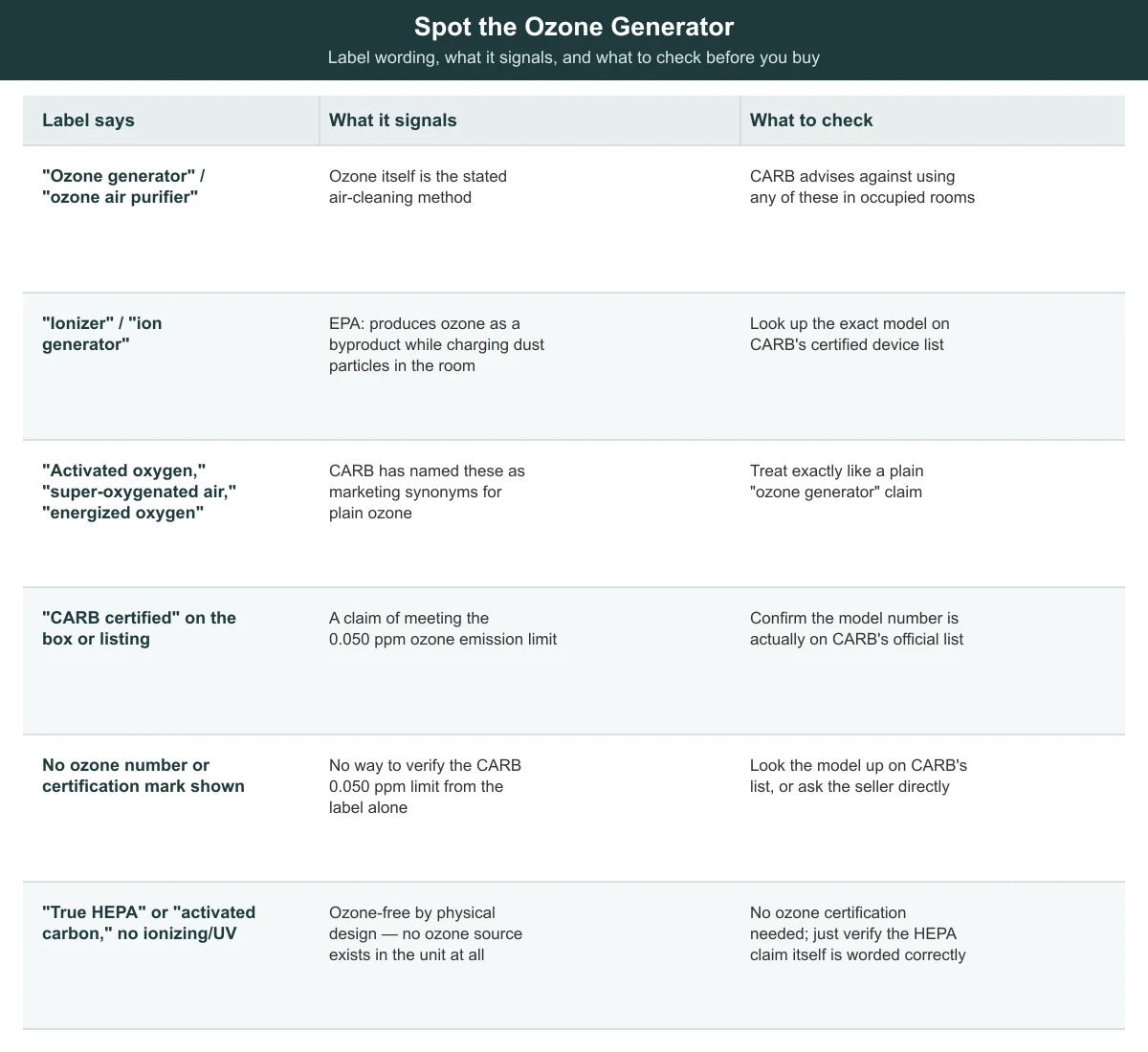
Ozone-generating devices aren’t always labeled that plainly. The table below lists the wording patterns to watch for on packaging or in a product listing, what each one signals, and what to check before buying.
| Label says | What it signals | What to check |
|---|---|---|
| “Ozone generator” or “ozone air purifier” | Ozone itself is the stated air-cleaning method | CARB advises against using any of these in occupied rooms, regardless of certification |
| “Ionizer” or “ion generator” | Per EPA, produces ozone as a byproduct while electrically charging dust particles in the room | Look up the exact model on CARB’s certified device list before assuming it’s ozone-free |
| “Activated oxygen,” “super-oxygenated air,” or “energized oxygen” | CARB has identified these as marketing terms used in place of the word “ozone” | Treat exactly like a plain “ozone generator” claim |
| “CARB certified” stated on the box or listing | A claim of meeting California’s 0.050 ppm ozone emission limit | Confirm the specific model number appears on CARB’s official certified list — don’t take the printed claim alone as proof |
| No ozone emission number, certification mark, or ANSI/UL standard listed anywhere | No way to verify from the label whether the device meets the CARB limit | Look the model up on CARB’s list, or ask the seller directly, before buying |
| “True HEPA” or “activated carbon” filter, with no ionizing, UV, or “plasma” stage mentioned | Ozone-free by physical design — there is no ozone source in the unit at all | No ozone certification is needed; confirm the HEPA claim itself is worded correctly |
What about devices marketed for an empty room or a specific odor problem?
Some listings suggest running an ozone generator only when a room is unoccupied, then airing it out before anyone returns. CARB’s guidance doesn’t carve out an exception for this use in a home: its advice is against use in spaces occupied by people or animals, which is a statement about the device category, not about a specific operating mode. Ozone that lingers in a room, furniture, or fabric after the device is switched off isn’t addressed by that workaround either, and verifying when a space is fully clear of elevated ozone isn’t something a consumer can easily check without a meter.
Industrial and specialized ozone equipment does exist for specific, controlled applications handled by trained professionals — that’s a different context from a consumer air cleaner sold for home use, and outside what this article covers.

What should I use instead?
If you want to reduce dust, pollen, pet dander, or smoke particles, a true HEPA filter removes them by physically trapping particles rather than releasing a gas into the room. For odors and some chemical fumes, an activated carbon filter stage works by absorption. Neither technology has an ozone-generating step built in. See our full buying-guide checklist for how to compare specs once ozone generators are off your shortlist.
Frequently asked questions
Are “ionizer” air purifiers the same thing as ozone generators?
Not by name, but they’re related. An ionizer’s stated job is charging particles so they stick to surfaces, not producing ozone on purpose. However, EPA’s guidance notes that ion generators produce ozone as a byproduct of that process, and under some conditions can reach levels above what’s considered safe. Checking a specific ionizer model against CARB’s certified device list is the only reliable way to know its ozone output.
Is a CARB-certified ozone generator safe to run in a room with people in it?
Certification only confirms the device’s ozone output was tested against California’s 0.050 ppm limit — it doesn’t change CARB’s broader advice. CARB’s guidance advises against using ozone generators in any space occupied by people or animals, certified or not. Certification and “safe for occupied use” are two separate questions, and the second one isn’t answered by a certification label alone.
Can ozone generators help with wildfire smoke or cooking smells?
EPA’s assessment found that ozone does not remove particles such as smoke from the air, and at concentrations within health standards, it doesn’t effectively remove gases or odors either. For smoke particles, a true HEPA filter is the technology built to physically capture them; for lingering odors, an activated carbon stage is designed to absorb gas-phase compounds. Neither requires releasing ozone into the room.
Why would a company sell something CARB and EPA warn against?
Ozone generators aren’t illegal to sell everywhere, and in California they can be sold once certified to the 0.050 ppm emission limit. Certification addresses the emission limit, not whether CARB or EPA recommend using the device in occupied spaces — both agencies’ broader safety guidance stands regardless of what’s legal to sell.
How do I check if a specific model is CARB certified?
CARB maintains a searchable list of certified air cleaning devices on its website, organized by brand and model. Looking up the exact model number there is more reliable than a “CARB certified” claim on the packaging or an online listing, since CARB’s list reflects devices that were actually tested, not just marketing copy.
Related reading on this site
- How to Choose an Air Purifier: Specs That Actually Matter — the full spec-sheet checklist this article is part of.
- True HEPA vs HEPA-Type: How to Spot the Marketing Trick — label wording to check on the filter side, the same way this checklist covers ozone-related wording.
Sources
- California Air Resources Board, Hazardous Ozone-Generating Air Purifiers — checked November 12, 2026
- California Air Resources Board, Air Cleaner Information for Consumers — checked November 12, 2026
- U.S. EPA, Ozone Generators that are Sold as Air Cleaners — checked November 12, 2026
- U.S. EPA, What Are Ionizers and Other Ozone-Generating Air Cleaners? — checked November 12, 2026
airpurifierspace.com Editorial Team. Last updated: November 12, 2026.