How Often to Replace Your Air Purifier Filter (By Usage)
A usage-adjusted schedule for replacing air purifier pre-filters, HEPA, and carbon filters, sourced from EPA and state health department guidance.

Image: jeanvdmeulen via Pixabay
Most air purifiers need three different filter checks on three different clocks: a washable pre-filter every few weeks, a HEPA filter around once a year, and a carbon filter sooner than that if you cook, smoke, or have pets. There is no single “6 to 12 months” number that fits every filter in every home — it depends on filter type and how hard the unit is working.
- A pre-filter, a HEPA filter, and a carbon filter wear out at different rates — treat them as three separate maintenance tasks, not one.
- Pets, smoking, cooking, and wildfire smoke events all shorten filter life faster than a calendar date can predict.
- HEPA and carbon filters cannot be washed and restored; once they’re due, they need full replacement.
- Weakening airflow or a filter that looks discolored is a more reliable signal than counting months, according to Washington State’s health department.
- This guide covers filter maintenance specifically — for the full spec checklist when buying a unit, see our air purifier buying guide.
Why isn’t there one filter-replacement number?
Because a typical air purifier isn’t running one filter — it’s running two or three stages stacked together, and each stage degrades for a different reason. A pre-filter catches the largest particles (hair, lint, large dust) and usually can be rinsed or vacuumed, so it lasts the longest between full replacements. A HEPA filter catches fine particles permanently — it cannot be cleaned and restored, so its life is a one-way countdown from install to replacement. A carbon filter works by chemical adsorption: gas and odor molecules stick to the carbon’s surface until the available sites fill up, at which point it stops helping and, in some cases, can start releasing what it previously trapped.
The U.S. Environmental Protection Agency’s consumer guide on air cleaners points to the same starting place: check your specific unit’s manufacturer instructions first, because “if a filter is dirty and overloaded, it won’t work well.” That’s the right baseline. The schedule below exists for the common case where that manual isn’t handy, and you want a usage-adjusted starting point instead of guessing.
What’s a realistic replacement schedule by filter type and usage?
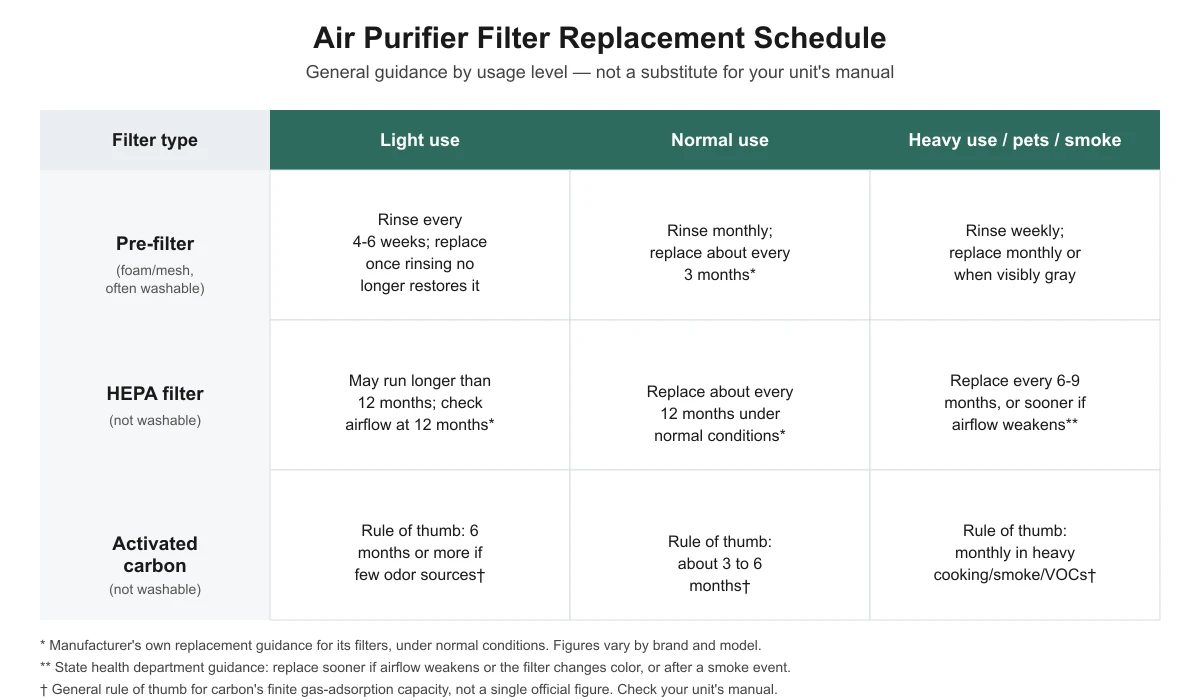
The table below splits the three usage levels this site’s keyword research found people actually asking about — light use, normal household use, and heavy use (pets, smokers, or during a smoke event) — against the three filter types. Figures marked with an asterisk come from a manufacturer’s own published replacement guidance for its filters; figures marked with a dagger are a general rule of thumb, not a single official number, because no standards body publishes a universal carbon-filter lifespan.
| Filter type | Light use | Normal use (most households) | Heavy use (pets, smokers, smoke events) |
|---|---|---|---|
| Pre-filter (foam/mesh, often washable) | Rinse or vacuum every 4-6 weeks; replace once rinsing no longer restores it | Rinse or vacuum monthly; replace about every 3 months* | Rinse weekly; replace monthly, or sooner if visibly gray or matted |
| HEPA filter (not washable) | May run longer than 12 months if the unit runs only part of the day and air quality is good; check airflow at 12 months* | Replace about every 12 months under normal operating conditions* | Replace every 6-9 months, or immediately if airflow weakens or the filter looks discolored** |
| Activated carbon (not washable) | General rule of thumb: 6 months or more if there are few odor or VOC sources† | General rule of thumb: about 3 to 6 months† | General rule of thumb: as often as monthly during heavy cooking, smoking, or a wildfire smoke event; replace immediately if odor returns before then† |
* Based on Honeywell’s own published replacement guidance for its Type A charcoal pre-filters (about every 3 months) and its True HEPA filters (about every 12 months) under normal operating conditions. Honeywell’s guidance also flags pets, smokers, heavy cooking odors, and high pollen as reasons to replace sooner. Exact intervals vary by brand and model — check your unit’s manual first.
** Based on Washington State Department of Health guidance on recognizing a filter that’s due and on replacing filters sooner after a poor air quality event such as wildfire smoke.
† No single standards body publishes a universal carbon-filter lifespan, because it depends on how much carbon is in the filter and how much gas load it’s exposed to. Treat this range as a planning estimate, not a verified figure, and replace sooner if odors come back.
Does having pets change the schedule?
Yes, on both ends of the filter stack. Pet hair and dander add to the particle load a pre-filter and HEPA filter catch, which fills them faster, and pet odor adds to the gas-and-odor load a carbon filter has to adsorb. Honeywell’s own filter-replacement guidance specifically names homes with pets as a case that needs more frequent replacement than its stated normal-conditions intervals. In practice, that usually means checking a pre-filter weekly instead of monthly, and leaning toward the shorter end of the HEPA and carbon ranges in the table above rather than the longer end.

What should I do with filters during a wildfire smoke event?
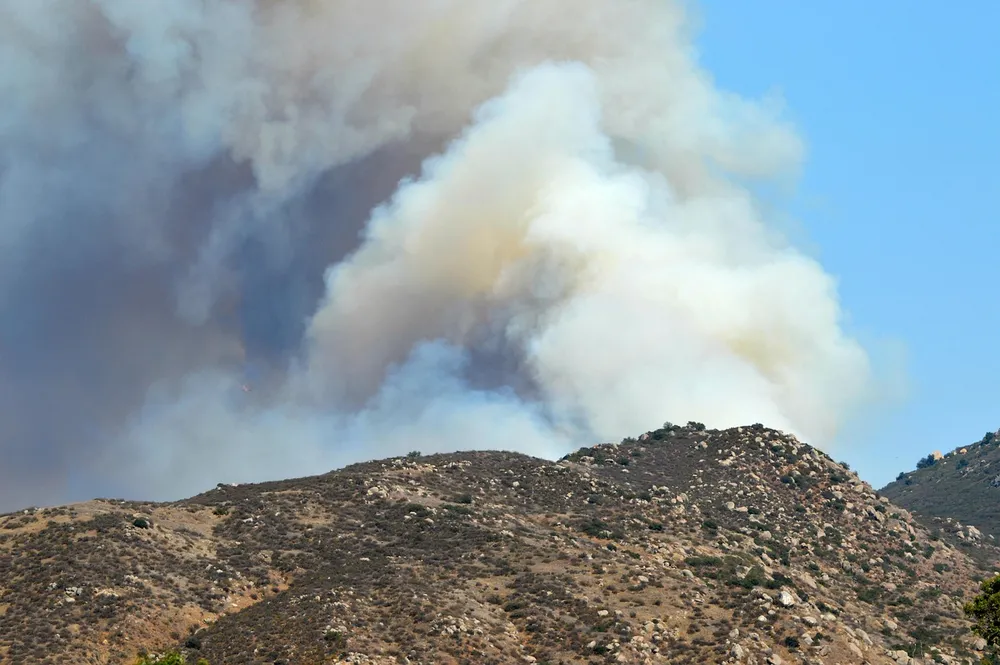
Expect to replace filters sooner than usual, and plan ahead if you live somewhere smoke events happen more than once a year. Washington State’s health department guidance recommends keeping spare filters on hand during wildfire smoke season, and treating a poor air quality event — specifically once the Air Quality Index reaches the “Unhealthy for Sensitive Groups” level or higher — as a trigger to check filters, not just a trigger to run the unit on high. A pre-filter and HEPA filter loaded up quickly during a smoke event will restrict airflow, and a carbon filter can saturate with smoke odor well before its normal-use interval is up. If the smell of smoke starts coming through the unit’s output air, that’s a sign the carbon filter is already saturated, regardless of how long it’s been installed.
Can I just wash a HEPA or carbon filter instead of replacing it?
No — not if it’s a true HEPA or carbon filter, as opposed to a washable pre-filter. Washington State’s health department guidance is direct on this point: “HEPA and carbon filters cannot be washed and must be replaced.” Running water through a HEPA filter’s dense fiber mat can collapse the fine structure that traps small particles, and washing a carbon filter doesn’t restore the adsorption sites that have already filled up with gas molecules. Only pre-filters that are specifically labeled washable should be rinsed, and even those eventually need full replacement once rinsing stops restoring their performance, as shown in the table above.
What signs mean a filter is due, even before the calendar says so?
Two signs matter more than a date on the calendar, according to Washington State’s health department guidance: a visible color change on the filter, and weaker airflow coming out of the unit. Either one means the filter is due for replacement regardless of how many months it’s been installed. A third practical sign, specific to carbon filters, is odor breaking through — if smells the unit used to block (cooking, smoke, pet odor) start reaching the room again, the carbon has saturated even if its typical replacement window hasn’t passed yet. None of these signs require special equipment to check; they’re things you can notice during a normal filter inspection.
Keep reading: related guides on this site
For the full spec checklist when choosing a unit in the first place — including filter type, certifications, and running cost — see our air purifier buying guide. If you’re not sure whether your unit’s carbon layer is doing enough against odors versus its HEPA layer catching particles, read our HEPA vs. activated carbon filter guide. And if you’ve already replaced a filter but the reset light won’t clear, see our filter light troubleshooting guide.
Frequently asked questions
How often should I replace my air purifier’s HEPA filter?
As a general starting point, about every 12 months under normal household conditions, based on manufacturer guidance for True HEPA filters. That interval shortens to roughly 6-9 months with pets, smokers, or heavy use, and can run longer with light, part-time use in clean air. Check your own unit’s manual, since exact figures vary by brand and filter design.
How often should I replace the carbon filter?
There’s no single official number, because it depends on how much carbon the filter holds and how much odor or gas load it’s exposed to. A commonly used rule of thumb is about 3 to 6 months for normal household use, shorter with heavy cooking, smoking, or recent wildfire smoke exposure, and sooner than that if odors start coming through the unit before the usual interval is up.
Do pre-filters need to be replaced as often as HEPA filters?
No. Most pre-filters are washable, so the routine is rinse or vacuum every few weeks and replace the pre-filter itself only every few months, once rinsing stops restoring it. HEPA filters are typically not washable at all, so their only maintenance option is full replacement on a longer interval, usually measured in months rather than weeks.
Can I tell a filter is due without checking the calendar?
Yes. State health department guidance points to two practical signs: the filter visibly changes color, or the airflow coming out of the unit gets noticeably weaker. For carbon filters specifically, odors breaking through that the unit used to block is also a sign it has saturated, even if the usual time-based interval hasn’t passed yet.
Does a wildfire smoke event mean I should replace filters sooner?
Yes. Health department guidance recommends checking and replacing filters after poor air quality events, including wildfire smoke, and keeping spare filters on hand during smoke season rather than waiting for a normal replacement date. Smoke loads both the particle-catching stages and the odor-adsorbing carbon stage faster than typical day-to-day use.
Sources
- U.S. EPA, Guide to Air Cleaners in the Home — read November 2026
- Washington State Department of Health, Using a Portable Air Cleaner — read November 2026
- Honeywell Store, How to Replace Honeywell Air Purifier Filters — read November 2026
airpurifierspace.com Editorial Team. Last updated: November 12, 2026.



1 thought on “How Often to Replace Your Air Purifier Filter (By Usage)”