Air Purifier Buying Decisions — The Complete Guide
If you want the clearest particle-filtering benchmark, choose HEPA, which is rated at least 99.97% for particles as small as 0.3 microns; if you want a…
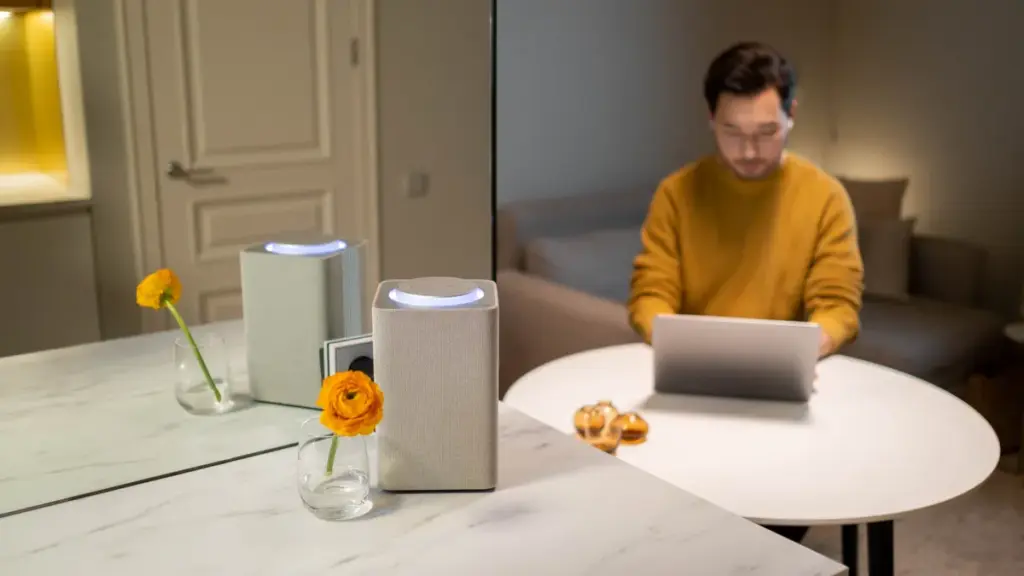
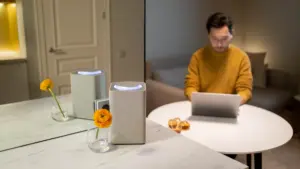
Man beside two air purifier units at a table
Last updated: November 26, 2026
Air purifier buying decisions: the complete guide
Quick answer: if you want the clearest particle-filtering benchmark, choose HEPA, which is rated at least 99.97% for particles as small as 0.3 microns; if you want a washable collector-plate design, a 3M Filtrete purifier is the more specific fit. This guide to Air purifier buying decisions — The Complete Guide focuses on the trade-offs that change ownership: filtration standard, maintenance, electricity, and noise.
I know how to read air-cleaner spec sheets for the details that actually change ownership: the filter standard, the electricity draw, and the noise trade-off. Those are the decisions that matter more than glossy ads.
- Key takeaways
- What should I choose first?
- HEPA purifier: who should buy it?
- 3M Filtrete purifier: when does it win?
- How do the two options compare?
- What costs keep showing up after the purchase?
- When should I skip both options?
- What are the exceptions that change the verdict?
- What is the verdict?
- FAQ
Key takeaways
- A HEPA filter is the safer pick when you want the most recognizable particle-removal standard: at least 99.97% of particles as small as 0.3 microns, according to AchooAllergy.com and EPA guidance on air cleaners and filters.
- A 3M Filtrete purifier makes sense when you want a reusable collector plate instead of a replaceable filter.
- A standard room air cleaner running continuously uses about 394 kWh of electricity per year, according to ENERGY STAR, so energy use is part of the buy.
- White noise is normal with air cleaners, so a unit that seems acceptable on paper can still annoy you in a bedroom; if noise sensitivity is a concern, it is worth checking the room setup and, if needed, consulting a qualified professional.
- The wrong purchase is usually not “bad filtration”; it is a mismatch between the machine’s maintenance style and the room you plan to put it in.
What should I choose first?
Start with the filter type, because that is the choice that changes the whole ownership experience. If you want the simplest, easiest-to-recognize particle standard, HEPA is the cleaner decision. If you want a system built around a washable collector plate, 3M Filtrete is the more specific fit.
For air purifier buying decisions — The Complete Guide, that first filter choice should come before brand names, fan settings, or color. It decides how you will live with the machine after the box is open.
A HEPA filter removes at least 99.97% of particles as small as 0.3 microns, according to AchooAllergy.com. That number is the cleanest shorthand in the category because it tells you the purifier is built around a widely understood particle target instead of a vague marketing claim.
For a buyer who wants more context, the EPA’s consumer guidance on air cleaners and filters is also a useful reference point for how these devices are described and compared. That does not make every HEPA purifier identical, but it does make the category easier to evaluate.
The 3M Filtrete line uses a filter technology that charges particles as they pass through, according to AchooAllergy.com. Its collector plates never need replacement and can be washed in the dishwasher, which changes the maintenance story completely. That is a real advantage if you dislike buying replacement filters or do not want to keep track of another consumable.
So the first choice is not “best brand” or “best price.” It is whether you want the familiar HEPA path or the reusable-plate path. That one decision affects cost, upkeep, and how annoying the machine feels six months later.
If you are weighing options quickly, use this short checklist:
- Choose HEPA if you want the clearest particle standard.
- Choose 3M Filtrete if you want a washable collector plate.
- Choose neither until you check the room size and sound tolerance.
- Choose based on upkeep you will actually do, not the spec sheet you wish you had.
HEPA purifier: who should buy it?
A HEPA purifier is the better choice for most buyers who want the most direct particle-removal claim. If you care about a clear standard and do not want to think too hard about how the technology works, HEPA is the safer default.
HEPA is also the better fit when you want a purifier that does not depend on a special collector-plate cleaning routine. Some people want a machine they can plug in and trust without learning a different maintenance style. That is especially true if the purifier will sit in a bedroom or office, where you may not want to remember dishwasher cycles or plate cleaning.
The main strength is simple: HEPA means at least 99.97% of particles as small as 0.3 microns, according to AchooAllergy.com. That gives you a hard, checkable benchmark instead of a loose promise. For a learning-stage buyer, that matters because it turns a fuzzy category into a known one.
The weakness is that HEPA is not the most distinctive choice if your real priority is minimizing maintenance decisions. It is also not the strongest fit for a person who wants a washable internal collection system. If you know you will resent buying and handling replacement filters, a HEPA unit may feel like a chore rather than a solution.
HEPA is wrong for anyone whose top concern is a reusable collector plate. It is also not the obvious answer if you are trying to narrow the purchase by ownership style instead of filtration standard. In that case, the 3M Filtrete route gives you a more specific maintenance story.
Before you buy, ask two practical questions:
- Will I tolerate replacement filters?
- Do I want a widely understood rating or a more specialized design?
3M Filtrete purifier: when does it win?
A 3M Filtrete purifier wins when you care more about reusable parts than about the HEPA label. It is the right buy for people who want a washable collector plate and less dependence on replacement filters.
Because the collector plates never need replacement, the upkeep is different from a standard filter-based machine. According to AchooAllergy.com, the plates can be washed in the dishwasher. That is a concrete maintenance advantage, not a vague convenience claim.
This matters because the hidden cost of an air purifier is not only electricity. It is also the ongoing friction of upkeep. A washable plate removes one recurring task from the list, which can make the machine easier to live with if you hate consumables.
The downside is that the Filtrete path is more specialized. A buyer who wants the familiar HEPA standard may not see a reusable plate as enough of a reason to change course. If your main goal is the most widely recognized particle-filtering benchmark, HEPA is still the clearer choice.
A 3M Filtrete purifier is also the wrong fit if you want the simplest shopping decision. The technology is more specific, and the maintenance story is more unusual than the plain HEPA answer. That can be a good thing for the right buyer, but it is not the easiest default for someone who just wants a dependable first purifier.
In practical terms, the Filtrete option fits households that want fewer disposable parts and a lighter maintenance routine. It does not remove trade-offs; it just changes which trade-offs you are making.
How do the two options compare?
HEPA wins on standardization; 3M Filtrete wins on reusable maintenance. That is the cleanest way to compare them, and it is the comparison that actually changes the buy.
| Criteria | HEPA purifier | 3M Filtrete purifier | Winner for [condition] |
|---|---|---|---|
| Particle standard | At least 99.97% of particles as small as 0.3 microns, according to AchooAllergy.com | Uses a technology that charges particles as they pass through, according to AchooAllergy.com | HEPA for buyers who want the clearest benchmark |
| Maintenance style | Filter-focused ownership | Collector plates never need replacement and can be washed in the dishwasher | Filtrete for buyers who hate replacement parts |
| Familiarity | Very familiar to most shoppers | More specialized design | HEPA for first-time buyers |
| Ownership friction | Simple if you accept filter replacement | Lower friction if you prefer washing plates | Filtrete for low-maintenance households |
| Tech transparency | The 99.97% at 0.3 microns claim is easy to understand | The charging-particles design is less intuitive | HEPA for easy comparison shopping |
| Upkeep planning | You have to think about the filter path | The washable plate removes one recurring task | Filtrete for people who want fewer consumables |
| Buying confidence | Easier to judge from a spec sheet | More dependent on how the design fits your habits | HEPA for shoppers who want fewer unknowns |
| Noise trade-off | White noise still applies to air cleaners in general | White noise still applies to air cleaners in general | Neither; this depends on room sensitivity |
| Energy use | A standard room air cleaner running continuously uses about 394 kWh per year, according to ENERGY STAR | A standard room air cleaner running continuously uses about 394 kWh per year, according to ENERGY STAR | Neither; energy use is a whole-category issue |
| Best use case | Clean, familiar, standards-based buying | Reusable, dishwasher-friendly maintenance | Match the maintenance style to the room |
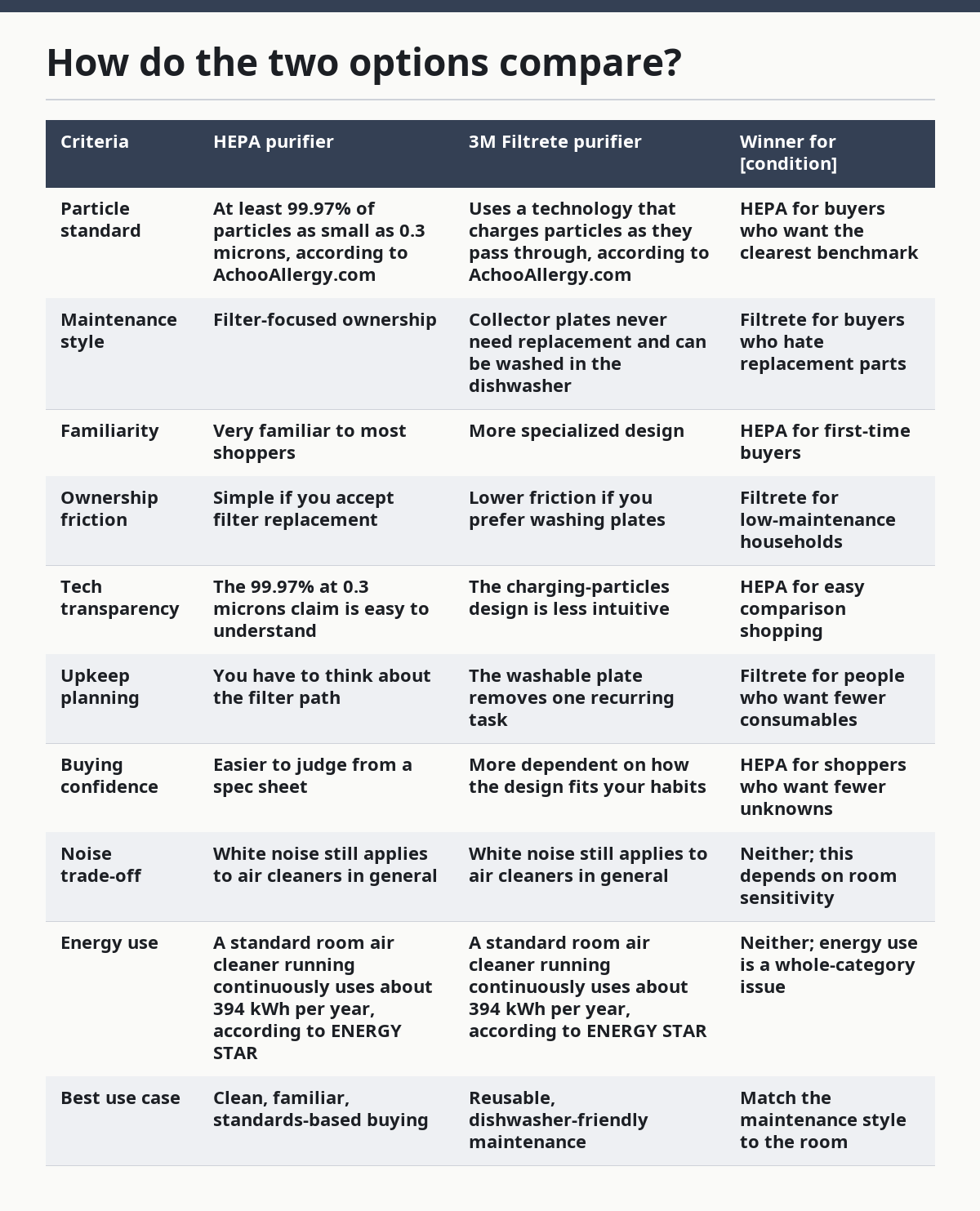
The table makes the central point plain: the choice is less about “which one cleans air” and more about how you want to own it. Both sit inside the same category of room air cleaners, and both carry the same real-world background costs of electricity and noise. What changes is the filter story.
For example, a buyer who wants a familiar, standards-based decision may be happiest with HEPA, while a buyer who wants fewer disposable parts may prefer 3M Filtrete. That is why the comparison is practical rather than theoretical.
If you are comparing two boxes in a store or on a product page, a useful decision rule is this: choose the one whose maintenance you will actually tolerate. A 99.97% HEPA label is a strong anchor, but a washable plate can be the more practical answer if you dislike consumables.
What costs keep showing up after the purchase?
Electricity and noise are the two costs that keep showing up after the purchase. A standard room air cleaner running continuously uses about 394 kWh of electricity per year, according to ENERGY STAR, and white noise is one of the stated side effects.
That 394 kWh figure matters because it reminds you that air cleaning is not free after checkout. If you run a purifier all the time, the machine becomes part of your home’s ongoing energy use. That is true no matter how clean the marketing page looks.
To put the number into buying context, it is not just a technical footnote. It is a standing cost that should be considered alongside the purchase price, especially if the unit will run every day.
White noise is the other cost, and it is the one many buyers underestimate. Some people like a little sound. Others find it irritating, especially in a quiet bedroom or a child’s room. A purifier that seems fine during a short demo can feel different after several nights of sleeping next to it.
If white noise is a concern, consult the manufacturer’s specifications and, if needed, a qualified professional who can help you think through room placement and sound sensitivity. That is especially useful when the room is small or the air cleaner will run at night.
These costs do not decide the brand choice by themselves, but they do decide whether the machine will be tolerated. A purifier that filters well and annoys you every night is not a good buy. The room matters as much as the spec sheet.
This is also why a “best air purifier” list without any mention of energy use or sound is incomplete. The box can look right and still be wrong for a light sleeper or for someone watching monthly power use.
When you compare models, scan for three numbers or facts:
- Filter standard
- Continuous electricity use
- Noise or sound notes
When should I skip both options?
Skip both when your real problem is not particle filtering. If your main issue is sound, placement, or daily upkeep, a purifier may not be the first fix you need.

A purifier is a poor fit if you cannot tolerate white noise in the room where you need it most. That is especially true in a small bedroom or office where every sound gets louder because the room is quiet. Even a good filter cannot solve a bad sleep setup.
Skip both if you know you will never clean or manage the machine properly. A HEPA unit needs enough attention to stay worth keeping, and a 3M Filtrete unit still depends on you using the dishwasher-ready collector plates as designed. A device that is ignored becomes dead weight.
Skip both if you are shopping for the wrong reason, such as chasing a brand name without knowing whether you want HEPA or a reusable collector plate. The technical choice comes before the logo. If you get that wrong, the rest of the decision is just decoration.
Skip both, too, if you want a purchase that disappears into the background with no trade-offs. Air cleaners do not work that way. They use power, they make noise, and they ask for some kind of maintenance. The honest job of this guide is not to hide that.
In other words, the best purifier decision starts with the room, not the ad. Once you know what the room will tolerate, the choice becomes much clearer.
What are the exceptions that change the verdict?
The verdict flips when your room or habits make maintenance more important than filtration labels. There are cases where the default HEPA answer is not the most practical one.
First, choose 3M Filtrete if the idea of a dishwasher-safe collector plate matters more than the label on the front. That is a real exception because the maintenance experience can matter more than the standard itself. If you know you will resist replacement filters, the reusable design can be the better long-term choice.
Second, choose HEPA if you want the clearest known benchmark and do not want to compare technologies. The 99.97% at 0.3 microns claim is easy to understand and easy to explain to yourself later. For a first-time buyer, that simplicity is worth a lot.
Third, avoid both if you are looking for a silent machine. White noise is a stated side effect in air-cleaner use, and that matters in a room where quiet is the whole point. If you are extremely sensitive to sound, buying on filtration alone is a mistake.
Fourth, avoid both if you cannot justify the ongoing energy use of a continuously running purifier. A standard room air cleaner using about 394 kWh per year is not the same as a device you forget about. If energy use is your top concern, the category itself may be the issue.
Those exceptions are not edge cases for the sake of it. They are the situations that most often turn a good-looking product into a regretted purchase.
For a shopper comparing options in real life, the exception list is the quickest way to spot a mismatch before money is spent.
What is the verdict?
Choose HEPA if you want the simplest, most recognizable particle standard and you are fine with a conventional filter-based machine. Choose 3M Filtrete if you want a reusable collector plate you can wash in the dishwasher and you care more about maintenance than labels.
That is the clean buying decision. HEPA is the safer default for most readers because it gives you the clearest filtration claim: at least 99.97% of particles as small as 0.3 microns, according to AchooAllergy.com. 3M Filtrete is the more practical choice for a buyer who wants less filter handling and likes the idea of a washable part.
Do not force the decision through brand loyalty. Force it through ownership style. If you know which upkeep you will tolerate, the rest gets much easier.
And if the room makes either option hard to live with, step back and reconsider the category before buying. The best purchase is the one that still makes sense after the first month.
FAQ
Is HEPA worth paying attention to when I buy an air purifier?
Yes, because HEPA gives you a specific benchmark instead of a vague promise. A HEPA filter removes at least 99.97% of particles as small as 0.3 microns, according to AchooAllergy.com. That makes it one of the easiest ways to compare purifier claims without guessing what the marketing means.
The EPA’s consumer guidance on air cleaners and filters for home use is also worth a look if you want a more official framing of how these products are discussed.
Is a washable collector plate better than a regular filter?
It is better for people who want less replacement hassle, not for every buyer. In the 3M Filtrete design, the collector plates never need replacement and can be washed in the dishwasher, according to AchooAllergy.com. That is a strong fit if you want fewer consumables, but it is not the same as saying every shopper should prefer it.
How much electricity does a room air cleaner use?
A standard room air cleaner running continuously uses about 394 kWh of electricity per year, according to ENERGY STAR. That is why electricity belongs in the buying decision, not just the product page. If you plan to run the unit all day, that number should be part of your thinking.
Will an air purifier be loud?
Expect white noise, because that is one of the stated side effects. Some people barely mind it, and some people hear it all night. If you are sensitive to sound, room placement matters as much as the purifier model itself, and a professional opinion can help if you are unsure about the setup.
Should I buy the first HEPA purifier I see?
Only if the rest of the room already fits the machine. HEPA is a strong default, but the right buy still depends on whether you can live with the sound, the electricity use, and the maintenance style. If a reusable collector plate would make ownership easier, the 3M Filtrete option may be the better match.
Sources
- ENERGY STAR, Air Cleaners – ENERGY STAR (checked 26 Nov 2026)
- AchooAllergy.com, Air Purifier Buying Guide – How To Choose The Right Air Cleaner For Your Home (checked 26 Nov 2026)
Drafted with AI; not yet reviewed by a person.