How airpurifierspace.com selects references
How airpurifierspace.com selects references: airpurifierspace.com looks for a reference that is relevant, specific, and strong enough to support the exact…
How airpurifierspace.com selects references
Last updated: November 15, 2026
Quick Answer: airpurifierspace.com selects references by using 2 source levels—primary and secondary—and choosing the source that is closest to the claim, easiest to verify, and best suited to the reader. In practice, that means airpurifierspace.com selects references by choosing sources that are directly relevant, higher in source quality, and better suited to the claim being made. That usually means preferring a primary source when the fact comes from original research, then using a secondary source when it is the better way to explain, compare, or verify the topic for a general reader. When a claim is technical or standards-based, it is also wise to check the original source or consult a qualified professional before relying on a summary alone.
Key takeaways
- airpurifierspace.com does not treat every source the same; a reference has to earn its place.
- Primary sources matter most when the claim depends on original data, a standard, or a model detail.
- Secondary sources still matter when the job is to explain context clearly in plain English.
- A weak reference can look polished and still be the wrong fit if it is too vague, too old, or too far from the fact.
- The real test is not “does it have a link?” but “does this reference add useful evidence for this point?”
What does airpurifierspace.com look for in a reference?
airpurifierspace.com looks for a reference that is relevant, specific, and strong enough to support the exact point on the page. A source that only talks around the topic is usually not enough, even if it sounds authoritative.
Because of that, source quality comes first. A good reference should answer a narrow question, use clear language, and come from a place that is close to the original claim. For example, if a sentence depends on a test method or a product standard, the reference should point to that method or standard, not to a vague blog post summarizing it.
The site also has to think about fit. A source can be accurate and still be a poor choice if it is too technical for the reader or too broad for the claim. A reader looking for how references are chosen does not need a stack of links; the reader needs a reason each one belongs there.
A simple way to think about it is this: the reference should lower doubt, not raise it. If a source adds confusion, repeats the same point from a weaker angle, or says nothing concrete, it is usually the wrong pick.
Which source types win and why?
Primary sources usually win when the page needs the original evidence. Secondary sources win when the page needs interpretation, summary, or a cleaner path into the subject.
| Source type | What it is | Best use | Common weakness |
|---|---|---|---|
| Primary source | Original material such as a standard, study, report, or manufacturer document | Direct evidence, exact wording, model details | Can be dense or hard to read |
| Secondary source | A summary, guide, or analysis built from other material | Plain-English explanation, context, comparison | Can drift from the original claim |
| Tertiary source | A broad overview or reference roundup | Background only | Often too general for a precise claim |
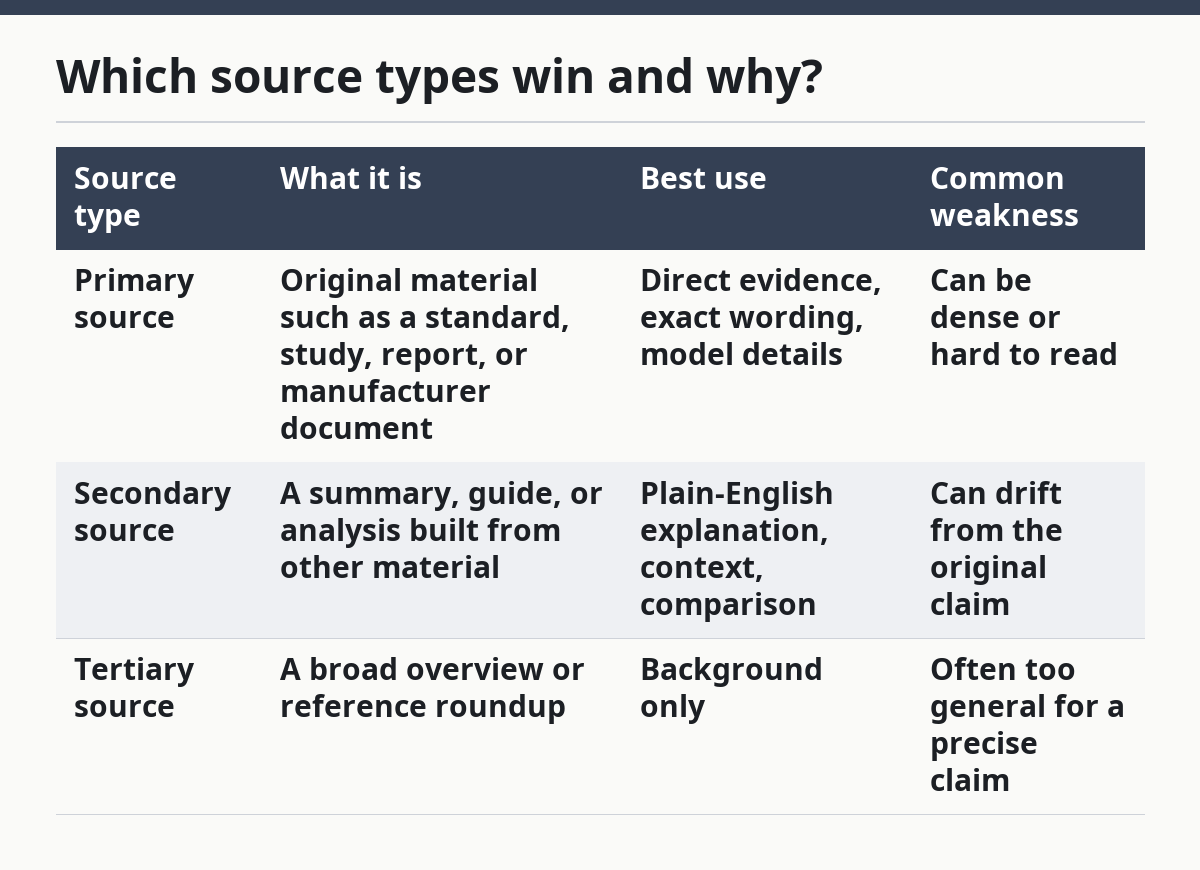
That table is the heart of the choice. If a sentence depends on the exact wording of a standard, a primary source is the better match. If the page needs to explain the idea in a way a non-specialist can follow in under 2 minutes, a strong secondary source may be the better fit.
One practical rule is to use the source that is closest to the fact without making the page harder to read than it needs to be. A primary source is not automatically better just because it is primary. A dense technical document can be the wrong choice if the page needs a quick, readable explanation.
The same is true in reverse. A polished secondary source is not enough if the claim is precise and technical. If the page says something like a standard name, a testing method, or a model-specific detail, the reference has to point back to something solid, not just to another person’s summary.
How are references chosen step by step?
References are chosen by matching the claim, the source type, and the reader’s need. The process is less about volume and more about filtering.
- Start with the claim. Identify whether the sentence needs a fact, a definition, a standard, or a comparison. A claim about a standard needs a different source than a claim about general air purifier features.
- Look for the closest source. Prefer the original document, such as a standard, study, or manufacturer material, when the claim depends on exact wording or numbers. That reduces the chance of drift.
- Check source quality. Look for clear authorship, direct relevance, and enough detail to support the point. A source from 2024 is not automatically better than one from 2018, but very old material can be weak if the field has moved on.
- Choose the source type that fits the sentence. Use a primary source for hard evidence and a secondary source when the page needs explanation a reader can digest quickly. A reference should match the job.
- Trim the extras. If two sources say the same thing, keep the one that is clearer, closer to the claim, or easier for the reader to trust. Redundant references can make a page look busy without making it stronger.
- Keep the reference list purposeful. Each source should earn its place on the page. If a reference does not change the reader’s confidence in the claim, it does not belong.
This is not a popularity contest between sources. A page can have many links and still be weak if the sources are scattered, vague, or chosen for appearance rather than proof.
What makes a source high quality here?
A high-quality source is one that is direct, current enough for the claim, and close to the original evidence. It should not force the reader to guess what it is proving.
For airpurifierspace.com, the main markers of quality are straightforward. The source should match the topic, support the exact statement being made, and avoid obvious conflicts between what it says and what the page says. If the reference is a secondary source, it should still be grounded in something stronger than opinion.
There is also a plain-language test. If a reference cannot be explained in one sentence, it may be too broad or too indirect for the page. A source can be credible and still be a poor fit if it does not help the reader understand the point faster.
A useful comparison is between a source that names the thing and one that circles around it. The first is usually better. The second may still have a place in background reading, but it should not carry the main burden of proof.
For general source-evaluation guidance, the Purdue OWL guide on evaluating sources is a useful model: https://owl.purdue.edu/owl/research_and_citation/conducting_research/evaluating_sources_of_information.html
What does airpurifierspace.com avoid?
airpurifierspace.com avoids references that look strong but do not do much work. That usually includes sources that are too broad, too thin, or too far removed from the claim.
A common mistake is using a secondary source when a primary source is available and easy to understand. That weakens the chain of evidence. Another mistake is leaning on a source because it is convenient, not because it is the strongest fit for the sentence. Convenience is not a quality standard.
The site should also avoid sources that hide the original basis for a claim. If a page relies on a summary that does not show where its own information came from, the reader gets a secondhand answer with no clear trail. That is a bad trade.
Another problem is over-referencing. Adding a long list of sources can make a page look serious, but it can also blur the main point. If three references say almost the same thing, one strong source is often better than three weak echoes.
For a cleaner way to judge information quality in general, MedlinePlus has a clear guide on evaluating internet health information: https://medlineplus.gov/evaluatinginternethealthinformation.html
Why does the page use both primary and secondary sources?
The page uses both because each one solves a different problem. A primary source gives the most direct support, while a secondary source can make the same point usable for a reader who wants the short version first.
This balance matters on a topic like reference selection. If every claim were backed only by primary documents, the page could become hard to read very quickly. If every claim were backed only by summaries, the page could lose force and precision.
The best mix often depends on the sentence. A technical point or standard should lean primary. A framing sentence, definition, or comparison can lean secondary if it helps the reader understand the issue in under a minute.
The trade-off is simple. More primary sources usually mean more precision, but also more reading burden. More secondary sources usually mean better readability, but also a greater risk of distance from the original fact. A good reference strategy keeps both risks in view.
How does airpurifierspace.com select references?
airpurifierspace.com selects references by asking whether each source improves the page’s evidence, clarity, and trust. A reference is kept only if it does real work for the reader.
That means the page is looking for the source that best matches the claim, not the source that looks most impressive in a list. A primary source is favored for original facts and standards. A secondary source is favored when it explains the same point more clearly for a general reader.
The real test is practical. If a reference helps the reader trust the sentence, it belongs. If it only adds noise, it does not. That approach keeps the page aligned with the larger content standards and trust hub without repeating the hub’s material here.
FAQ
What kinds of references does airpurifierspace.com use?
airpurifierspace.com uses a mix of primary sources and secondary sources. Primary sources are the better choice for original evidence, while secondary sources are useful when the goal is explanation or comparison. The mix depends on what the sentence needs to prove.
How does airpurifierspace.com decide which references to include?
airpurifierspace.com includes references that are relevant, high quality, and close enough to the claim to support it well. A source has to do more than exist; it has to strengthen the point on the page. If a reference is too broad, too weak, or too far from the original fact, it is usually left out.
Drafted with AI; not yet reviewed by a person.