Do Air Purifiers Produce Ozone? What to Know Before You Buy
Yes, some air purifiers do produce ozone, but many standard filter-based models do not, so the safest 0-ozone goal is a plain filter-only unit. In the…

Do Air Purifiers Produce Ozone? What to Know Before You Buy
Last updated: November 26, 2026
Quick Answer: yes, some air purifiers do produce ozone, but many standard filter-based models do not, so the safest 0-ozone goal is a plain filter-only unit. In the article Do Air Purifiers Produce Ozone? What to Know Before You Buy, the main risk usually comes from features like ionizers and electrostatic precipitators, not from plain mechanical filtration. If you want low-ozone air cleaning, check the product label, look for certification, and avoid anything marketed as an ozone-producing “fresh air” device; if you are unsure, consult a professional and check the EPA’s air cleaner guidance and CARB’s home air cleaner resources.
Key takeaways
- Ozone is not part of normal HEPA-style filtration; it shows up when a purifier uses a charged process.
- Ionizers and electrostatic precipitators can create ozone as a side effect, even when the device is sold as an air purifier; if you are choosing between models, consult a professional and review EPA and CARB guidance.
- Product labels matter more than marketing claims. Words like “ion,” “plasma,” or “electronic” deserve a close look.
- For shoppers, the safest default is often a purifier with standard filtration and clear safety certification, especially if you want to avoid added ozone.
- A model can clean air and still be a poor choice if it adds ozone you do not want in the room.
Do air purifiers produce ozone?
Yes, some air purifiers produce ozone, but many do not. A basic air purifier that uses only a fan and a filter is usually not an ozone source, while devices with ionizers or electrostatic technology may generate ozone as part of how they work.
That difference matters because the phrase “air purifier” covers several designs. A box fan with a filter behaves very differently from a unit that charges particles in the air. The label on the front may look similar, but the internal technology is not.
However, the EPA’s indoor air guidance treats ozone as a separate issue from ordinary filtration, and that is the right way to think about it; if you are unsure, consult a professional and check the EPA and CARB links above. If a product claims to “refresh” air, “charge” particles, or “neutralize” odors with electricity, it deserves extra scrutiny. The same is true of products described as electronic air cleaners.
For a shopper, the practical question is not “Can an air purifier ever make ozone?” It is “Does this specific model use a process that can make ozone, and is that process something I want in my room?” That is the question that prevents a bad buy, and if it is unclear, consult a professional before you purchase.
If you want the broader safety context, the hub on air purifier safety and standards is the right place to start before comparing models.
Which features are the ozone risk?
Ionizers and electrostatic precipitators are the main features that can raise ozone concerns. They are built to give particles an electric charge, then collect them on plates or nearby surfaces, and that electrical action can create ozone as a byproduct.
A standard mechanical filter does not rely on that charging step. A HEPA-style filter traps particles in the filter media, which is a different process altogether. That is why a purifier can be sold for clean air and still have very different ozone behavior depending on the technology inside.
Here is the simple comparison, and if you are unsure how to read a spec sheet, consult a professional and review the EPA and CARB guidance linked above:
| Feature | How it works | Ozone concern | What a buyer should watch |
|---|---|---|---|
| Mechanical filter | Air passes through filter media | Low, if there is no ionizing stage | Plain filtration, filter replacement, CADR info |
| Ionizer | Charges particles so they clump or stick | Possible | “Ion,” “plasma,” or “electronic” in the product description |
| Electrostatic precipitator | Charges and captures particles on plates | Possible | Removable plates, electric collection system, cleaning needs |
| Ozone generator | Makes ozone on purpose | High | Do not treat this as a normal air purifier |
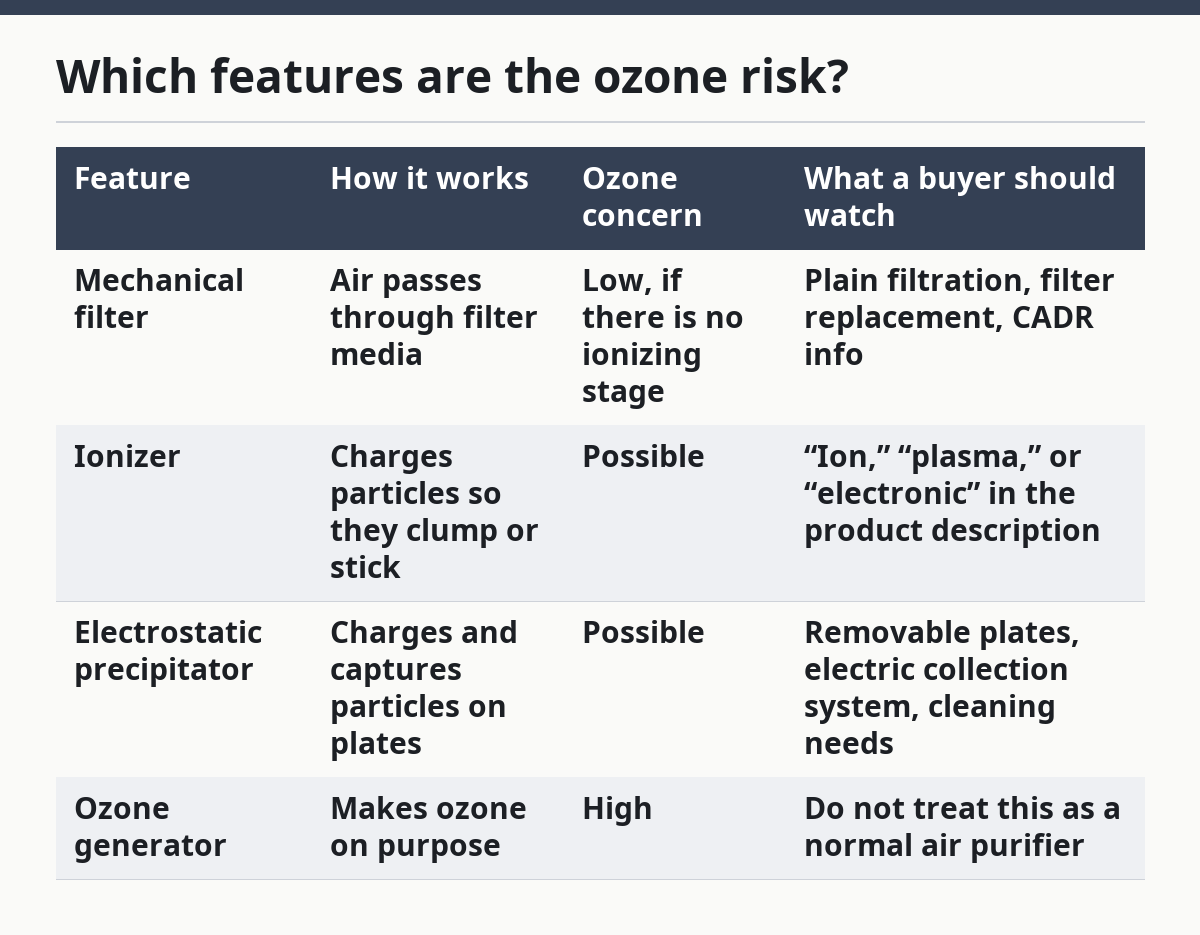
That table is the key buying filter. If a model uses electricity to charge air instead of just moving it through media, ozone becomes part of the decision. The issue is not only whether the product cleans air; it is what else it may add to the room while it works.
A lot of marketing blurs that line. Terms such as “fresh air technology” and “active purification” can sound harmless, but they do not tell you whether the unit uses an ionizer. When the label is vague, the buyer pays the price later.
How do I check a product before buying?
You check a purifier for ozone risk by reading the manual, the box, and the spec sheet for the exact technology, then confirming whether the model has a recognized safety claim or certification. The goal is to spot ionizers and electrostatic parts before the purchase.
Use this order:
- Look for the technology name first. Search the listing for “ionizer,” “electronic,” “electrostatic precipitator,” or “plasma.” If one of those terms appears, assume ozone is a question until proven otherwise.
- Read the user manual, not just the sales page. Manufacturers often place the real feature list in the manual. A sales page may say “advanced air cleaning,” while the manual reveals an ionization stage.
- Check whether the unit can run with that feature turned off. Some models let you disable the ionizer. If that option exists, the purifier may still work as a filter-based unit, which gives you more control.
- Look for recognized safety or emissions claims. A clear certification or listing is better than a vague promise. If the label only says “safe” with no standard named, that is weak evidence.
- Search the exact model number, not the brand name. Different models from the same brand can behave differently. A brand that sells one low-ozone unit may also sell another with an ionizer.
The result you want is simple: a product description that plainly says how the unit cleans air and whether any ionizing feature is present. If you need to squint to find that answer, the product is already wasting your time.
One useful habit is to treat “can be turned off” as a good sign, not a clean pass. A switchable ionizer still means the device can produce ozone when the feature is on, so if you are uncertain, consult a professional and review the EPA and CARB materials before buying. That may be fine for one buyer and wrong for another.
What labels and certifications matter?
Product labels and certifications matter because they are the fastest way to separate a plain filter from a device that may emit ozone. A label that names the technology is more useful than a slogan that says the air will feel “clean” or “fresh.”
The most helpful labels are the ones that tell you what the machine does, not what it promises. Look for clear references to filter type, ionizer status, or an emissions-related standard. If a product has a safety mark, check the exact model tied to that mark, not the brand family in general.
Two organizations are worth knowing here: the U.S. Environmental Protection Agency and the California Air Resources Board. EPA guidance helps you understand how air cleaners are supposed to work, while CARB certification is often used as a signal that the device meets a low-emissions requirement.
That does not mean every certified product is identical, and it does not mean every uncertified product is dangerous. It does mean certification is far better than guessing from ad copy. When a purifier is sold with a lot of talk about “ion boost” or “electronic cleaning” and no clear label, you are taking on more risk for little benefit.
A generic mistake here is buying by room size and CADR alone. Those numbers matter, but they do not answer the ozone question. A purifier can have a solid airflow rating and still include an ionizer you did not want.
Should I avoid ionizers and electrostatic models?
Yes, if you want the lowest ozone risk, a model without ionizers or electrostatic collection is the safer pick. That does not make every ionizing purifier bad, but it does make them a poorer fit for buyers who care most about avoiding added ozone.
The trade-off is straightforward. Ionizers and electrostatic precipitators can help with particle capture, but they do so with an electrical process that can create ozone. Plain filtration avoids that specific issue, though it may require regular filter changes and may not have the same “charged particle” effect that some brands advertise.
This is also where the wrong purchase happens most often. A buyer sees a sleek unit with several cleaning modes, a light display, and one button for “ion.” That button may look optional, but the device was still designed with ozone-producing potential in mind. If the purifier will sit in a bedroom, nursery, or a small closed room, that design choice matters even more.
The safe buying rule is simple: if you do not want ozone, do not pay for a feature that can make it. There are plenty of purifiers that rely on standard filtration alone. Those models keep the decision cleaner, and the maintenance is usually easier to understand too.
What should I buy instead?
A standard filter-based air purifier is the better buy for most people who want to avoid ozone. It gives you the main job of air cleaning without the added question of ionizers, electrostatic plates, or other electrical treatment stages.
Therefore, the shopping process becomes simpler. You are looking for a unit that clearly states its filter type, filter replacement schedule, and any safety or emissions labeling. If the product description is full of charged-air language, keep moving. If it says it uses straightforward filtration and no ionizer, that is a better sign.
This choice is not for someone who wants every possible feature turned on in one box. A device packed with extra modes can sound impressive, but more features often mean more ways to introduce side effects. In ozone safety, less technology is often the better design.
A good first filter for buyers is this: would the product still make sense if every “electronic” air-cleaning feature were removed? If the answer is yes, that is usually the safer direction.
Are ionizers safe in air purifiers?
Ionizers can be acceptable in some purifiers, but they are not the best choice if you are trying to avoid ozone. The main issue is not that every ionizer creates a large amount of ozone; the issue is that the feature exists at all and may be hard to judge from a sales page.
Some products let you switch the ionizer off, which gives you flexibility. Even then, the presence of that feature means the device is not just a plain filter unit. If you are sensitive to odors, have a small room, or want the simplest option, a non-ionizing purifier is the cleaner buy.
How can i tell if an air purifier emits ozone?
You can tell by checking the exact model for an ionizer, electrostatic precipitator, or ozone-related language in the manual or spec sheet. If the device is described as “electronic,” “charged,” or “ionizing,” ozone becomes a real possibility and you should keep reading before buying.
A low-ozone model usually gives you a plain, specific description of its filtration. If the listing avoids naming the cleaning method, that is a warning sign. When in doubt, look for a clear emissions or safety claim tied to the exact model number, not just the brand.
For a quick screen, compare the product against the shortlist below:
- Plain filter only: usually the safest default
- Ionizer present: check whether it can be switched off
- Electrostatic precipitator: read carefully for ozone information
- Ozone generator language: do not buy it as a normal purifier
The point is not to memorize every brand detail. The point is to spot the design before the box arrives. Once you know that ionizers and electrostatic systems are the pieces that change the ozone picture, the buying decision gets much easier.
Ozone is not something to ignore, but it is also not a mystery. If you read the technology name, check the manual, and favor clear certification over vague marketing, you can avoid most bad surprises.
Drafted with AI; not yet reviewed by a person.