Air Quality Problems and What to Do: The Complete Guide
In the first 10 minutes, close off dirty outdoor air, stop the indoor source if it is safe to do so, and use HEPA or a compatible MERV 13 system to reduce…
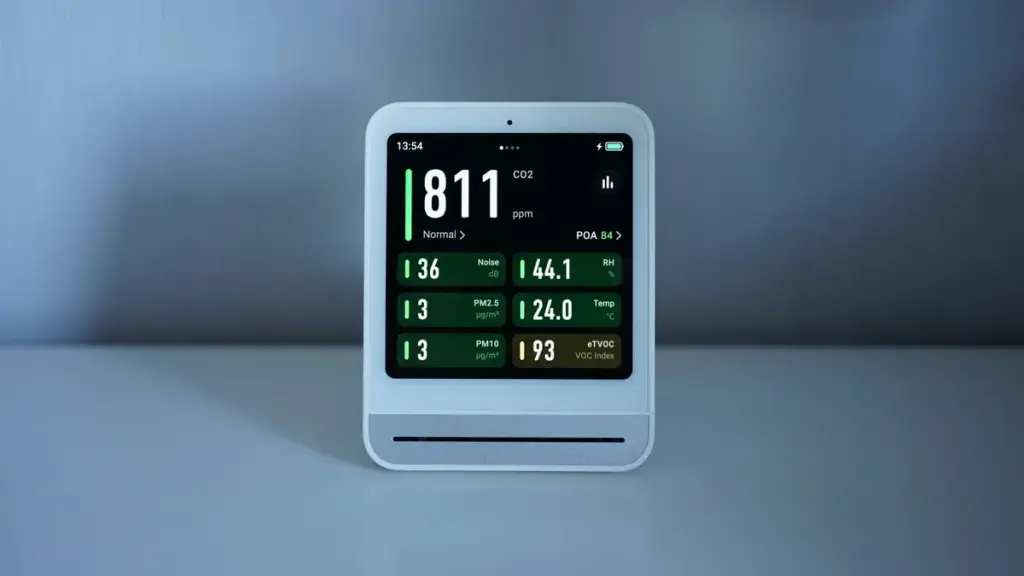
Digital air quality monitor on a table
Last updated: November 27, 2026
Quick Answer: in the first 10 minutes, close off dirty outdoor air, stop the indoor source if it is safe to do so, and use HEPA or a compatible MERV 13 system to reduce exposure. Air quality problems and what to do — The Complete Guide is about matching the fix to the source, whether the problem is wildfire smoke, a dusty HVAC system, mold, gas cooking, or a ventilation issue.
Key takeaways
- Start with the source, not the gadget. A purifier helps, but it does not fix a gas leak, a mold source, or a blocked vent.
- If the problem is outside smoke or pollution, keep windows closed and filter the air with a HEPA purifier or a MERV 13-rated HVAC filter where the system can take it.
- If the problem is indoors, cut the pollutant at the source first: stop the smoke, clean the dust, fix moisture, or service the appliance.
- Watch for the signs that mean the answer changes: burning eyes, headache, damp smell, visible soot, or symptoms that improve when you leave the space.
- When breathing gets hard, or a gas appliance seems unsafe, do not wait for a purifier to solve it. Get professional help right away.
What air quality problem are you actually dealing with?
The right response in Air quality problems and what to do — The Complete Guide depends on whether the problem is outdoor pollution drifting in, an indoor source, or bad ventilation that traps both. That sounds obvious, but most bad advice skips this step and sends people straight to a purifier when the real issue is a leak, moisture, or combustion.

If the air feels dusty, smells stale, or makes eyes itch only in one room, the problem is often inside the building. If the smell or haze appears across a whole area, or gets worse on bad outdoor air days, the source may be outside. The U.S. Environmental Protection Agency has a useful overview of indoor air quality basics here: https://www.epa.gov/indoor-air-quality-iaq and the CDC has guidance on mold and dampness here: https://www.cdc.gov/mold-health/about/index.html
A quick sort helps:
- Smoke or haze from outside: close windows, run filtration, and limit infiltration.
- Dust, dander, or pollen inside: clean surfaces, vacuum with a HEPA vacuum if possible, and filter the air.
- Musty smell or damp walls: treat moisture as the source, not the smell, and consult a qualified professional if you cannot find or stop the moisture source.
- Headache, nausea, or a fuel-like smell: treat this as a ventilation or combustion issue first and consult a qualified professional if the source is not obvious.
This is not the time for generic “fresh air” advice. Fresh air is good only when the outdoor air is cleaner than the indoor air. If the outdoor air is worse, open windows can make the room dirtier within minutes.
Quick check: if the problem is tied to a bad weather day, a smoky smell, or a dusty room, the source is probably not the same, and the fix should not be the same either.
What should you do in the first 10 minutes?
You should reduce exposure first, then identify the source. The first 10 minutes are about damage control, not perfect diagnosis.
If someone in the space has asthma, chest tightness, dizziness, or trouble breathing, move them to cleaner air right away. If the air smells like gas, solvent, or something burning, leave the area and get help before doing anything else. No purifier can make an unsafe combustion problem safe.
Here is the practical order that works best in most homes or small offices:
- Close windows and exterior doors if the outdoor air is poor or smoky.
- Turn on a HEPA purifier in the room where people spend the most time.
- Switch HVAC to recirculate if that mode is available and the system is safe to use.
- Replace a clogged filter with the highest rating the system can handle, often a MERV 13 filter if the system is designed for it.
- Stop the source: no candles, no smoking, no frying that fills the air with smoke, and no running a known damaged appliance.
- Check the outdoor air quality index if the issue seems tied to outdoors; the EPA’s AirNow page is a common reference point: https://www.airnow.gov/
- Look for the obvious indoor source: open trash, pet litter, wet carpet, recent paint, or visible dust buildup.
A good purifier is helpful, but room placement matters. Put it where people actually breathe air, not behind a couch or in a corner with no airflow. If there is one bedroom where sleep gets wrecked, put the purifier there first.
A generic article often forgets the simplest point: if the source stays on, the room never truly clears. A smoking pan, a cracked furnace vent, or wet drywall can keep feeding the problem all day.
Quick check: if your first instinct is “buy something,” stop and ask whether the problem is a source, an exposure path, or both.
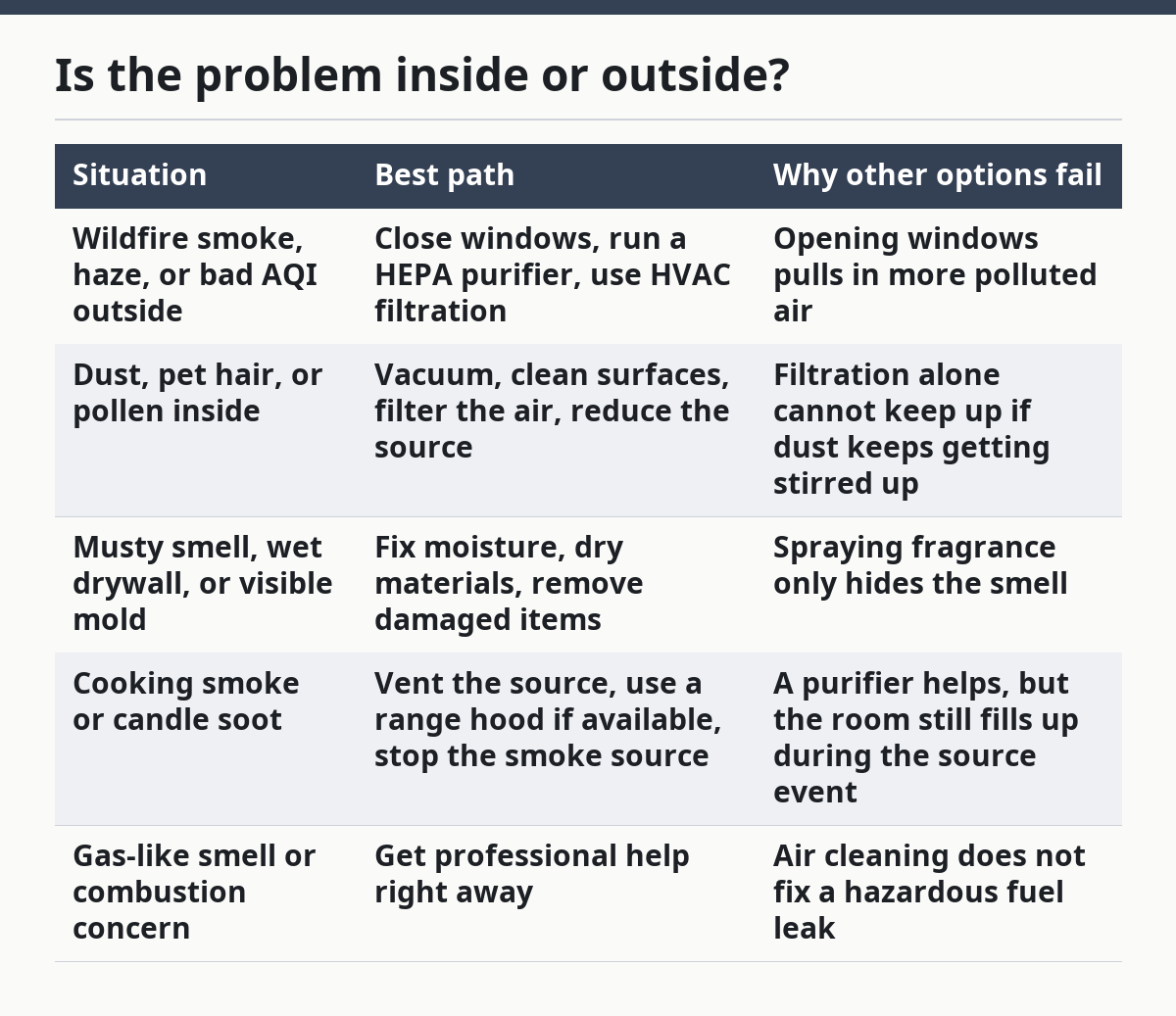
Is the problem inside or outside?
The problem is inside if the same room keeps causing symptoms even when outdoor air is fine, and outside if the building gets worse on bad air days or smoky days. That split decides whether you should focus on source control or filtration first.
Here is a simple comparison.
| Situation | Best path | Why other options fail |
|---|---|---|
| Wildfire smoke, haze, or bad AQI outside | Close windows, run a HEPA purifier, use HVAC filtration | Opening windows pulls in more polluted air |
| Dust, pet hair, or pollen inside | Vacuum, clean surfaces, filter the air, reduce the source | Filtration alone cannot keep up if dust keeps getting stirred up |
| Musty smell, wet drywall, or visible mold | Fix moisture, dry materials, remove damaged items | Spraying fragrance only hides the smell |
| Cooking smoke or candle soot | Vent the source, use a range hood if available, stop the smoke source | A purifier helps, but the room still fills up during the source event |
| Gas-like smell or combustion concern | Get professional help right away | Air cleaning does not fix a hazardous fuel leak |
If the building uses a central HVAC system, the filter rating matters. The EPA says MERV 13 or higher can improve particle capture in many systems, but only if the system can handle the pressure drop without damaging airflow. That trade-off matters because a filter that is too restrictive can reduce airflow and make the system perform worse.
If the outside air is worse than the inside air, fresh air is not the answer. If the inside air is worse than the outside air, opening windows can help only if the source has stopped and the outdoor air is actually cleaner.
If you want a second check on outdoor conditions, AirNow is useful because it translates pollution into an index people can act on rather than a chemistry lesson. The number matters less than the practical question: is the air outside better than the air inside right now?
Quick check: if symptoms ease when leaving the building, the problem is probably inside; if symptoms spike on smoky or polluted days, outside air is likely part of the answer.
Which fix works best for air quality problems?
The best practical order is source control first, then filtration, then ventilation when outdoor air is clean enough. That order matters because the most expensive option is often the least useful if it comes before the source is handled.
For particles, HEPA filtration is the gold standard for portable cleaners because HEPA is defined by its particle capture performance at 0.3 microns. For whole-house systems, a MERV 13 filter is often the better target when the equipment can support it. The EPA’s air cleaner guidance and filter advice are a good starting point: https://www.epa.gov/indoor-air-quality-iaq/guide-air-cleaners-home and https://www.epa.gov/indoor-air-quality-iaq/air-filters-hvac-furnace-filters
The right option depends on the job.
- Stop the source. Turn off smoke, repair leaks, clean wet materials, or remove the pollutant if you can do it safely.
- Catch what remains. Use a HEPA purifier in the main occupied room, or a properly rated HVAC filter such as MERV 13 if the system allows it.
- Move cleaner air through the space. Use ventilation only when the outdoor air is cleaner than the indoor air.
- Keep the room closed against dirty outdoor air. Seal obvious gaps, keep doors shut, and reduce how much polluted air enters the space.
- Monitor results. If the smell, haze, or symptoms do not improve after the source is stopped and filtration is running, the original guess was probably wrong.
This is where many generic guides go off track. They tell people to buy an air purifier for everything, but a purifier is not the right answer for every air problem. It can reduce particles, not fix an exhaust leak, high humidity, or a moisture problem in a wall cavity.
A second trade-off matters: bigger air cleaners can help more, but only if they move enough air for the room size and are used consistently. A purifier in the wrong room, run at the wrong speed, does less than a smaller unit placed where people actually sit or sleep.
If the problem is odor rather than particles, the answer may also change. Odor can come from chemicals, moisture, or combustion, and not every smell is removed by particle filtration alone. That is why the source matters more than the brand on the box.
Quick check: if the room still smells or feels dirty after the source is removed, the next move is stronger filtration or a different diagnosis, not just more ventilation.
When standard advice is wrong
Standard advice is wrong when the air problem is actually a safety issue, a moisture issue, or a ventilation failure that a purifier cannot solve. These are the cases where “just run a fan” or “open a window” can make things worse.

If the smell is gas, solvent, or burning electrical plastic, the priority is safety, not comfort. Get professional help right away. A purifier does nothing for a leak or a fire risk.
If there is visible mold or repeated dampness, the fix is not fragrance, bleach on every surface, or a bigger purifier. The source is water. Dry the area, repair the leak, and remove materials that cannot be dried properly. The CDC’s mold guidance is useful here: https://www.cdc.gov/mold-health/about/index.html
If the issue is cooking smoke, a purifier helps but does not replace a range hood or a covered pan. A room can clear eventually, but repeated smoke events still leave residue on walls, fabric, and filters.
If the problem is outdoor wildfire smoke, opening windows for “fresh air” can turn the inside into a worse version of the outside. In that case, closed windows plus filtration is usually the better temporary path.
If the issue is very dry or very humid air, particle cleanup alone is incomplete. Dry air can irritate eyes and throat; humid air can support mold and dust mites. A purifier does not change humidity, so the moisture source still needs attention.
Here is a quick decision path for the cases that break the normal rules:
- If you smell gas or burning wiring: get professional help right away and treat it as a hazard first.
- If you see water damage or mold: stop the moisture source before cleaning the air.
- If the problem appears during cooking: improve capture at the stove and stop the source event.
- If outdoor smoke is the issue: seal the space and filter the indoor air.
- If symptoms only happen in one room: inspect that room for dust, dampness, or a local source.
The honest limitation here is simple: not every indoor air problem can be solved with a machine. Sometimes the real answer is a repair, a cleanup, or a professional inspection.
Quick check: if the problem includes gas, smoke, water, or a burning smell, standard “air quality tips” are too weak and too slow.
What if the symptoms are the clue?
The symptoms can be a useful clue, because the body may react before the room looks obviously bad. Coughing, throat irritation, eye burning, headache, and chest tightness point to exposure, but they do not point to one single cause.
If symptoms improve when leaving home, school, or work, that strongly suggests the building or something in it matters. If symptoms show up mostly during cooking, cleaning, or vacuuming, the trigger may be the activity, not the room itself. If symptoms appear mainly on smoky outdoor days, the fix is more likely to be filtration and closed windows.
A practical symptom log helps:
- Note the room.
- Note the time of day.
- Note the activity happening.
- Note whether windows were open or closed.
- Note whether an HVAC system or purifier was running.
- Note any visible clue such as dust, smoke, or dampness.
This does not require a special monitor to be useful. A pattern that repeats for 3 days can be enough to point to a source if the same room or same activity keeps showing up. The point is not perfect science. The point is to stop guessing.
A lot of advice ignores one critical reality: symptoms are not all from the same pollutant. Dust, smoke, mold, and combustion can feel similar at first. That is why the question is not only “What should be done?” but also “What problem is this trying to tell you?”
If someone has asthma, a heart condition, or severe allergy symptoms, it is wise to get professional medical advice rather than rely on general air tips alone. Air steps can help, but they are not a substitute for diagnosis when symptoms are strong or worsening. The American Lung Association and EPA both have practical guidance on indoor triggers and filtration: https://www.lung.org/clean-air/indoor-air and https://www.epa.gov/indoor-air-quality-iaq
Quick check: if the symptom pattern follows a room, a time, or a task, the trigger is probably close enough to find.
What should you buy or use first?
You should use the simplest tool that matches the source, which is usually a HEPA purifier for a room, a MERV 13 filter for the HVAC system if compatible, or a repair if the source is moisture or combustion. Buying the most expensive option first is often the wrong move.
A room purifier makes the most sense when the air problem is mostly particles: smoke, dust, pollen, or pet dander. A HVAC filter makes more sense when the whole system moves air through the space and can support a better filter. A repair comes first when the source is water, gas, or a broken exhaust path.
Use this order:
- Identify the source.
- Decide whether the problem is particles, odor, moisture, or combustion.
- Match the tool to the problem.
- Put the tool where people breathe the most.
- Recheck the room after a full day, not just 10 minutes.
- If nothing changes, rethink the diagnosis.
A product-heavy approach often fails because one gadget cannot do everything. A HEPA purifier can be excellent for smoke particles but poor at solving a musty wall cavity. A stronger HVAC filter can help the whole home but may not be enough if the source is actively making pollution in one room.
For readers who want a standards anchor, the EPA pages on air cleaners and HVAC filters are worth a bookmark:
- https://www.epa.gov/indoor-air-quality-iaq/guide-air-cleaners-home
- https://www.epa.gov/indoor-air-quality-iaq/air-filters-hvac-furnace-filters
The trade-off is straightforward. Portable purifiers are flexible and useful in one room, but they do not clean the whole building. HVAC filters can help a larger area, but only if the system is compatible and running. Repairs solve the source, but they take time and money.
Quick check: if the air problem is local to one room, start there; if it is spread through the whole space, start at the HVAC or the building source.
What should you do in special cases?
Special cases need different moves because the normal “close windows and use a purifier” advice breaks down. These situations are common enough to matter and specific enough to deserve their own path.
If the space is rented, document the problem with dates, photos, and a short symptom log. Then report the source clearly: leak, smoke, mold, odor, or HVAC issue. Landlords and building managers respond faster to a source description than to a vague complaint about “bad air.”
If the space is a school or office, identify the room or system that is driving the issue rather than trying to fix the whole building at once. One bad classroom, copier room, or break room can affect a lot of people, and the source is often easier to find than the symptoms suggest.
If the problem is new after a renovation or paint job, the source may be off-gassing from materials. In that case, more ventilation can help if outdoor air is clean enough, but the space may need time and source reduction rather than just filtration.
If the issue is pet-related, a HEPA purifier helps with airborne dander, but grooming, vacuuming, and keeping pets out of the worst room usually do more. A purifier is a support tool, not the only fix.
If the concern is wildfire smoke, focus on keeping the indoor air as separated as possible from outside air and run filtration continuously in the rooms people use most. Opening the windows “for a bit” can undo the whole effort fast.
If the issue is very old dust in a basement or attic, disturbing it can make the problem worse before it gets better. Clean carefully, avoid stirring debris into the air, and use filtration while cleaning.
Quick check: if the problem came from a renovation, a pet, a shared building system, or wildfire smoke, the basic advice still helps, but the order of steps matters more.
How do you know the air is getting better?
The air is getting better when the smell fades, visible haze drops, symptoms ease, and the room stays stable after the source is off. That should happen over time, not instantly, and the best clue is a repeated pattern rather than a single good moment.
A simple way to judge improvement is to compare before and after in the same room:
- Does the smell fade after the source stops?
- Do eyes, throat, or lungs feel less irritated after several hours?
- Does dust settle more slowly on surfaces?
- Do symptoms stay lower on the next bad-air day when filtration is on?
If the problem is particle pollution, a purifier or HVAC filter often shows its value within hours. If the problem is moisture, the room may improve only after drying and repair work. If the problem is combustion or a leak, improvement should follow the fix quickly; if it does not, the source may still be active.
A lot of people get stuck because they never check whether the fix actually matched the problem. They buy a device, feel hopeful, and stop looking for the source. That is how the same bad air keeps coming back every week.
If air quality keeps slipping back after a few good days, the source is probably still present. That is the signal to inspect the room, the appliance, the moisture pattern, or the ventilation path again.
Quick check: if the space only improves while the machine is running but falls apart when it stops, the source was not fully solved.
What if you need a short answer?
If the air is bad, close off dirty outdoor air, stop the indoor source, and filter the room with HEPA or a compatible MERV 13 system. If there is smoke, mold, gas, or burning smell, the order changes fast: safety first, source control second, filtration third.
The most useful question is not “What is the best air cleaner?” It is “What is making the air bad, and what is the fastest safe way to reduce exposure?” That question keeps the focus where it belongs and saves time, money, and guesswork.
FAQ
How do I tell if my air quality problem is inside or outside?
If symptoms get worse on smoky or polluted days, outside air is likely part of the problem. If the issue stays tied to one room, one appliance, or one activity, the source is probably inside.
Is a HEPA purifier enough for bad air?
A HEPA purifier helps with particles, but it is not enough for every problem. It will not fix a gas leak, moisture damage, or a combustion hazard, and it works best when the source is also controlled.
Should I open windows when the air smells bad?
Only if the outdoor air is cleaner than the indoor air and the smell is not from a gas or combustion problem. If outdoor smoke or pollution is worse, opening windows can make the space dirtier.
What filter should I look for in HVAC systems?
A MERV 13 filter is often a useful target when the system can handle it, because it captures more fine particles than lower-rated filters. If the system cannot support it, a filter that is too restrictive can hurt airflow.
When is this a medical issue?
If someone has trouble breathing, chest tightness, severe dizziness, or symptoms that keep getting worse, professional medical advice is the right move. Air fixes can help, but they are not a substitute for care when symptoms are serious.
Drafted with AI; not yet reviewed by a person.




1 thought on “Air Quality Problems and What to Do: The Complete Guide”