Air Purifiers for Allergies: What Helps Pollen, Dust, and Pet Dander
A true HEPA air purifier is the best first pick for Air Purifiers for Allergies: What Helps Pollen, Dust, and Pet Dander, and one unit can help most when…

Pleated white air filter close-up
Last updated: November 27, 2026
Quick answer: a true HEPA air purifier is the best first pick for Air Purifiers for Allergies: What Helps Pollen, Dust, and Pet Dander, and one unit can help most when it runs in the room where you spend 7 to 9 hours a night. It is not a cure for allergies, and it will not stop every trigger in a room, but it can lower the load in a bedroom or small living space when the filter, fan, and room match the job. If you have asthma, severe symptoms, or mold concerns, talk with a clinician or other qualified professional about the right mix of filtration, cleaning, and source control.
Key takeaways
- Pollen, dust, and pet dander are all particle problems, so filtration matters more than fancy features.
- A true HEPA filter is the main feature to look for when the goal is allergy relief.
- Bedroom use matters because the longest stretch of exposure often happens while sleeping for 7 to 9 hours.
- Oversized claims are a red flag; an air purifier helps most when it runs long enough and sits where the air moves.
- Poor filter care can make the unit weaker fast, even if the box says “for allergies.”
What actually helps allergies?
An allergy-focused air purifier helps by pulling indoor air through a filter that catches the small particles that can trigger sneezing, itchy eyes, and congestion. For pollen, dust, and pet dander, the filter does the real work; extra modes like timers, lights, or app control are secondary. The EPA’s guidance on home air cleaners says portable air cleaners can help reduce indoor particle levels, especially when you use them as part of a broader clean-air plan. See the EPA’s Guide to Air Cleaners in the Home and Air Cleaners and Air Filters in the Home.
The strongest single feature is a true HEPA filter. HEPA is a filter standard, not a marketing phrase, and it is built to capture very fine particles. That matters because allergy triggers often come attached to particles small enough to stay airborne for a while, especially after vacuuming, grooming, or opening windows during pollen season. EPA guidance also notes that a portable purifier is most useful in the room where you spend the most time.
There is a limit. An air purifier does not stop new pollen from coming in through an open window, and it does not remove allergens sitting on a couch, curtain, or bedspread. A purifier also cannot address a dirty HVAC system by itself, so source control still matters. If the room has heavy dust buildup or a shedding pet that sleeps on the bed, the purifier helps, but only after you reduce the source.
Which allergen is it helping?
An air purifier helps different allergens in slightly different ways, but the basic logic is the same: capture the particle before it stays in the air long enough to be breathed in. The table below shows what usually matters most for each trigger.
| Allergen source | What the purifier can do | What matters most | What it cannot do |
|---|---|---|---|
| Pollen | Catch pollen that drifts in from open doors, windows, clothes, and hair | True HEPA filter, steady run time | Stop outdoor pollen from entering the home |
| Dust | Pull fine dust out of the air after movement, cleaning, or fan use | Strong filtration and regular dusting | Remove dust that is already settled on shelves or bedding |
| Pet dander | Capture airborne skin flakes and dried saliva particles | Continuous use in the pet’s main room | Remove dander already on fabric or carpet |
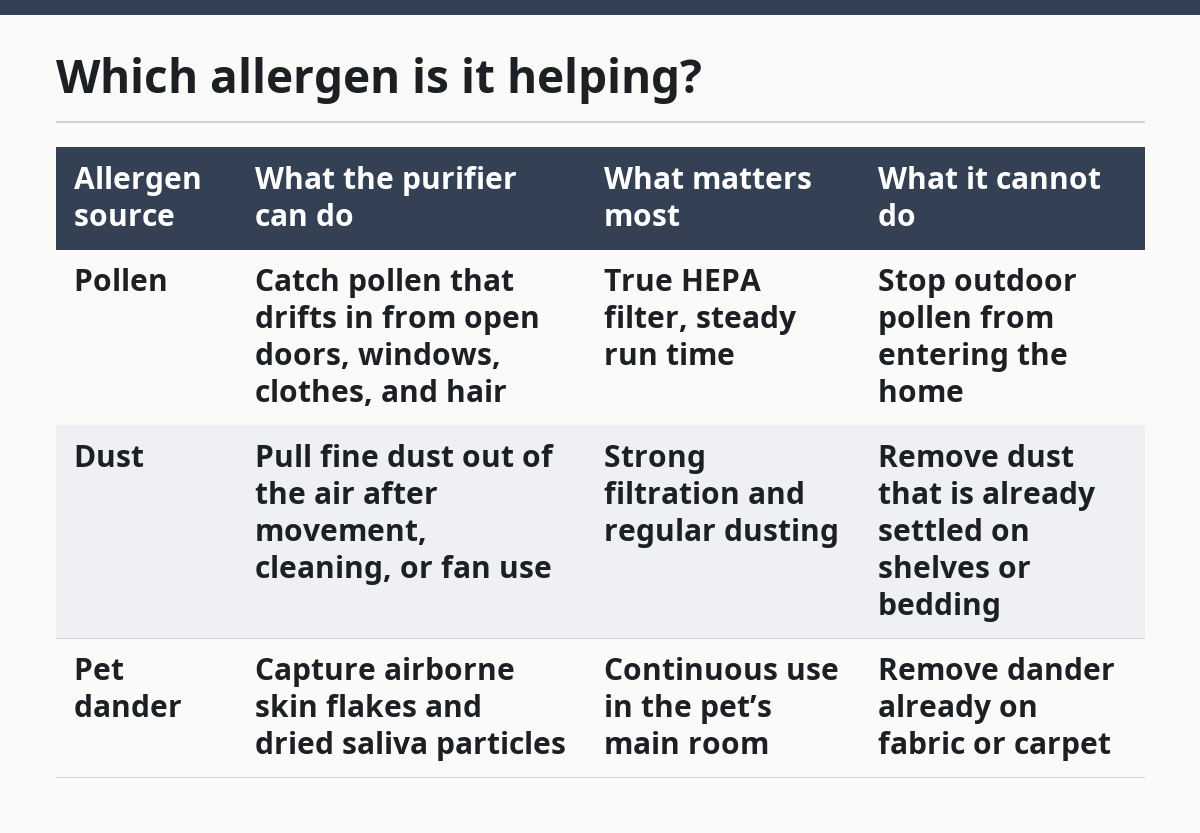
For pollen, the main win is reducing what floats indoors after a high-pollen day. A purifier in the bedroom can help more than one placed in a hallway, because pollen exposure often piles up where you sleep for 7 to 9 hours. For dust, the unit is most useful after movement stirs the room, such as changing sheets or vacuuming. For pet dander, the purifier helps most in the room where the pet spends the most time, especially if the pet sleeps there.
A common mistake is buying for “allergies” without asking which allergen is the problem. A unit that looks powerful on paper may still feel useless if it sits in the wrong room or the filter is not the right type. If your main trigger is pollen, bedroom placement and closed windows matter more than flashy features. If the trigger is pet dander, source control matters more, because a purifier can only catch what is airborne.
How do I choose one for my room?
You choose one by matching the filter, the room, and the way the room is used. A true HEPA unit is the best place to start, then place it where you spend the most time, especially the bedroom. The EPA’s home air cleaner guidance says placement matters because a portable unit only cleans the air it can actually pull through the filter.
A simple picking process
- Start with the allergen. If the problem is pollen, dust, or pet dander, choose a unit with a true HEPA filter rather than a vague “allergen filter” label. The result you want is smaller airborne particle load, not just less odor.
- Choose the main room first. Put the purifier in the bedroom or the room where symptoms hit hardest. A bedroom is often the first room to target because you spend many hours there at once.
- Keep it where air can move. Leave space around the intake and outlet so the fan can pull air, not just churn against a wall or curtain. A blocked unit often feels weak even when it is running.
- Run it when exposure is highest. Keep it on during sleep, cleaning, or when a pet is in the room. Short bursts are less useful than steady use.
- Replace or clean the filter on schedule. A clogged filter slows airflow and weakens capture. The purifier still runs, but the clean-air output drops.
The practical question is whether this one will keep filtering the air in the room where you actually react. That is why a simple true HEPA unit often beats a feature-heavy model that sits unused in the wrong room.
Why does bedroom placement matter so much?
Bedroom placement matters because the bedroom is where allergy exposure can stack up for many hours in a row. If pollen lands on bedding, dust lifts when you move, or a pet sleeps near the bed, you spend the night breathing the same air over and over. The EPA’s advice on portable air cleaners fits that pattern: one room used heavily is often the best place to start. See also CDC indoor allergy guidance and the American Academy of Allergy, Asthma & Immunology for related trigger control advice.
A bedroom purifier should run quietly enough that you will keep it on. If the fan noise is too high, the unit often gets turned off, which defeats the point. A smaller, steady machine in the bedroom is often more useful than a louder one in a room you only pass through. For many people, that single room does more good than trying to treat the whole house at once.
There is also a timing issue. Seasonal allergies often spike before bedtime and after waking, when pollen on hair, clothes, and sheets gets stirred up. A purifier running for several hours can lower that indoor buildup, but it does not replace washing bedding, keeping windows closed on high-pollen days, or changing clothes after coming in from outdoors. It is one layer, not the whole plan.
If the bedroom has a pet, the purifier helps, but the pet is still the source. A dander-heavy room may need more than filtration: frequent vacuuming, washing soft surfaces, and keeping the pet off the pillow area matter too. That is the trade-off many ads skip. The purifier reduces exposure; it does not erase the source.
What are the common mistakes?
The most common mistakes are buying the wrong filter, using the unit in the wrong room, and expecting it to solve a source problem alone. Those mistakes cost comfort, time, and money because the machine runs without changing symptoms much. The fix is usually simple, but it has to be specific.

One mistake is choosing by label instead of filter type. “For allergies” on the box does not tell you much unless the unit uses a true HEPA filter or a clearly stated equivalent standard. Another mistake is placing the purifier too far from where you sleep or sit. Air cleaning is strongest where the machine is actually moving air, not across the hall.
A third mistake is ignoring maintenance. A filter packed with dust cannot keep working at the same level, so the purifier can start strong and fade quietly. The fourth is treating odors and allergens as the same problem. Odor control and particle capture are not identical, and a unit that smells better is not always filtering better.
The table below shows the difference between a useful setup and a weak one.
| Setup | What it does | Why it works or fails |
|---|---|---|
| True HEPA unit in the bedroom, running nightly | Lowers airborne pollen, dust, and dander where exposure is longest | Filters the air you actually breathe for many hours |
| “Allergy” unit in a hallway | Small effect on the room that matters most | The air in the problem room may barely pass through it |
| Filter left unchanged for too long | Performance drops over time | Airflow falls and capture weakens |
| Purifier used with closed windows, cleaning, and pet control | Better overall symptom control | Reduces both airborne particles and source buildup |
A healthy amount of skepticism helps here. If a product promises to “eliminate all allergens,” that claim should be treated as marketing, not a plan. The better question is whether it can reduce airborne particle load in your main room and whether you will keep using it.
What should you expect after you turn it on?
You should expect fewer airborne particles in the room, not a total cure. That means symptoms may ease, but they may not disappear if the source is still active or if the room has heavy fabric, open windows, or a shedding pet. EPA guidance on indoor air cleaning supports this more realistic view: portable air cleaners are one part of reducing exposure, not the whole solution.
The best result is often a slower buildup of symptoms over the day and a better night in the bedroom. That matters most for people who notice congestion, throat irritation, or sneezing after sleeping. If the purifier is in the right room and the filter is the right type, the change is usually more about steady relief than dramatic instant relief.
Because of that, do not expect the machine to replace cleaning. Dusting with a damp cloth, vacuuming, washing bedding, and keeping pets off the bed still matter. For seasonal allergies, closing windows on high-pollen days usually helps more than a purifier alone. For pet dander, grooming and fabric care matter almost as much as filtration.
The simplest rule is this: use the purifier where you spend the most time, keep the filter working, and pair it with source control. That is the setup that gives pollen, dust, and pet dander the least chance to hang in the air.
Sources and standards to know
The EPA’s Guide to Air Cleaners in the Home and Air Cleaners and Air Filters in the Home are useful starting points for the basics of room air cleaning. Those pages explain why portable air cleaners can help with particle exposure and why placement matters. AHAM’s Clean Air Delivery Rate, or CADR, is also a common performance term for room air cleaners, though the exact model choice still depends on the room and the allergen. See EPA indoor air quality guidance and AHAM’s CADR information.
A useful standard to remember is HEPA, which is a filter class, not a vague promise. When a box uses that term loosely, the label deserves a second look. If you are comparing units, compare the filter type, the room it will sit in, and how likely you are to run it every day.
Do air purifiers help with allergies?
Yes, air purifiers can help with allergies by lowering airborne particles such as pollen, dust, and pet dander in the room where they run. The effect is usually strongest in a bedroom or another room used for long periods. They help most when paired with cleaning and source control, not used alone.
What kind of air purifier is best for pollen?
A true HEPA air purifier is the best simple choice for pollen because it captures the fine particles that drift indoors on clothes, hair, and airflow. Bedroom placement matters as much as the filter because pollen exposure often builds overnight. Closing windows on high-pollen days helps the purifier do its job.
Can an air purifier help with pet allergies?
Yes, an air purifier can help with pet allergies by catching airborne pet dander in the room where the pet spends time. It works best when the filter is true HEPA and the unit runs steadily. It will not remove dander already settled on fabric, carpet, or bedding, so cleaning still matters.
Drafted with AI; not yet reviewed by a person.