airpurifierspace.com archive pages explained
Airpurifierspace.com archive pages explained: Airpurifierspace.com archive pages are the site’s older-content lists, grouped by date, topic, or post…

archive card catalog drawers in a room
Last updated: November 18, 2026
Airpurifierspace.com archive pages are the site’s older-content lists, grouped by date, topic, or post listing so you can find past articles without guessing the exact title. They are not the same as the homepage or a sitemap. Think of them as the site’s filing system: one page may show a month, another a topic, and another a list of posts.
Key takeaways
- Archive pages are for browsing older articles, not for starting from scratch.
- Date archives group posts by time, while topic archives group posts by subject.
- A post listing can show several recent or related articles on one page.
- Archives help when you remember a rough time period or topic, but not a full title.
- They are useful for discovery, yet they can be slower than a direct search when you know exactly what you want.
What are airpurifierspace.com archive pages?

Airpurifierspace.com archive pages are the site pages that group published articles into browsable lists. On a content site, an archive page usually sits behind the scenes of the main article flow and collects posts by month, category, tag, or another sorting rule.
That matters because archives answer a different question than a regular article page. A normal article explains one topic, while an archive page helps you scan 10, 20, or more related items without opening each one from the homepage. If the site uses a standard blog setup, the archive page is the place where older articles stay reachable after they fall off the front page.
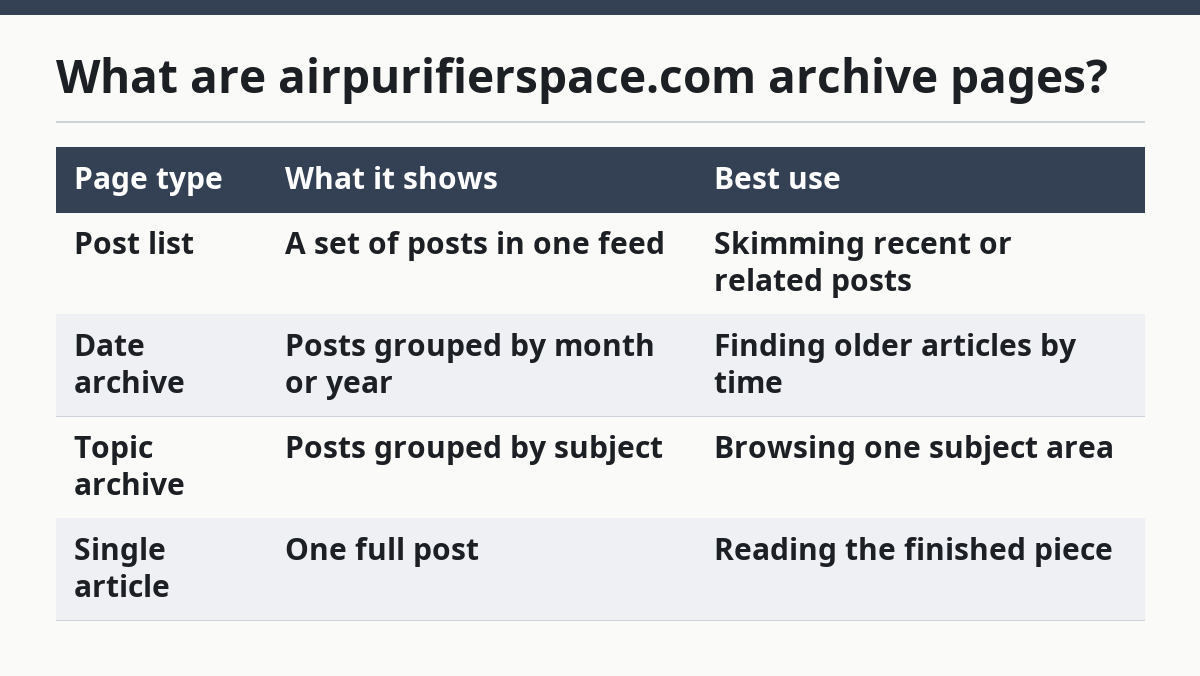
A simple way to picture it is this:
| Page type | What it shows | Best use |
|---|---|---|
| Post list | A set of posts in one feed | Skimming recent or related posts |
| Date archive | Posts grouped by month or year | Finding older articles by time |
| Topic archive | Posts grouped by subject | Browsing one subject area |
| Single article | One full post | Reading the finished piece |
That structure is common on sites built with a content management system. WordPress, for example, uses category and tag archive pages in its normal publishing flow, and its support docs describe those groupings as archive-style navigation. The WordPress support pages on categories and tags show the same basic idea.
Which archive types matter on this site?
The archive types that matter here are date archives, topic archives, and post listings. Those are the three that most clearly explain how airpurifierspace.com organizes older articles for readers.
A date archive groups posts by when they were published. If a post went live in March 2024, a March 2024 archive would collect it with other posts from that same period. A topic archive groups posts by subject, such as a category or tag tied to one air purifier question. A post listing is the broader list view that shows multiple articles in one place, often sorted by newest first.
Here is the difference in plain language:
| Archive type | What it answers | What it is bad at |
|---|---|---|
| Date archive | “What was published around this time?” | Finding a topic with no time clue |
| Topic archive | “What else did the site say about this subject?” | Showing the full timeline of posts |
| Post listing | “What recent or related posts are here?” | Narrowing to one exact article fast |
That difference matters because a reader often arrives with only part of the clue. If you remember the topic but not the month, a topic archive helps more. If you remember the month but not the subject wording, a date archive is the better fit. If you only want a quick scan of what is on the site, a post listing does the job.
How do archive pages help readers?
Archive pages help readers by shrinking a large site into smaller, readable groups. Instead of forcing someone to scroll through every article, they turn a long list into a short path: one month, one topic, or one post feed at a time.
That saves effort in a very practical way. A reader who is comparing older air purifier articles may not know the exact title, but may know the rough subject or period. An archive page gives a way to search by memory instead of by perfect keyword. It also helps when a site has many older articles that no longer appear on the homepage.
Archive pages also support sorting. On a standard content site, sorting usually means newest first, oldest first, or grouped by taxonomy such as topic. That gives the reader a choice that a single article page cannot provide. The trade-off is that archives can become long and repetitive if the site publishes often, so they are better for browsing than for precise lookup.
The main benefit is discovery. The main drawback is noise. A post list can show 15 items when you only care about 1, and a date archive can hide a useful article under a month you would never think to check.
How do you use an archive page to find older articles?
You use an archive page by starting with the strongest clue you have, then narrowing the list in 3 to 4 steps. That is the fastest way to make a long archive page useful instead of overwhelming.
- Open the archive page that matches your clue. If you remember when the article was likely published, choose the date archive; if you remember the subject, choose the topic archive.
- Scan the titles first, not the snippets. Titles usually tell you faster than the first paragraph whether a post is the one you want.
- Watch the sorting order. If the page is arranged newest first, recent posts will appear near the top; if it is oldest first, the title you want may be farther down.
- Open the most likely post in a new tab if the browser allows it. That keeps the archive page available in case the first pick is wrong.
- Use the archive’s structure as your filter. If the page has 12 posts and the one you want is not there, switch to a different archive type instead of scanning the same list again.
The mistake many readers make is treating every archive page as the same tool. A date archive is not ideal when you only know the topic, and a topic archive is not ideal when you only know the time period. Choosing the right archive type first saves minutes, not seconds.
What are the limits of archive pages?
Archive pages are helpful, but they are not a full search system. They work best when you already have one clue, such as a topic, a month, or a rough title.
The biggest limit is coverage. If an archive page only includes posts from one category or one time range, it may leave out related material that sits somewhere else on the site. That means a reader can miss a useful article simply because it was tagged differently. Another limit is depth: a long archive may bury older posts several scrolls down, which makes it slower than a direct search for a known title.
There is also a sorting trade-off. Newest-first sorting is easy to follow, but it pushes older posts down the page. Oldest-first sorting does the opposite and can make current material harder to spot. Neither choice is wrong; each serves a different kind of reader.
This is why archive pages are not the best tool for every job. They are strong for browsing and weak for exact lookup. If someone needs a specific article and already knows the title, an archive page is usually the slower path. If someone wants to scan related posts or trace older content, it is the right path.
How do archive pages fit with site structure and navigation?
Archive pages fit into site structure by acting as mid-level paths between the homepage and a single article. They are part of the site’s navigation logic, but they are not the whole navigation system.
That distinction matters. A homepage points to what the site wants to feature now. A single article gives one finished answer. An archive page sits between them and helps the reader move through groups of content, usually in sets of 5, 10, or more posts. This is why archive pages belong in the larger “site structure and navigation” picture: they help readers travel through the site without making every page a starting point.
A useful mental model is this:
- Homepage: current spotlight
- Archive page: grouped back catalog
- Article page: one specific piece
If a site is well structured, archive pages reduce friction for readers who return later. They keep older posts reachable without crowding the main page. They also give the site a cleaner way to sort content by date or topic rather than by guesswork. That said, they work best when the labels are clear and the sorting makes sense.
For broader structure questions, this page sits under the site’s navigation and content organization area, not under a search how-to or a glossary. That keeps the purpose narrow: explain what the archives are and how to use them, not how to search the whole site.
What is an archive page on airpurifierspace.com?
An archive page on airpurifierspace.com is a grouped list of older posts. It can be built around date, topic, or a general post listing, so readers can browse content without needing the exact article title. That makes it useful for backtracking through the site’s published material.
How do archive pages help on airpurifierspace.com?
Archive pages help on airpurifierspace.com by sorting older articles into smaller sets. A reader can use a date archive to check a month, a topic archive to scan one subject, or a post list to see related posts in order. They are most useful when the reader has a rough clue, not a precise title.
Drafted with AI; not yet reviewed by a person.