Portable vs Whole-Home Air Purifiers: Which Setup Fits Your Space?
For most homes, a portable air purifier is the better fit for 1 room, while whole-home works best in 1 ducted house with an HVAC system that can support…
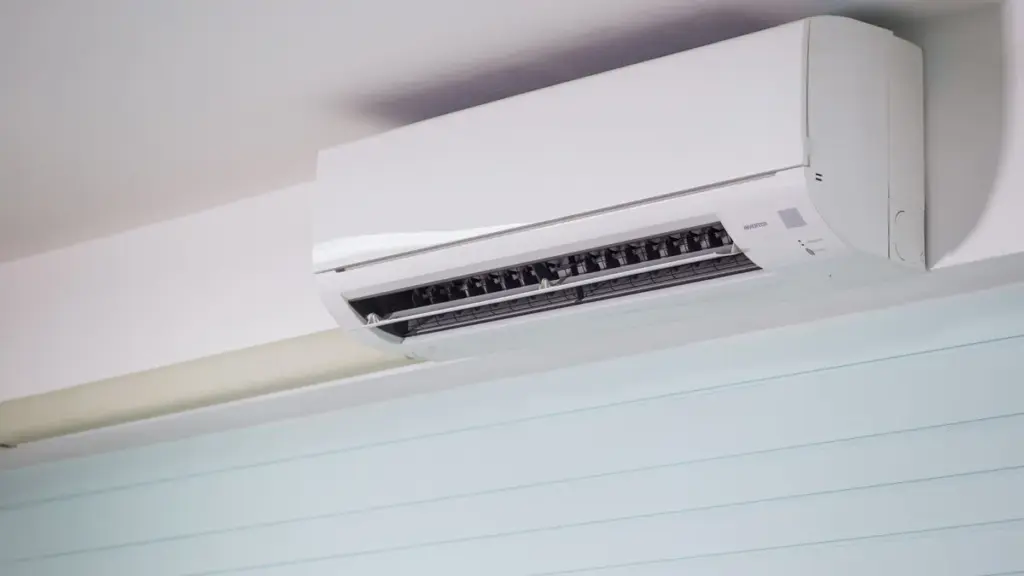
Close-up of a wall-mounted air conditioner
Last updated: November 28, 2026
Quick answer: for most homes, a portable air purifier is the better fit for 1 room, while whole-home works best in 1 ducted house with an HVAC system that can support central filtration. Portable vs Whole-Home Air Purifiers: Which Setup Fits Your Space? is mainly a question of coverage, installation, and maintenance, not brand hype. If the goal is to clean one room, rent without major work, or avoid adding another maintenance chore to the air handler, portable wins. If the goal is to treat the whole house from one point, whole-home can win when the ductwork and HVAC setup are already in place; consult an HVAC professional and check guidance from the EPA before tying anything into the central system.
This comparison is about how the systems fit a real home, not about brand hype. The deciding factors are coverage, installation, maintenance, and whether the air handler and ductwork can do the heavy lifting. For room sizing, AHAM uses CADR ratings to match portable units to space.
Key takeaways
- Portable units are the safer pick for 1 room, a rental, or a space that changes often.
- Whole-home units make sense when the home already has ductwork and the HVAC system can support central filtration.
- The biggest trade-off is control versus reach: portable gives room-by-room control, whole-home gives central coverage.
- Whole-home setups usually ask more of the existing HVAC system, while portable units ask more of the person moving them from room to room.
- If the issue is 1 bedroom, a nursery, or a home office, portable is usually the cleaner fit.
- EPA guidance notes that portable air cleaners can help reduce indoor particle levels, especially when used in the room where the problem is concentrated.
Portable vs whole-home air purifier: which fits your space?
Portable air purifiers fit a single room or a few rooms you care about most, while whole-home air purifiers fit the entire house through the HVAC system. That is the core difference, and it changes everything else: cost, installation, upkeep, and how much control you keep over airflow.
Portable units sit in the room you want to improve. They need a plug, floor space, and filter changes. Whole-home units tie into the air handler or ductwork, so they work through the central system instead of in one spot. That means one setup can cover the house, but it also means the home needs the right layout and the right kind of HVAC backbone.
The common mistake is treating “whole-home” as an automatic upgrade. It is not. A central system is only a good answer if the home has ducts, the HVAC design can handle it, and the problem is broad enough to justify the added complexity. If the issue stays inside 1 bedroom, the extra reach is wasted.
Here is the honest split: portable is a room tool, whole-home is a house tool. The right one is the one that matches where the air problem actually lives.
How does a portable air purifier work day to day?
A portable air purifier works best when 1 room matters more than the rest of the house. It can be a practical way to get cleaner air in a bedroom, nursery, or office because the unit sits where the air problem is strongest.
Its biggest strength is control. A portable unit can be moved, turned off, or run only in the room that needs it. That matters in homes with uneven use, such as a downstairs den used for 3 hours a day and an upstairs bedroom used every night. It also matters in rentals, where changing the HVAC system is usually off the table. EPA guidance on home air cleaners also supports using a portable unit where the source or exposure is concentrated.
The drawbacks are just as real. A portable unit does not clean the whole house at once, and it cannot fix a stale hallway, a closed kitchen, or a distant bedroom unless it is moved there. It also adds visible clutter and another filter to track. If the home has 4 occupied rooms and the same problem shows up in all of them, 1 portable unit may feel like too little coverage.
Portable setups are the better fit for people who want the least disruption, the least installation work, and the most flexibility. They are the wrong choice for anyone who wants a central answer to a whole-house problem and does not want to manage the unit room by room. For upkeep tips, see how to replace air filters.
When does a whole-home air purifier make more sense?
A whole-home air purifier makes more sense when the entire house needs cleaner air and the HVAC system can support it. It is the stronger choice for a homeowner who already has ductwork, uses the air handler regularly, and wants 1 central system instead of several small ones.
The main advantage is reach. Air moves through the house instead of only through a single room, so the setup can serve bedrooms, living areas, and hallways without being moved around. That is useful in larger homes and in layouts where doors stay open and the HVAC system runs often.
The trade-off is installation and dependence on the existing system. A whole-home purifier is not a casual add-on like a plug-in box. It needs the right HVAC setup, and once it is part of the central system, it depends on that system being maintained. If the ductwork is leaky, the air handler is undersized, or the layout is awkward, the whole-home route can become more trouble than it is worth. If you are comparing system options, our HVAC maintenance checklist is a useful next step.
This option is also a poor match for renters and for homes without ductwork. If there is no central path for air to move through, the whole-home idea stops making sense. It is strongest in owned homes with standard HVAC systems, and weakest where the structure itself fights the installation.
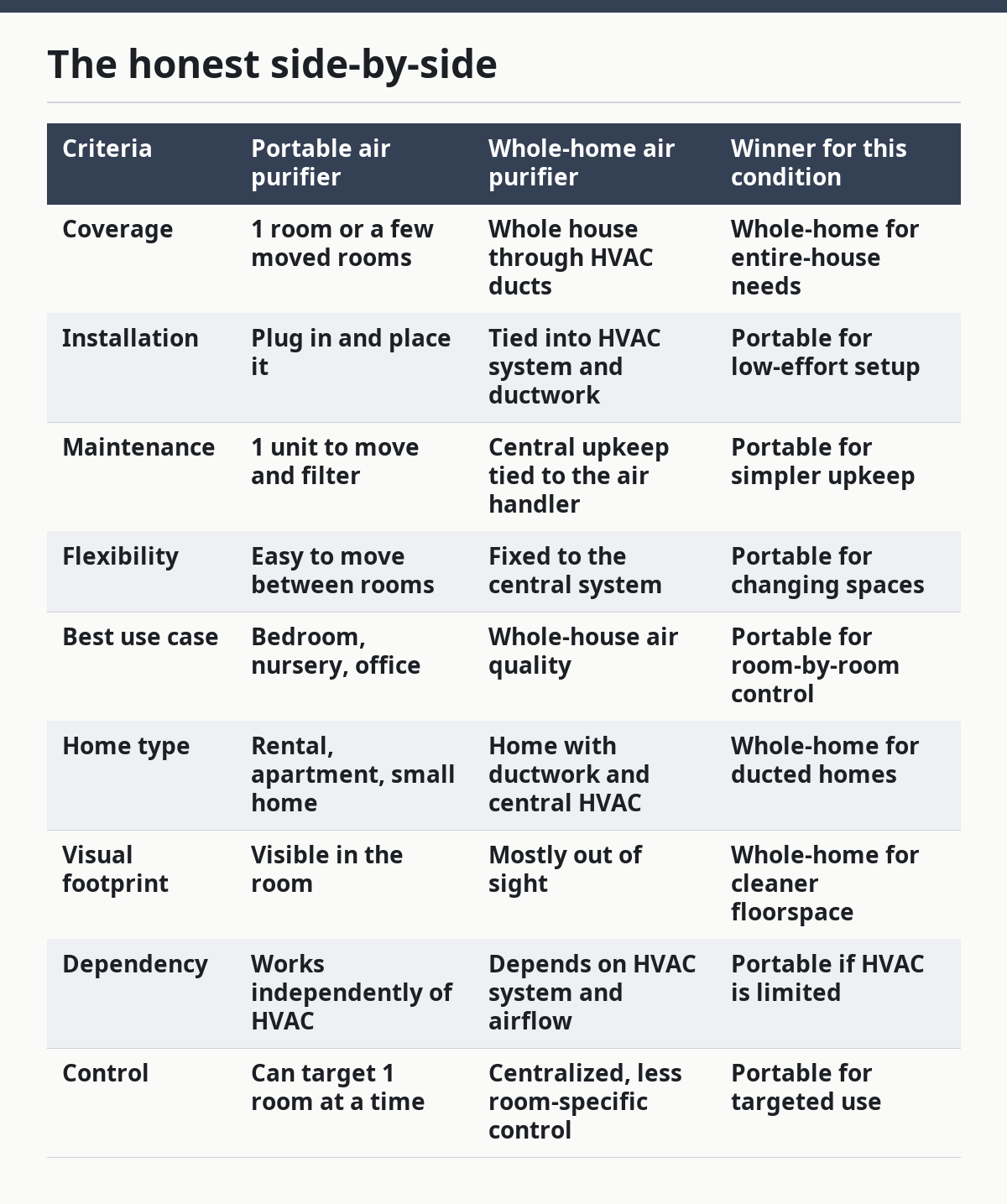
The honest side-by-side
The portable setup wins on flexibility, while the whole-home setup wins on whole-house reach. The table below shows where each one is strongest and which setup fits each condition better.
| Criteria | Portable air purifier | Whole-home air purifier | Winner for this condition |
|---|---|---|---|
| Coverage | 1 room or a few moved rooms | Whole house through HVAC ducts | Whole-home for entire-house needs |
| Installation | Plug in and place it | Tied into HVAC system and ductwork | Portable for low-effort setup |
| Maintenance | 1 unit to move and filter | Central upkeep tied to the air handler | Portable for simpler upkeep |
| Flexibility | Easy to move between rooms | Fixed to the central system | Portable for changing spaces |
| Best use case | Bedroom, nursery, office | Whole-house air quality | Portable for room-by-room control |
| Home type | Rental, apartment, small home | Home with ductwork and central HVAC | Whole-home for ducted homes |
| Visual footprint | Visible in the room | Mostly out of sight | Whole-home for cleaner floorspace |
| Dependency | Works independently of HVAC | Depends on HVAC system and airflow | Portable if HVAC is limited |
| Control | Can target 1 room at a time | Centralized, less room-specific control | Portable for targeted use |
Which one should most people choose?
Portable air purifiers should be the default choice for most people, because most people are trying to solve a room problem, not redesign the house. A single bedroom, home office, or nursery is easier and cheaper to address with a unit that sits in that room than with a central system that requires ductwork and HVAC coordination.
Whole-home air purifiers can be the better choice when the home already has the right infrastructure and the need is broad. If the house has ductwork, the air handler is already central to comfort, and the goal is to treat the whole space instead of 1 corner, the central option is cleaner and more integrated. It also avoids the need to manage separate units in multiple rooms. Consult a qualified HVAC professional if you are unsure whether the system can handle added filtration.
The honest downside for whole-home is commitment. It asks for more planning, more installation, and more reliance on the existing HVAC system. The honest downside for portable is scale. 1 unit cannot do the work of a central system across a large home.
Portable is the better choice for renters, smaller homes, and people who want control room by room. Whole-home is the better choice for owners with standard ductwork who want 1 system to cover the house. Whole-home is the wrong choice if the home lacks ducts or if the problem is isolated to 1 space. If you are comparing room and house options, our portable air purifier guide and whole-home filtration guide can help.
When should you reconsider both options?
Reconsider both options if the home has no usable ductwork, if the HVAC system is already struggling, or if the air quality problem is not really a purifier problem. In those cases, the right answer may be ventilation, source control, or fixing the room itself before buying any air-cleaning setup.
A portable unit can only do so much in a space with poor airflow or a layout that traps air in a corner. A whole-home unit can also miss the mark if the central system is not moving air well through the house. In both cases, the equipment is only part of the answer.
This is also the point where a buyer should stop comparing gadgets and start comparing the home. A room with a closed door, a sticky source of dust, or weak circulation may need a different fix than a purifier. If the house has no ductwork, whole-home should fall off the list right away. If 1 room is the problem and the rest of the home is fine, portable remains the cleaner call.
The verdict
Choose portable if you need cleaner air in 1 room, you rent, or you want the simplest setup with the least dependence on the HVAC system. Choose whole-home if you own the house, already have ductwork, and want 1 central solution for the entire home. Neither if the home has no practical ductwork or if the real problem is a ventilation issue that a purifier will not solve.
Drafted with AI; not yet reviewed by a person.