When to Clean vs Replace an Air Purifier Filter
Clean only the washable or removable pre-filter, and replace the main filter when it is torn, warped, saturated, or not made to be washed. For this topic…
Hands installing a round air filter on a car engine
Last updated: November 27, 2026
Quick answer: clean only the washable or removable pre-filter, and replace the main filter when it is torn, warped, saturated, or not made to be washed. For this topic, When to Clean vs Replace an Air Purifier Filter, the key cutoff is simple: if the manual does not allow washing, replace the part. A pre-filter is often the part you clean first; an activated carbon filter is more often replaced once odors start to linger.
Key takeaways
- Cleaning helps with dust on a pre-filter or a washable filter, but it does not revive a filter that is worn out.
- A hepa filter and many activated carbon filters are usually replace-only parts.
- Odor that sticks around after cleaning points to a spent carbon layer, not just surface dirt.
- Tears, warping, collapsed pleats, or a broken frame mean replacement, even if the filter still looks partly clean.
- The owner’s manual wins every time; the brand’s instructions beat general advice.
Clean or replace air purifier filter?
Clean a filter when the filter is designed for cleaning and the problem is surface buildup; replace it when the filter media itself is done. That split matters because an air purifier filter can look dirty long before it is truly finished, and it can also look acceptable while being damaged or clogged deep inside.
A pre-filter is the easiest case. It catches hair, lint, and larger dust before they reach the main filter, so a quick clean often restores airflow. A washable filter follows the same logic, but only if the label or manual says it can be washed and dried.
A hepa filter is different. True hepa media is made to trap fine particles in a dense mat of fibers. Once that mat is loaded or damaged, washing usually does more harm than good. An activated carbon filter also has a limit, but the limit is chemical, not visual: once the carbon sites are used up, smells can return even if the surface still looks dark and intact.
If the question is “clean or replace?”, the honest answer is usually: clean the pre-filter, check whether the middle filter is washable, and replace the main filter when the manual says to. That rule does not fit people trying to save a spent hepa cartridge by rinsing it, and it does not fit anyone trying to rescue an odor-saturated carbon filter with soap and water.
The EPA’s Guide to Air Cleaners in the Home is a useful starting point for understanding filter types. ENERGY STAR also explains room air cleaners and their maintenance expectations on its product pages, and the American Lung Association gives a plain-language overview of air cleaners and filter care.
Which filter types can be cleaned?
A pre-filter is the most likely part you can clean, while a hepa filter is the least likely. That is the simplest rule to keep in mind before you open the unit and start shaking dust around the room.
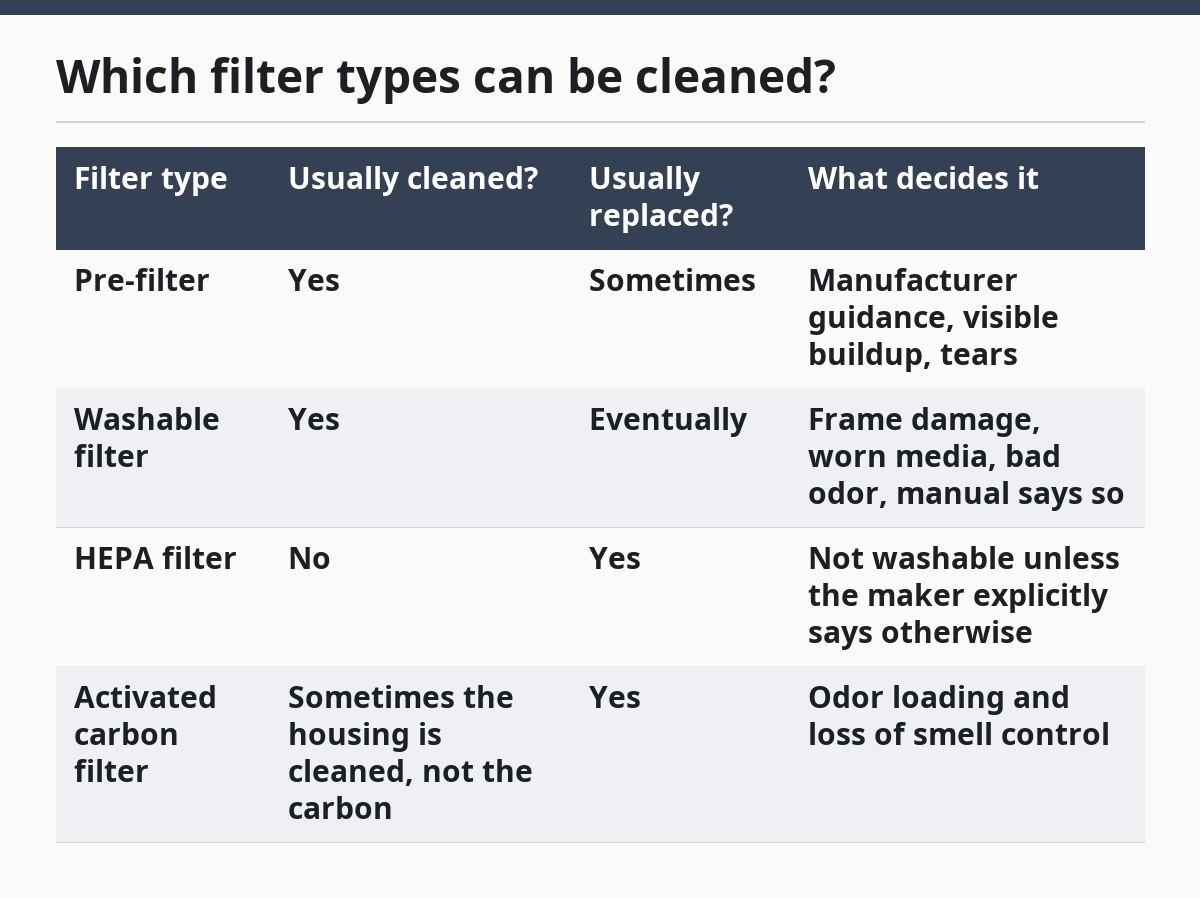
Here is the quick comparison:
| Filter type | Usually cleaned? | Usually replaced? | What decides it |
|---|---|---|---|
| Pre-filter | Yes | Sometimes | Manufacturer guidance, visible buildup, tears |
| Washable filter | Yes | Eventually | Frame damage, worn media, bad odor, manual says so |
| HEPA filter | No | Yes | Not washable unless the maker explicitly says otherwise |
| Activated carbon filter | Sometimes the housing is cleaned, not the carbon | Yes | Odor loading and loss of smell control |
A pre-filter often sits closest to the air intake and catches the biggest debris. Because of that location, it may be the only part that needs regular cleaning in a unit with a separate hepa cartridge. Removing lint from the pre-filter can also help the rest of the system breathe more easily.
A washable filter is the exception, not the rule. If the manual says it can be rinsed, cleaned, or vacuumed, follow that exact method. Some washable filters still need replacement when the mesh frays, the frame bends, or the cleaning no longer clears the surface.
A hepa filter is usually replace-only because water can damage the fine fiber structure. The same caution applies to many activated carbon filters: the carbon can be embedded in a layer, pouch, or sheet, and washing does not restore the odor-absorbing material inside. That is why a filter can be visually dark and still be partially useful, or look clean and still be spent.
How do I tell if a filter is still usable?
A filter is still usable if it is intact, seated correctly, and performing the job it was built to do. The three checks that matter most are physical condition, airflow, and smell control.
Use this sequence:
- Turn the purifier off and open the filter compartment as the manual shows. Pull the filter out in one piece, so dust does not spill into the unit.
- Look at the frame and media under good light. A tear, crushed pleat, bent frame, or loose seal points to replacement, not cleaning.
- Check the pre-filter first. If it holds a layer of lint or hair, clean that part and see whether airflow improves after reassembly.
- Smell the exhausted air after the unit has run for a short period. If odors still hang around after a cleaned pre-filter and a dust-free room, the carbon layer may be loaded.
- Put the filter back only if it matches the manual’s instructions for fit, drying time, and reinstallation. A damp washable filter can cause odor or mildew inside the machine.
There is a useful difference between a dirty-looking filter and a failed one. Dust on the outside does not automatically mean the filter core is dead. A cleanable pre-filter can look rough and still work after washing. A hepa filter can look only lightly gray and still need replacement because the fibers are clogged in ways the eye cannot measure.
One common mistake is cleaning the wrong layer because it is the easiest thing to reach. That can cost airflow and shorten the life of the purifier if dust gets pushed deeper into the housing. Because of that, many owners should treat the pre-filter as the first line of defense and the hepa or carbon layer as a consumable part unless the manual says otherwise. For related guidance, see the air purifier maintenance and air purifier buying guide pages.
When does odor mean replace the filter?
Odor that returns quickly after cleaning usually means the activated carbon filter is spent and should be replaced. Dust smell, cooking smell, pet odor, and smoke residue all load carbon over time, and cleaning the outside does not restore the inside of the carbon layer.
This is the part of the decision that trips people up. A filter can still catch particles while losing odor control. That means the purifier may seem “fine” if you only watch the fan or the dust level, but the room still smells stale after a few minutes or hours. That is a replacement clue, not a cleaning clue.
A bad smell can also come from the purifier housing, not just the filter. If the filter is a washable type and you rinse it, let it dry fully before putting it back. A filter that goes back in damp can create a musty smell that sounds like carbon failure but is really trapped moisture.
A good rule: if the odor changed from “dusty” to “stale” or “smoky” even after a proper clean, stop trying to scrub it back to life. Replace the carbon part if the model uses a separate one, and replace the full filter assembly if the carbon is built into the main cartridge.
This is why the activated carbon layer is the least forgiving part of an air purifier. It does not announce failure with a hole or a crack. It fades in performance first, which is harder to notice than a torn pre-filter.
What does the manufacturer guidance override?
The manufacturer guidance overrides general advice because filter construction differs by model, not just by brand name. If the manual says “replace only,” do not wash the filter to save money or stretch its life.
That rule matters for hepa filters in particular. Some products use the word “filter” loosely, but the physical design may still be replace-only. Others bundle a pre-filter, carbon layer, and hepa stage into one cartridge, which means one damaged layer can force replacement of the whole unit.
Read the manual for three clues: whether the part is washable, whether it must dry before reinstalling, and whether the whole cartridge is meant to be changed at once. Those details are more reliable than the color of the filter or the number of weeks it has been in use.
A short maintenance routine also helps prevent false decisions. If a unit has a removable pre-filter, clean that first. If the airflow is still weak or odors still linger, then the main filter deserves a closer look. That keeps the replaceable part from being blamed for a problem caused by lint, pet hair, or a clogged intake screen.
For a broader ownership view, the hub on air purifier maintenance and ownership can help with the rest of the routine; this page stays focused on the clean-versus-replace call.
Cleaning vs replacing: which choice fits your filter?
Cleaning is the better choice for surface dust on a washable filter or a removable pre-filter; replacing is the better choice for a damaged hepa filter or a carbon layer that no longer controls odor. The best option depends on the part, not the purifier as a whole, and the manual should decide the final call.
| Option | Best for | Main advantage | Main drawback | Not for |
|---|---|---|---|---|
| Clean | Pre-filters, washable filters, light surface dust | Lower waste, faster turnaround, can restore airflow | Won’t fix worn media or trapped odors | Heavily damaged filters, non-washable hepa filters |
| Replace | HEPA filters, spent carbon filters, torn or warped parts | Restores full filter function when the old one is finished | Costs more and creates more waste | Filters that are clearly washable and still intact |
Because the filter can only work as designed when it is intact, the safest choice for most owners is to clean only the parts the maker says are washable and replace the rest. That approach protects airflow without gambling on a filter that has already failed in the one way you cannot see. For maintenance basics, the EPA indoor air quality page and ENERGY STAR room air cleaner guidance are both useful references.
This recommendation is wrong for anyone hoping to wash a standard hepa filter back into shape. It is also wrong for anyone ignoring a carbon filter that has lost odor control but still “looks okay.” The clean-first mindset saves money only when the filter was built for cleaning in the first place.
FAQ
can i wash a hepa filter?
A hepa filter is usually not washable, and washing it can damage the fiber structure that captures fine particles. Some brands make washable-looking filters, but those are not standard hepa cartridges unless the manual says so. If the instructions do not clearly allow washing, replace it instead of rinsing it.
how do i know if a filter needs replacing?
A filter needs replacing when it is torn, warped, hard to seat, or no longer controls dust or odor the way it should. A strong sign is a carbon filter that still leaves smells in the room after cleaning the pre-filter and running the purifier for a while. If the manual says the part is replace-only, that is enough on its own.
can a dirty filter be cleaned and reused?
A dirty filter can be cleaned and reused only if it is a washable filter or a removable pre-filter made for that purpose. A dirty hepa filter usually should not be cleaned and reused, because the media can be damaged even when the surface dirt comes off. If the filter is crumbling, bent, or smells stale after cleaning, replace it.
Drafted with AI; not yet reviewed by a person.



1 thought on “When to Clean vs Replace an Air Purifier Filter”