What CARB Certification Means for Air Purifiers
CARB certification is a California compliance label, and the key number is 0.050 parts per million for ozone-emission limits. In the topic of What CARB…

What CARB Certification Means for Air Purifiers
Last updated: November 28, 2026
Quick answer: CARB certification is a California compliance label, and the key number is 0.050 parts per million for ozone-emission limits. In the topic of What CARB Certification Means for Air Purifiers, that usually means the unit is represented as meeting California’s indoor-air rules rather than being a broad quality seal.

Key takeaways
- CARB certification is about ozone emissions, not a promise that a purifier cleans better than other models.
- The label matters because it tells you the unit is allowed to be sold and used in California under state rules.
- A certified unit can still be a poor fit if you do not need its room size, filter type, or noise level.
- The certification label on the box, manual, or product page is usually the quickest check, along with the model name.
- CARB certification does not answer every air-quality question; it only tells you something specific about compliance.
What does CARB certification mean?
CARB certification means an air purifier has been registered as meeting California’s air cleaner requirements, including an ozone-emission limit of 0.050 parts per million. That is the main point of the label, and it is why people use CARB certification as a safety screen when they shop.
For a buyer, the label signals compliance, not performance magic. A CARB-certified air purifier may still clean a room better or worse depending on filter design, fan strength, and how well it matches the room. The certification only says the device meets the state’s rules for ozone output.
This matters because some air-cleaning devices use technology that can create ozone, intentionally or as a byproduct. CARB certification is one way to separate a standard filter-based purifier from products that may add ozone to the air you breathe. The California Air Resources Board explains the program on its air cleaner certification page.
A generic article often misses this point and makes CARB sound like a broad quality seal. It is narrower than that. It does not rate filter life, room coverage, or particle capture. It is a compliance label tied to one specific indoor-air concern.
Why does the label matter to a buyer?
The label matters because it helps you avoid guessing about whether the purifier is allowed in California and whether the maker says it meets the state ozone rule. If you are comparing two devices that look similar on a retail page, the CARB label can separate a simple HEPA-style purifier from one that uses a process you may not want in your home.
This is especially useful when a product page is vague. Some listings focus on marketing language and skip the compliance details. A CARB certification label gives you a concrete check: the model name should match the certification listing, and the product should be represented as compliant with California’s air cleaner rules.
The label is also useful because it is easy to misread a product’s features. A unit can say “air purifier” on the front and still not be the kind of device a cautious buyer wants. The CARB label does not tell you everything, but it does tell you that the product passed a specific regulatory hurdle. The U.S. Environmental Protection Agency also has a useful overview of indoor air cleaning devices for shoppers sorting through purifier claims.
A CARB label is not the same thing as “best for allergies,” “quiet,” or “most effective.” It is a compliance signal. If your only goal is lower ozone exposure from an indoor air cleaner, this is the label to check first. If your goal is dust capture in a large living room, you still need to look at the rest of the product specs and the air purifier safety and standards context.
How do I check if an air purifier is CARB certified?
You check CARB certification by matching the exact model name on the product to the certification label or listing. The quickest path is usually the box, the manual, the manufacturer’s product page, or the retailer listing that names the California Air Resources Board compliance status.
Here is the simple process:
-
Find the exact model number on the unit, box, or manual.
A name like “Model X200” is not enough if the seller also uses a size code or revision mark. The result you want is the full model identifier. -
Look for the certification label or wording tied to California.
The label should point to CARB compliance, not just general “eco” language. If the wording is missing or fuzzy, treat that as a warning sign and, if needed, consult a qualified retailer or the manufacturer for confirmation. -
Check the product page for the same model name.
The model on the page should match the model on the label. If the seller shows one name and the manual shows another, do not assume they are the same device. -
Confirm that the purifier is described as meeting California’s air cleaner rule.
A correct listing should not force you to guess. The wording should make the compliance status plain. -
If the device uses a feature that might change emissions, read the fine print.
Some products include extra modes or add-on technologies. A CARB-certified listing should still be tied to the exact configuration being sold.
This takes only a few minutes, but it saves you from buying a device that looks compliant in photos and turns out not to be the model you thought it was. If you are comparing products in a store, bring the model name with you. If you are shopping online, keep the manual PDF open in another tab and compare it with the product page.
What should the certification label say?
The certification label should connect the product to California’s air cleaner requirements and identify the unit clearly enough that you can match it to the model you are buying. A vague sticker that says only “safe” or “clean air” is not enough.
A useful label check usually has three parts: the model name, the compliance wording, and the manufacturer’s identification. If any one of those is missing, the label becomes much less helpful. You should not have to infer the product’s status from a slogan.
Here is a simple way to read the label against the product, and if you are unsure, consult the manufacturer or a qualified professional before buying:
| What you see | What it should mean | What to do |
|---|---|---|
| Exact model name | The label belongs to the purifier you are buying | Compare it with the box and manual |
| California / CARB wording | The model is represented as meeting state air cleaner rules | Treat it as a compliance signal, not a performance claim |
| No clear model match | The label may not apply to this unit | Do not rely on the label alone |
| Marketing words only | The label may be trying to sound official without proving compliance | Look for the manufacturer’s certification details |
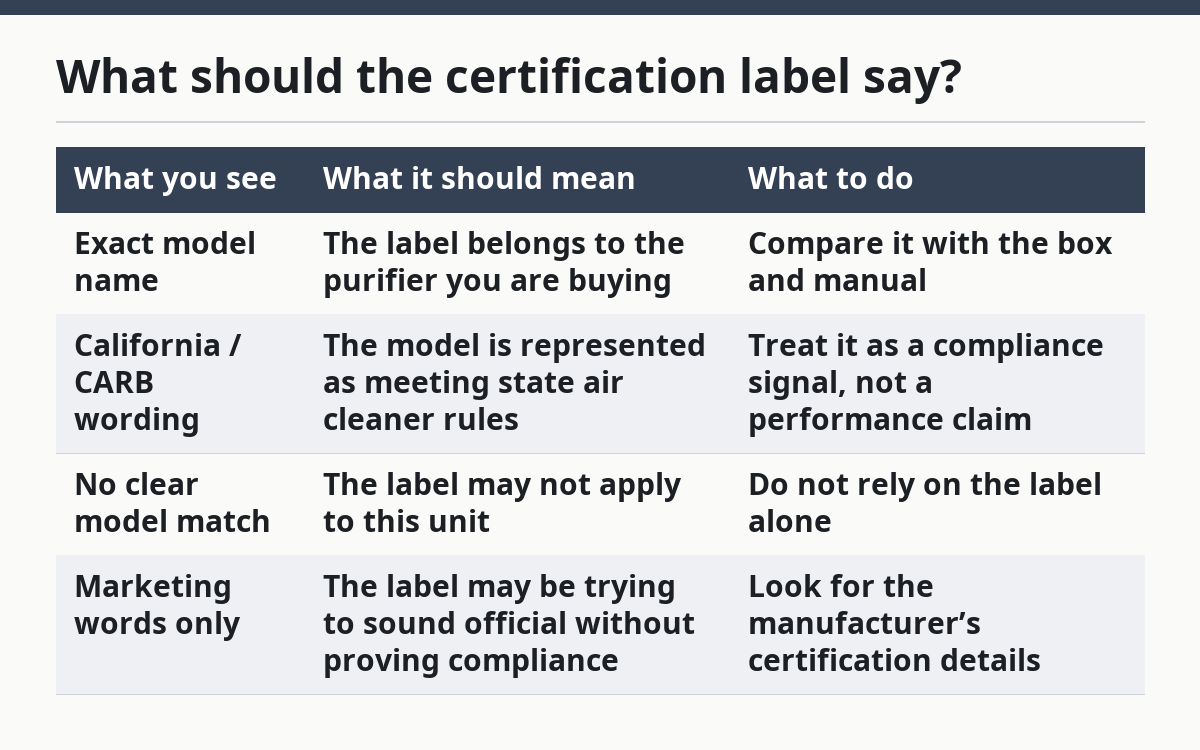
The common mistake here is trusting a badge without checking the model. That costs you clarity. A certification label that belongs to a different version of the same product line does not help you. The fix is simple: match the exact model name before you buy, then verify it against the CARB certification page.
Where does CARB fit with ozone and indoor air safety?
CARB fits into indoor air safety as a rule about ozone output from air cleaning devices. It does not tell you that an air purifier removes particles, odors, or smoke well. It only tells you that the product is being sold as meeting California’s ozone-related limit.
That distinction matters because ozone is not the same thing as particle filtration. A HEPA-type purifier can be CARB-certified and still be just one piece of a larger indoor-air plan. You may still need source control, ventilation, and a filter that matches your room size. CARB certification is one check on the box, not the whole plan.
The label is also not a green light to ignore product design. A unit can be compliant and still be noisy, underpowered, or poorly suited to your space. If you buy only on the CARB label, you may end up with a safe-looking product that does not solve the problem you actually have.
This is why the certification is most useful as a filter, not a final answer. It helps you exclude a class of products that do not fit your safety threshold. It does not choose the right purifier for you. A reader who wants the full safety picture should treat this page as one part of the larger air purifier safety and standards hub, alongside the EPA’s indoor air cleaning devices guidance.
Who is CARB certification for — and who is it not for?
CARB certification is for buyers who want a purifier that fits California’s indoor air rules and want a quick way to screen out higher-risk ozone-emitting devices. It is especially useful if you shop online and see a mix of purifiers, air cleaners, and devices that are not clearly explained.
It is not for someone who thinks the label means “best purifier.” That is the wrong use of the label. If your main concern is room size, filter replacement, or sound at night, CARB certification will not answer those questions for you. You still need to compare the rest of the spec sheet.
It is also not a shortcut for deciding between every possible air-cleaning technology. Some buyers want to know whether a device uses ionization, ozone, or another method. That is a separate question and belongs on a different page. CARB certification only tells you that a particular model is represented as meeting California’s air cleaner standard.
The honest trade-off is simple: CARB certification gives you a clear compliance signal, but it narrows the field more than it ranks the field. If you want the safest first pass, use the label and then compare the actual purifier specs. If you want the best fit, use the label and then compare room size, filter type, and noise.
What does CARB certified mean?
CARB certified means the air purifier has been listed as meeting California Air Resources Board requirements for air cleaners, including the ozone-emission limit tied to that rule. It is a compliance term, not a performance score. The label tells you something specific about emissions, not whether the purifier is the quietest or most effective model.
Is CARB certification important for air purifiers?
CARB certification is important if you want a simple check on whether the purifier meets California’s air cleaner rules. It is especially helpful when you are trying to avoid products that may add unwanted ozone. It is not the only thing that matters, because room coverage, filter type, and noise still decide whether the purifier works for your space.
How do I check if an air purifier is CARB certified?
Check the exact model name on the box, manual, or product page, then look for wording tied to California Air Resources Board compliance. The model number has to match the certification label or listing. If the seller is vague, or if the model names do not line up, treat that as a warning and verify before you buy.
Can a CARB-certified air purifier still be a poor fit?
Yes. A CARB-certified air purifier can still be noisy, underpowered, or too small for a room. The label only addresses compliance, not performance fit.
Does CARB certification guarantee better cleaning?
No. CARB certification does not measure dust removal, smoke capture, or room coverage. It only signals compliance with California’s ozone-related rule.
Should I check the model number before I buy?
Yes. The model number should match the certification label, manual, and product page. If it does not, do not assume the unit is the same one that was certified.
Is CARB certification enough by itself?
No. It is one useful check, but you still need to compare room size, filter type, and noise. For the full picture, use the label as a first screen and then review the rest of the specs.
Drafted with AI; not yet reviewed by a person.