Are Air Ionizers Worth It?
Are Air Ionizers Worth It, or Just a Feature to Avoid?: an air ionizer is worth it only in one narrow case—when you want a fan-less feature that helps…

Minimal room with a potted plant beside a tall white air device
Last updated: November 27, 2026
Quick answer: an air ionizer is worth it only in one narrow case—when you want a fan-less feature that helps particles clump or settle, and you can keep an eye on ozone concerns. For most buyers, an air ionizer is an optional feature, not a reason to choose an air purifier. If the purifier already has a good HEPA filter, the ionizer often adds less value than people expect.
Key takeaways
- An ionizer changes charged particles, but it does not replace a HEPA filter.
- The upside is mostly about helping fine particles stick together or drop out of the air.
- The main downside is ozone, which is why the feature deserves a closer look.
- Skip ionizers if you want the simplest setup, have strong sensitivity to odors or fumes, or just want fewer features to manage.
- For most homes, a well-built air purifier with a HEPA filter does the heavier lifting.
What does an ionizer do in an air purifier?
An ionizer charges particles in the air so they are more likely to stick to nearby surfaces or to each other. In plain terms, it gives dust, smoke, and other charged particles a push that can make them easier to capture later or easier to fall out of the air.
That sounds useful, and sometimes it is. But the ionizer itself is not the main cleaning system in most air purifiers. The HEPA filter is usually the part doing the real work of trapping particles, while the ionizer is an add-on feature that may help with particle handling at the edges.
This is why the word “ionizer” can be misleading. It sounds like a core cleaning method, yet on many units it is closer to a helper function than the main act. If the purifier already has a HEPA filter, the ionizer is often a bonus feature, not the deciding factor.
A simple way to think about it: air purifier plus HEPA filter is the baseline, and ionizer is the optional extra. The EPA’s general guidance on home air cleaners is a good place to compare those basics: EPA guide to air cleaners in the home. For standards and safety context around air-cleaning devices, CARB is another useful reference: California Air Resources Board air cleaner resources.
What are the real benefits of an ionizer?
The real benefit is particle charging, not magic air cleaning. When an ionizer sends charged particles into the room, those particles can clump more easily or stick to surfaces instead of floating freely.
That can help with very fine airborne material, especially when the purifier is already moving air through a filter. It may also let a unit feel like it is doing something even when it is running at a lower fan speed, because the ionizer is active without adding much noise.
Still, the benefit is limited. An ionizer does not remove the need for airflow, and it does not make a weak filter into a strong one. A purifier with a solid HEPA filter and decent airflow will usually matter far more than the ionizer switch.
Here is the simplest comparison:
| Feature | What it does | What it does not do | Best for |
|---|---|---|---|
| Ionizer | Charges particles so they clump or settle | It does not physically trap particles by itself | Supplemental help on some units |
| HEPA filter | Traps particles in the filter media | It does not charge particles first | Most particle-cleaning needs |
| Both together | Adds particle charging plus filtration | It still depends on the purifier design | Buyers who want the extra feature and can manage the trade-offs |
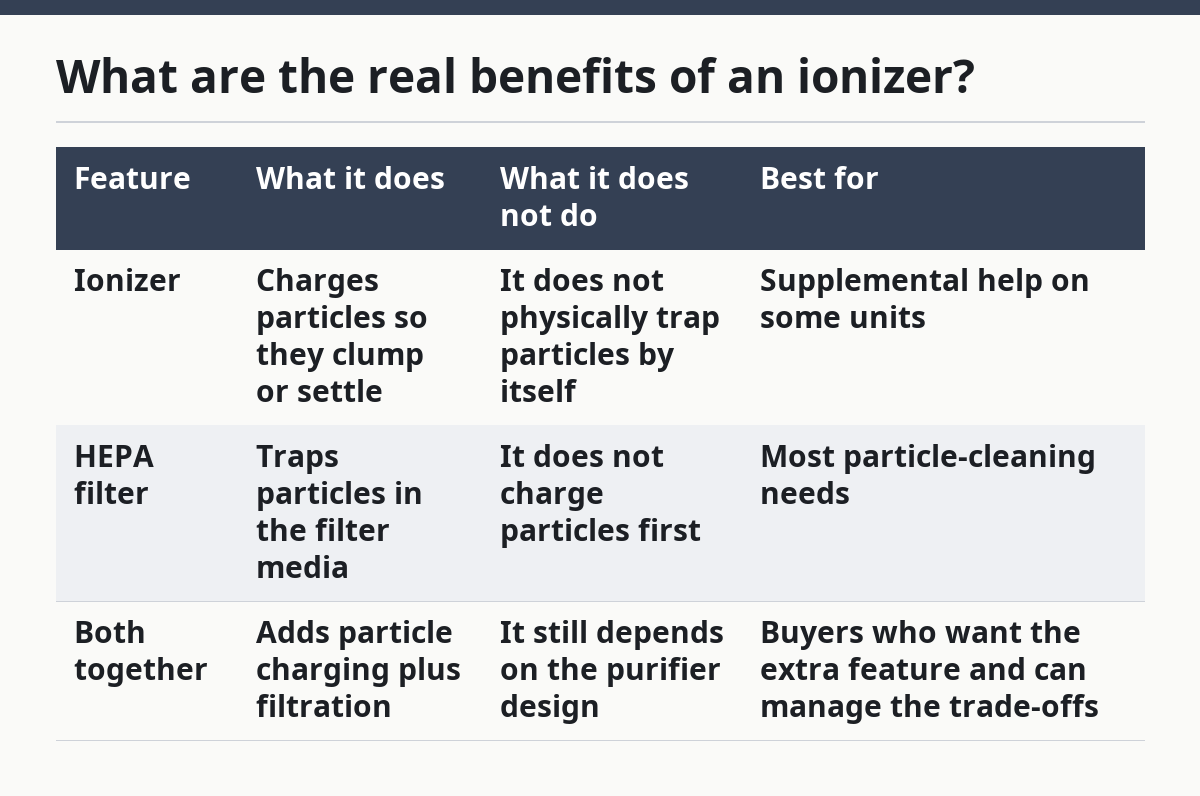
The useful question is not “Does an ionizer work at all?” It is “Does this extra feature improve the purifier enough to justify the trade-off?” For a lot of shoppers, the answer is no.
What is the ozone trade-off?
The ozone trade-off is the reason many people avoid ionizers. Ionizers can produce ozone as part of the process, and ozone is the part that makes this feature worth scrutinizing before you buy or use it.
Not every ionizer creates the same amount of ozone, and not every unit behaves the same way. That is the problem: the feature can add an air-quality concern right next to the air-cleaning feature. If a purifier already meets your needs without the ionizer, there is no reason to accept that extra concern.
This is where a generic article often gets lazy. It says “some ozone may be produced” and leaves it there. That is not enough. The practical point is that ozone shifts the value of the feature. If you are choosing between a purifier with a HEPA filter only and one with a HEPA filter plus ionizer, the ionizer has to earn its place.
For a safety-first shopper, that usually means asking two things. First, do you need the feature at all? Second, if the unit has it, can it be turned off? A switchable ionizer is easier to live with than one that runs all the time. If you have health concerns or respiratory sensitivity, consult a professional and review the EPA and CARB guidance before relying on the feature.
Do not confuse this with the separate question of ozone generators. That is a different topic. On this page, the issue is the ionizer feature inside an air purifier and whether the added function is worth the possible downside.
How should I decide before buying?
You should decide by matching the feature to your actual use, not by choosing the longest spec sheet. A purifier with an ionizer is not automatically better than one without it, and a plain HEPA purifier is often the safer default.
Use this quick decision process:
- Check whether the purifier already has a HEPA filter. If it does, that is the main cleaning tool and often the main reason to buy the unit.
- Look for an ionizer that can be turned off. If you cannot disable it, you are accepting the feature every time the machine runs.
- Ask what you want most: fewer particles, less noise, or fewer features to think about. An ionizer usually helps most with the first goal, but not enough to beat a strong filter by itself.
- Check the product information for ozone-related language and any safety claims. If you have questions about what the listing means, consult a professional and review EPA or CARB guidance before deciding.
- Choose the simpler model if you are unsure. In air purifiers, simple often means easier to trust and easier to live with.
A rule of thumb helps here: if you are buying the purifier for particle capture, the filter matters more than the ionizer. If you are tempted by the ionizer because it sounds advanced, pause and ask what problem it solves that the filter does not.
This is also the section where people overbuy. They spend extra on a feature they may never notice, then leave it on because they paid for it. If the goal is clean air, not gadget value, that is the wrong trade.
When should you skip the ionizer?
You should skip the ionizer when you want the least complicated path to cleaner air. That is the right move for many homes, especially if the purifier will run for 8 to 24 hours a day and you do not want to think about special modes.

Skip it if any of these describe you:
- You want the simplest setup possible.
- You already plan to rely on a HEPA filter.
- You are sensitive to chemical smells or ozone concerns.
- You do not want another setting to monitor or turn off.
- You are choosing between two similar purifiers and the ionizer is the only extra feature.
The downside of skipping it is small for most buyers. You may give up a feature that can help particles clump or settle, but you keep the machine simpler and avoid the extra worry that comes with ionization. For most households, that is a good trade.
There is one case where the feature may still be worth considering: if the purifier’s main design is strong, the HEPA filter is the real workhorse, and the ionizer can be turned off. In that case, the feature is not the main reason to buy, but it is not an automatic red flag either.
A good comparison is this: a reliable purifier with a turn-off ionizer is usually better than a weak purifier without one. But between two otherwise similar machines, the one without the ionizer is often easier to recommend.
What are the most common mistakes?
The most common mistake is buying the ionizer instead of buying the filter. That mistake costs you performance, because the HEPA filter is still the part that actually traps particles, while the ionizer mostly changes how particles behave in the air.
Another mistake is leaving the ionizer on because it came enabled from the factory. That can mean you are using the feature without ever deciding whether you wanted it. If the device has a switch, use it deliberately.
A third mistake is assuming “more features” means “better air.” That is not how air purifiers work. A model with a clear HEPA filter path and simple controls is often easier to trust than a model with extra functions that are hard to explain in one sentence.
The last mistake is treating ozone as a side note, so it is worth checking whether the product documentation addresses it clearly and whether a professional should weigh in if you have health concerns. It is not the whole story, but it is part of the story. The feature can be useful and still not be worth the trade-off for a cautious buyer.
If you want the shortest possible answer, it is this: buy the purifier for its filter and airflow, not for its ionizer. That rule keeps you from paying extra for a feature that may only matter on paper.
Which option fits different buyers?
An ionizer-equipped purifier fits a narrower buyer than a plain HEPA purifier. The table below shows the practical choice, not the marketing pitch.
| Buyer type | Better fit | Why |
|---|---|---|
| Wants the safest simple choice | HEPA-only purifier | Usually fewer features and fewer questions |
| Wants an optional particle-charging feature | Purifier with turn-off ionizer | Gives flexibility without forcing the mode on |
| Wants the most straightforward maintenance | HEPA-only purifier | Less to manage and explain |
| Shops by feature count | Ionizer model, but only if the rest of the unit is strong | Extra feature can appeal, but should not drive the purchase |
| Is sensitive to ozone concerns | HEPA-only purifier | Removes the extra worry tied to ionization |
The main lesson is that the ionizer is a “maybe,” not a must-have. If a model only looks better because of the ionizer line on the box, that is a weak reason to buy it. If the purifier is strong on filtration and the ionizer can be turned off, the feature becomes optional instead of risky.
For a broader safety view of purifier features and standards, the hub page on air purifier safety and standards is the better place to start, then come back here to judge the ionizer itself.
FAQ
What does an ionizer do in an air purifier?
An ionizer charges particles in the air so they are more likely to clump together or stick to surfaces. It is not the same as a HEPA filter, which physically traps particles in the filter media.
Is an ionizer better than HEPA?
No, an ionizer is not better than HEPA for most buyers. A HEPA filter is the main cleaning tool in a purifier, while the ionizer is an extra feature that may help particles settle or clump, but does not replace filtration.
Should I turn off the ionizer on my air purifier?
Yes, if your purifier still works well without it and the feature is optional. Turning it off is often the safer, simpler choice when you do not need the extra particle-charging effect or you want to avoid the ozone trade-off.
Drafted with AI; not yet reviewed by a person.