Air Purifier Safety and Standards: The Complete Guide
Air purifier safety and standards — The Complete Guide: the safest default for most homes is one true HEPA purifier with a CARB-friendly design and a…
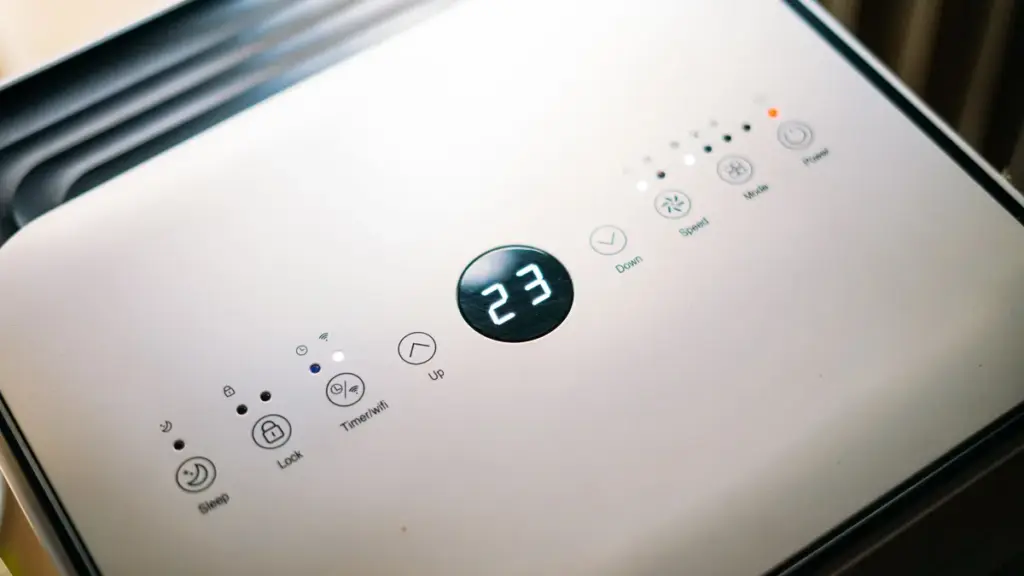
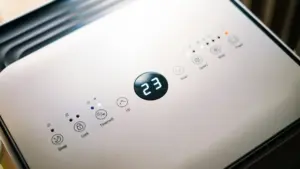
Air purifier control panel with buttons and display
Last updated: November 27, 2026
Quick answer: the safest default for most homes is one true HEPA purifier with a CARB-friendly design and a recognized electrical safety listing. If a unit leans on ionization, “fresh air” claims, or vague labelling instead of a real standard, it deserves a hard pass. For the basic rules on indoor air cleaners in Air Purifier Safety and Standards: The Complete Guide, the EPA and the California Air Resources Board are the two public sources worth reading first.
If you want the official starting points, see the EPA’s guide to air cleaners in the home and the California Air Resources Board’s air cleaning devices page.

Key takeaways
- Safe air purification is about filtration, emissions, and electrical safety, not just a big marketing claim.
- True HEPA is the clearest filter standard for home use because it targets fine particles without relying on ozone.
- Ionizers and ozone generators are not the same as HEPA; the ozone side is the risk, not the selling point.
- A purifier that looks good on paper can still be a bad fit if it lacks a clear standard, a room-size rating, or a simple filter plan.
- The right unit for a bedroom is not always the right unit for a workshop, a smoke-heavy apartment, or a nursery, so the room and use case should guide the choice.
- For a practical starting point, check the EPA’s air cleaners in the home page and CARB’s air cleaning devices page before you buy.
What makes an air purifier safe?
An air purifier is safe when it removes particles without adding a new hazard, and that means watching for three things: filter performance, ozone output, and electrical certification. A good unit should have a clear standard on the box or spec sheet, not a soft claim like “high efficiency” or “scientifically proven.”
The particle side is usually the easiest part to judge. A true HEPA filter, which is the common benchmark in homes, is built for fine particles; the dangerous part is when a device adds ionization or ozone to the mix. The EPA warns that some air cleaners can emit ozone, and the CARB certification program exists because ozone from indoor devices is a real concern, not a theoretical one.
Therefore, the electrical side matters too. A purifier should be listed for normal home use by a recognized safety lab, such as UL or ETL, because a fan and motor run for hours at a time. That is especially important in a bedroom, where the unit may run overnight for 8 hours or more.
A safe purifier also needs clear maintenance instructions. A filter that is never replaced can stop working well long before the sales page admits it. A unit that hides replacement timing, uses an odd filter size, or makes changing the filter hard is a practical safety problem, not just a convenience issue.
Which standards actually matter?
The standards that matter most are HEPA for filtration, CARB for ozone-related safety, and a recognized electrical safety listing such as UL or ETL. A page that throws around five logos but never explains what they mean is trying to look trustworthy instead of being trustworthy.
HEPA is the standard most readers should look for first. In home air cleaning, true HEPA is the cleanest shorthand for “captures particles well without needing a gimmick.” If a seller says “HEPA-type,” that is not the same thing, and the missing word matters.
CARB certification matters in California and matters everywhere else as a safety clue. CARB’s air cleaner program is built around low ozone emissions, which is why it is useful even if you do not live in California. If a purifier is CARB-certified, it is usually a better sign than a unit that advertises ionization without any emissions detail.
Electrical safety listings matter because the machine plugs into the wall and may run for long periods. A purifier that is marketed only by airflow and a glossy photo, with no visible safety listing, is a weaker choice than one with a normal third-party listing. That is not a performance issue; it is basic appliance safety.
The standards below are the ones worth checking before anything else:
| Standard or label | What it means | What it does not mean | Why it matters |
|---|---|---|---|
| True HEPA | High-efficiency particle filtration | It does not promise odor removal by itself | Best baseline for fine particles |
| HEPA-type | Marketing term, not a full HEPA claim | It does not prove the same filtration performance | A warning sign for buyers |
| CARB certification | Low-ozone air cleaner compliance | It does not tell you the unit is powerful | Reduces ozone risk |
| UL or ETL listing | Electrical safety review | It does not prove air-cleaning performance | Useful for long run times |
| CADR | Room-cleaning output rating | It does not guarantee quiet operation | Helps match the purifier to the room |
| Energy Star | Efficiency label | It does not mean the filter is better | Useful for power use and runtime |
| MERV 13 | Filter rating common in HVAC | It is not the same as a portable HEPA unit | Helps compare central-system filters |
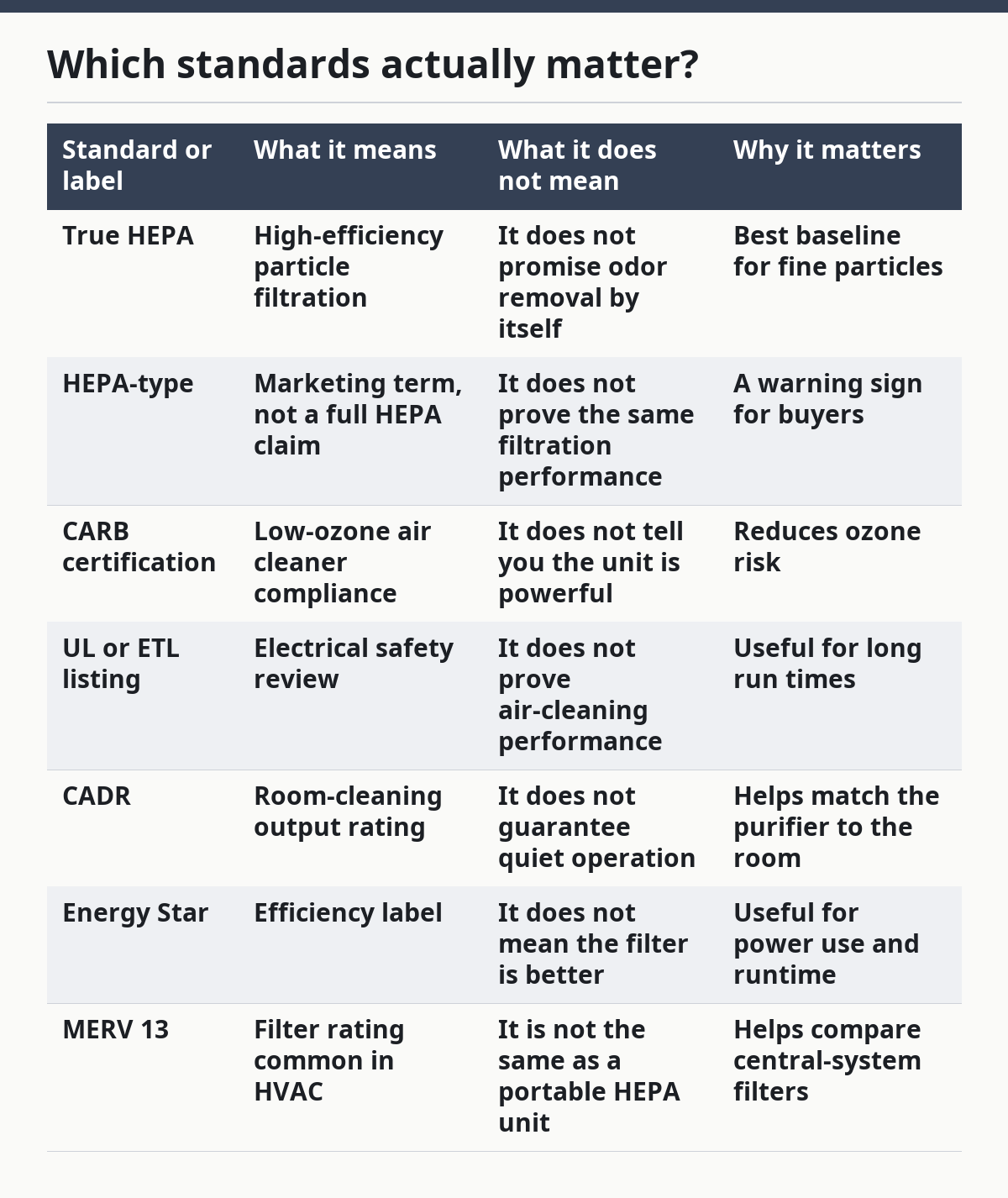
The strongest combination is not “the most logos.” It is one clear particle standard, one ozone-safe signal, and one electrical safety listing.
How do I read a purifier label?
You read a purifier label by checking the filter claim, the room rating, the ozone language, and the safety listing in that order. If any one of those is vague, the rest of the label deserves skepticism.
Start with the filter term. “True HEPA” is the phrase that tells you the device is built around a real particle filter. “HEPA-like,” “HEPA-style,” and “99% clean air” are not the same thing, and they can hide weak filtration or no third-party standard at all.
Next, look for CADR, which is the room-cleaning output rating used to compare units. A purifier without a clear CADR number is hard to match to a bedroom, living room, or home office. A reader does not need a perfect formula, but the box should say more than “large room coverage” and leave it at that.
Then check the ozone language. If the product promotes ionizing, plasma, electrostatic, or “fresh air” technology, that is a moment to slow down. Those features can help in some designs, but they also create the safety question that pure mechanical filtration does not create. For many buyers, the safer move is to consult the EPA and CARB guidance or a qualified professional before choosing a unit with those features. If the listing avoids saying whether ozone is produced, that silence is not a good sign.
Last, check the safety listing. A purifier should have a clear electrical safety mark from a recognized testing lab. The listing should be visible on the product page or the packaging, not buried in a manual scan. That matters because the machine is an electrical appliance that may run for 12 hours straight in a bedroom or office.
HEPA purifiers or ionizers: which is safer?
HEPA purifiers are the safer default, and ionizers are only worth considering when the product clearly shows low ozone emissions and a good filter setup. For most homes, the safer choice is the one that does not depend on an extra active treatment stage, though a qualified professional can help if a room has unusual constraints.
HEPA wins because it is straightforward. Air passes through a physical filter, particles get trapped, and the device does not need to add charged particles or ozone to work. That simplicity is a real safety advantage, especially in a child’s room, a bedroom, or any space where the purifier may run for hours at a time.
Ionizers and similar technologies are more complicated. They can make particles clump together, which may help some units capture them, but they can also create ozone or other byproducts if the design is poor. For that reason, a buyer should treat “ionizer,” “plasma,” and “electrostatic” as questions, not as upgrades, and should consult EPA and CARB guidance or a qualified professional if the label is unclear.
The table below shows the practical difference, with EPA and CARB guidance as the best starting point if you need help comparing a specific model:
| Criteria | HEPA purifier | Ionizer or ozone-producing purifier | Winner for this condition |
|---|---|---|---|
| Ozone risk | No ozone needed for core function | Can create ozone depending on design | HEPA, for bedrooms |
| Simplicity | Mechanical filtration only | Extra active treatment stage | HEPA, for beginners |
| Maintenance | Filter replacement is the main task | Filter plus emitter or plate upkeep may apply | HEPA, for easy upkeep |
| Particle removal | Strong, direct capture of fine particles | Can vary by design | HEPA, for predictable use |
| Odor help | Needs carbon or a separate odor stage | May seem stronger on smells | Ionizer/ozone, only with caution |
| Safety clarity | Easier to verify | Harder to judge from marketing copy | HEPA, for most buyers |
| Best for | Bedrooms, nurseries, offices | Specialized cases with clear certification | HEPA |
| Not for | People who want zero maintenance | People sensitive to ozone | Neither if the label is vague |
The practical downside of HEPA is that it does not solve every problem. Smoke odor, chemical fumes, and heavy kitchen smells may need activated carbon or better ventilation, not just a HEPA filter. That is a performance limit, not a safety flaw.
The practical downside of ionizers is more serious: if the unit does not clearly control ozone, the “extra” technology becomes the reason not to buy it. A device should not make indoor air cleaner on one axis while making it riskier on another.
What room and placement rules keep a purifier safe?
Room size, airflow path, and plug safety are the placement rules that keep a purifier safe. The same unit can work well in one room and badly in another if it is boxed into a corner or put too close to curtains.
The room-size match comes first. A purifier built for a small office will struggle in an open living room, and a unit meant for a larger room may be louder than needed in a bedroom. CADR is the number that helps here, but room shape matters too, because a long hallway or split-level layout changes how air moves.
Placement matters almost as much as the filter itself. The unit should have space around the intake and output so it can move air without choking. If the purifier sits behind a sofa, under a shelf, or next to heavy drapes, the fan can work harder for less result.
Electrical safety is part of placement too. The cord should not run under a rug or across a wet floor, and the outlet should be stable. A purifier near a sink, a humidifier spill, or a pet water bowl is a simple accident waiting to happen.
Night use deserves a separate mention. A unit that sounds harmless for 10 minutes may be annoying or unsafe in a bedroom if the controls are unclear and the sleep mode is weak. The safe choice is the one that can run for hours without forcing the user to turn it off at 2 a.m. because of noise or an odd smell.
What should I avoid?
You should avoid any purifier that hides its standards, leans on ozone, or gives only vague performance claims. A device that cannot explain itself clearly on the product page is usually a bad fit for a home.
The biggest red flag is ozone language without a safety explanation. “Fresh,” “sterilizing,” “sanitizing,” and similar claims can sound comforting while masking a technology that should be treated with care. If a purifier relies on ionization or plasma and never addresses emissions, skip it, or consult a professional and the EPA/CARB pages before considering it.
The second red flag is fake certainty. Claims like “kills all pollutants” or “100% pure air” are too broad to trust if taken literally. Air cleaning is a reduction task, not a miracle task, and any honest product page should sound more like engineering than like a promise poster.
The third red flag is poor maintenance design. If the filter is hard to replace, impossible to find, or expensive to replace often, the purifier becomes a weak safety tool over time. A filter that nobody changes is a filter that stops protecting the room.
The fourth red flag is missing match information. If the listing gives no room size, no CADR, and no clear safety mark, it leaves the buyer guessing. That is not a small gap; it is the difference between a device that belongs in a home and one that belongs on a shelf.
When does the verdict change?
The verdict changes when the room, the pollution source, or the user’s sensitivity makes a standard HEPA unit the wrong tool. That does not make HEPA unsafe; it means the job is different from the usual one.
The first exception is heavy smoke. If smoke is the main issue, a HEPA filter alone may not be enough because odor and gases do not disappear just because particles are captured. In that case, a unit with a strong carbon stage may make more sense.
The second exception is a large, open space. A purifier with a weak CADR can be safe but still useless in practice, because it never moves enough air for the room. A large room needs an appropriately sized unit, not a small one on a higher fan speed all day.
The third exception is a chemical-sensitive user. Some people are more sensitive to smell, ozone, and off-gassing than to dust. For that reader, the safest choice is the most boring one: a straightforward HEPA purifier with clear emissions guidance and no extra ionizing feature.
The fourth exception is central HVAC use. If the goal is whole-home filtration, a portable purifier may not be the best answer at all. A properly rated HVAC filter such as MERV 13, where the system can handle it, may be a better fit than buying several small machines for the same house.
What is the safest choice for most people?
The safest choice for most people is a true HEPA purifier with a CARB-friendly design, a visible electrical safety listing, and a room rating that fits the space. That combination gives the clearest balance of performance and low risk.
Choose a HEPA purifier if the main concern is dust, pollen, pet dander, or everyday indoor particles. Choose one with no ozone claim if the room will be used for sleep, study, or baby care. A bedroom purifier should be the quiet, simple kind, not the one with extra air-treatment tricks.
Choose a CARB-certified model if the label gives you a choice. It is a useful safety signal because it narrows the field away from ozone-heavy designs. If the same model is sold through Amazon, Walmart, Best Buy, or the brand site, that wider availability is also a good sign that the product is a normal consumer appliance, not a mystery device from a one-page storefront.
Do not buy an ionizer-first purifier unless the safety documentation is unusually clear and the emissions claim is easy to verify. That is a narrow case, not the common case. For a beginner, the simple filter wins because the failure mode is easier to avoid.
The safest default is not the fanciest machine. It is the one that cleans air by filtration, shows its standards plainly, and stays out of the ozone business. In other words, air purifier safety and standards work best when the product is boring in the right ways.
How do I choose without getting lost?
You choose by checking four things in this order: filter type, ozone status, room fit, and maintenance plan. That order prevents the most common mistake, which is buying on brand language before checking the actual standard.
First, confirm the device is true HEPA or a clearly equivalent particle filter for your use case. Second, confirm it does not rely on ozone-producing features as a selling point. Third, check that the CADR or room rating matches the room where it will run. Fourth, make sure the filter replacement is simple enough that you will actually do it.
A unit that passes those four checks is usually the right answer for a home. A unit that fails any one of them may still be acceptable in a special case, but that special case should be obvious. If the use case is not special, the safest path is also the simplest one.
One last point: a purifier is not a substitute for source control. A smoke-free room, decent ventilation, and regular cleaning still matter. A purifier is the last layer, not the first excuse.
FAQ
Are air purifiers safe to run all night?
Yes, a well-made HEPA purifier is generally the safer choice for overnight use because it removes particles without needing ozone. The key is a model with a visible electrical safety listing and a quiet mode that does not force you to shut it off. If the unit smells sharp, hot, or chemical-like, stop using it and check the manual.
Is HEPA better than an ionizer for safety?
Yes, HEPA is safer for most homes because it does not depend on ozone or charged-particle technology. Ionizers can be useful in some designs, but they add a layer of risk that a simple HEPA filter does not have. For bedrooms, nurseries, and shared living rooms, HEPA is the cleaner choice.
What does CARB-certified mean on an air purifier?
CARB-certified means the unit meets California’s air cleaner requirements, which are focused on low ozone emissions. That makes it a useful safety signal even outside California. It does not tell you the purifier is powerful, only that it is less likely to create an ozone problem.
Can an air purifier make air worse?
Yes, a poorly designed purifier can make indoor air worse if it produces ozone, uses a dirty filter, or has a bad placement that stirs up dust. A unit with ionization or plasma needs extra caution because the feature that seems advanced can be the part that adds risk. If the label is vague, the safer choice is to skip it.
What is the biggest mistake people make when buying one?
The biggest mistake is buying by room size claims and ignoring the actual standards. A purifier can look impressive and still be a bad fit if it is only “HEPA-type,” has no ozone guidance, or lacks a recognized safety listing. The best buy is the boring one with clear labels and a maintenance plan a normal person can follow.
Drafted with AI; not yet reviewed by a person.