Air Purifier vs Dehumidifier: Which One Solves Your Problem?
Air Purifier vs Dehumidifier: Which One Solves Your Problem?: In 2 words, use an air purifier for particles and a dehumidifier for moisture. An air…

Bedroom with bed and radiator by the window
Last updated: November 26, 2026
Quick Answer: In 2 words, use an air purifier for particles and a dehumidifier for moisture. An air purifier solves dust, allergies, and odor better; a dehumidifier solves damp air, mold growth, and that sticky feeling better. If the room smells musty or windows sweat, start with a dehumidifier. If sneezing, dust, or smoke is the problem, start with an air purifier. For a deeper buying walkthrough, see the air purifier buying guide and the dehumidifier buying guide.
Key takeaways
- Air purifiers clean the air you breathe by capturing particles; dehumidifiers change the room by lowering moisture.
- If mold keeps coming back because the room stays damp, moisture control matters more than particle filtering.
- If your main complaint is allergies, dust, or odor, an air purifier is usually the better first buy.
- Some rooms need both devices, but for most people one problem points clearly to one machine.
- The wrong pick can still “work,” just not for the thing that is bothering you most.
- For mold concerns, the CDC and EPA both emphasize fixing the moisture source first; if the source is unclear, consult a professional and review the CDC’s mold guidance and the EPA’s mold page.
What is the real difference here?
Therefore, the real difference is that an air purifier removes airborne particles, while a dehumidifier removes water from the air. That split matters because humidity, mold, allergies, dust, and odor are not the same problem, even when they show up together.
Specifically, a purifier uses a filter, often a HEPA-type filter, to catch particles such as dust, pollen, and smoke. A dehumidifier collects water from humid air, which helps rooms feel less clammy and can make it harder for dampness-related mold to spread. The CDC’s mold guidance makes clear that moisture control is central to mold prevention, not just cleaner air.
As a result, people get frustrated when they buy the wrong device. If the room feels wet and smells stale, a purifier may reduce the smell a little, but it will not dry the air. If the air is dry enough but you still sneeze, a dehumidifier does nothing for the particles triggering that reaction.
In short, the easiest way to think about it is simple: a purifier is for what floats in the air; a dehumidifier is for how much water the room holds. The air purifier buying guide covers more buying detail, but this page is about the choice itself.
Which one helps allergies, dust, and odor?
Therefore, an air purifier is the better pick for allergies, dust, and many indoor odors. It wins here because those problems come from particles or airborne compounds, not excess moisture.
For allergy sufferers, the useful part is filtration. Pollen, dust, and other irritants can move through a room and keep circulating unless they are captured. A purifier with a true filter can help cut that cycle. For dust, the same logic applies: less stuff drifting in the air means less settling on surfaces and less irritation when you breathe.
Odor is more complicated. A purifier can help with some smells when the smell is tied to particles, and it can help more if the machine includes activated carbon, but odor is not always a pure air-cleaning problem. Cooking smells and smoke are closer to a purifier’s strengths than a damp basement smell is.
The weakness is just as clear. A purifier does not lower humidity, so it will not fix a room that feels wet, fogs windows, or feeds mold because moisture stays high. If the smell is musty, the purifier may mask part of it while the actual cause keeps growing.
In particular, this is the better choice for someone who says, “I sneeze when I’m in this room,” “The dust keeps coming back,” or “I want help with smoke and light odors.” It is not the right first buy for a room with visible condensation or a wet basement smell.
When does a dehumidifier win?
Therefore, a dehumidifier wins when the room has a moisture problem first and an air problem second. That means damp walls, musty odor, condensation on glass, or recurring mold risk.
Moisture control matters because mold needs damp conditions to grow. The CDC and EPA both stress that fixing moisture is the real answer, not just cleaning what you can see; if the source is unclear or widespread, consult a professional. A dehumidifier lowers indoor humidity, which can help a room feel less sticky and less likely to support mold-prone conditions. For more on dampness and cleanup, see the EPA’s mold guidance and the CDC’s mold guidance.
This is the better choice for basements, laundry rooms, and other spaces that stay humid even when the air looks clean. If the issue is “the room feels wet all the time,” the dehumidifier is doing the main job. An air purifier cannot dry the air, and that limit is decisive.
The trade-off is that a dehumidifier is not a dust or allergy machine. It may make the room feel better, and some people notice less mustiness, but it does not trap pollen or remove smoke particles the way a purifier does. It also creates a different kind of maintenance burden: you have to empty or drain collected water, and the machine itself takes up floor space.
Because of that, this is the better choice for someone who says, “The room smells moldy,” “The windows sweat,” or “The basement always feels damp.” It is not the right first buy if the room is dry but your nose still reacts to dust or pollen.
Air purifier vs dehumidifier: the side-by-side comparison
The comparison below is the shortest path to the right pick because it shows what each machine actually changes.
| Criteria | Air purifier | Dehumidifier | Winner for [condition] |
|---|---|---|---|
| Main job | Captures airborne particles | Removes moisture from air | Air purifier for dust, allergens, smoke |
| Best for allergies | Yes, when the trigger is airborne particles | No direct help | Air purifier |
| Best for mold prevention | Only indirect help if mold spores are airborne | Yes, by reducing damp conditions | Dehumidifier |
| Best for humidity | No | Yes | Dehumidifier |
| Best for musty odor | Limited help if odor rides on particles | Stronger fit when odor comes from dampness | Dehumidifier |
| Best for dust | Yes | No direct help | Air purifier |
| Maintenance | Filter changes | Water emptying or drainage | Depends on user tolerance |
| Noise impact | Varies by fan speed | Varies by compressor and fan | Depends on room use |
| Room feel | Cleaner air, less floating debris | Less sticky, less clammy | Depends on complaint |
| Wrong-room use | Poor choice for wet rooms | Poor choice for allergy-only rooms | Depends on symptom |
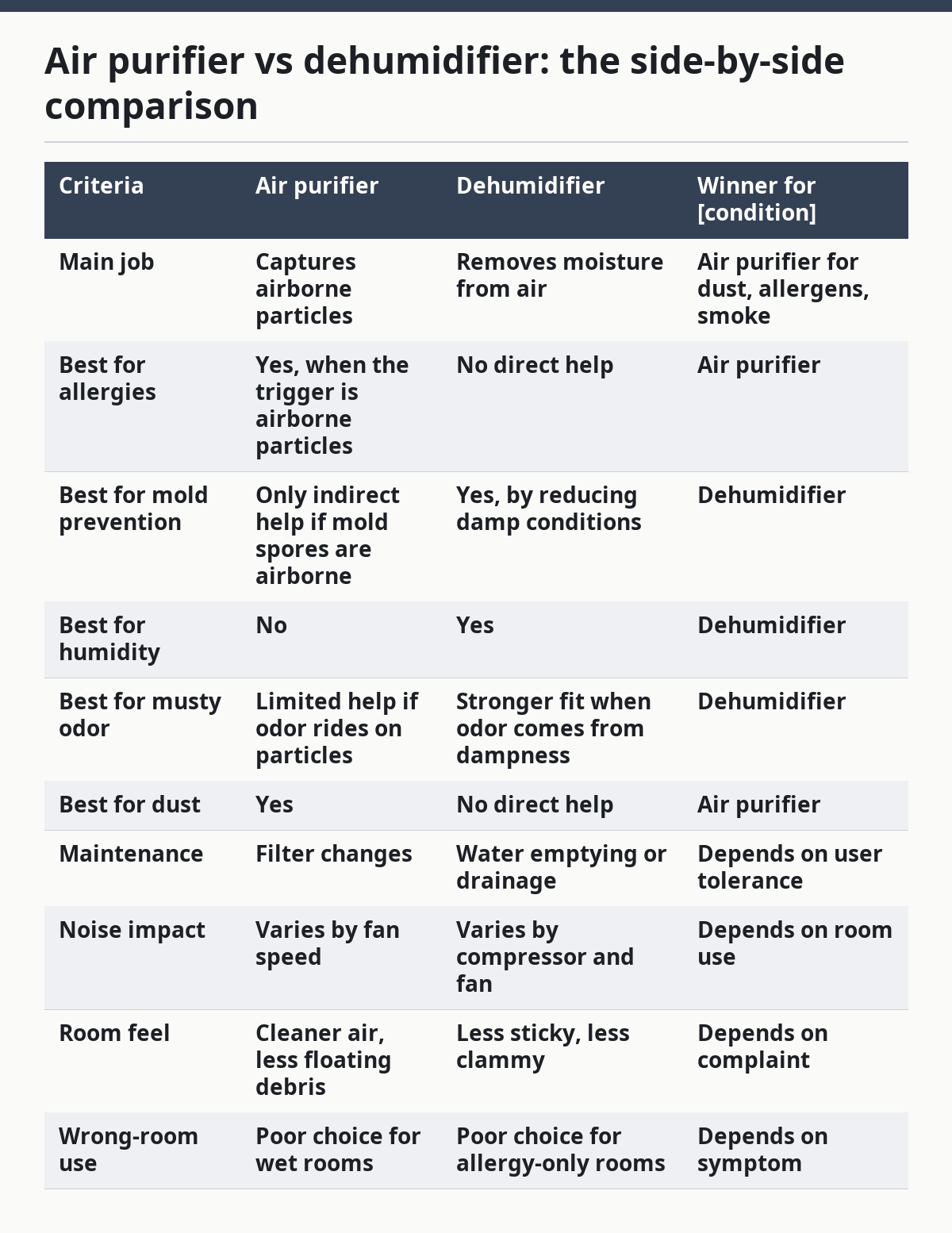
The table makes the core decision plain: choose by symptom, not by product category. If the room is damp, a purifier is the wrong first tool. If the room is dry but irritating, a dehumidifier will not solve the real issue.
This is also where many shoppers get tripped up. A musty room can contain both humidity and airborne particles, but the cause still matters more than the smell. If mold is being fed by moisture, dryness comes first. If dust is what is bothering the nose, filtration comes first.
Which one should you buy for your room?
Therefore, an air purifier is the better first buy for most people whose main complaint is allergies, dust, or indoor odor. A dehumidifier is the better first buy when the room is clearly humid, damp, or mold-prone.
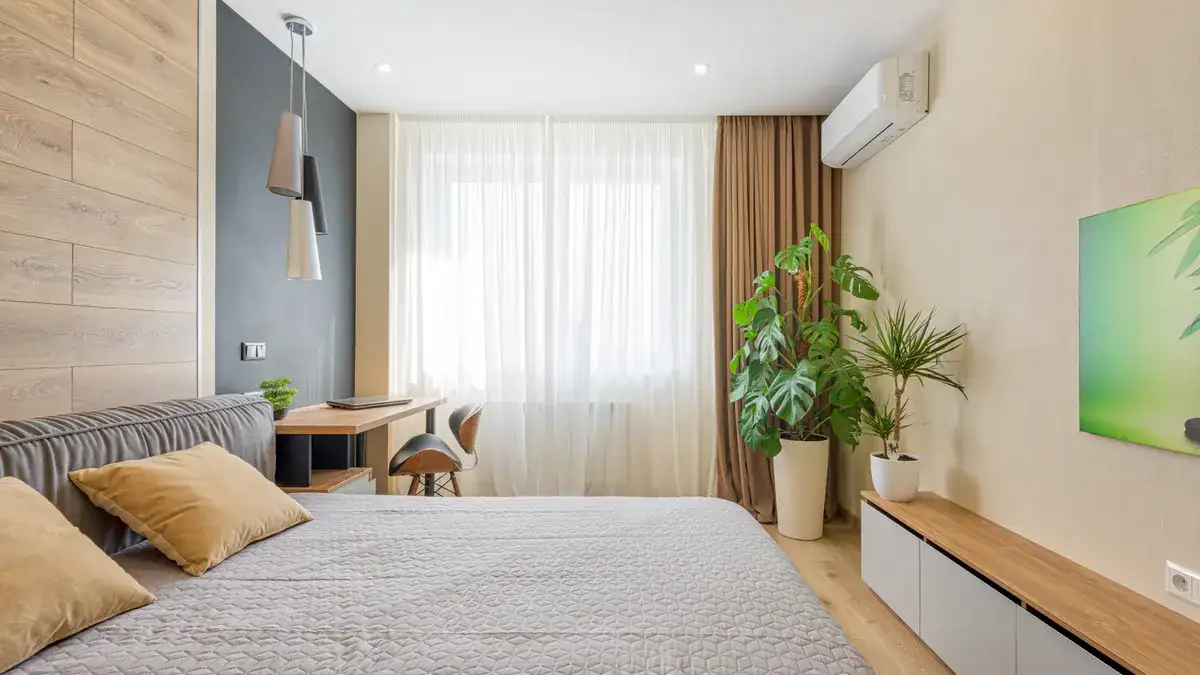
If the room is a bedroom, living room, or home office and the issue is sneezing, dust on furniture, or smoke smell, a purifier usually gives the faster, more targeted fix. If the room is a basement, laundry room, or any space with condensation and musty odor, the dehumidifier addresses the cause, not just the symptom.
Since that choice depends on the complaint, it helps to be strict about the problem. “The air feels bad” is too vague. “My nose is irritated and there is dust” points to a purifier. “The walls feel damp and there is a mold smell” points to a dehumidifier. Those are different jobs.
Pros and cons make the split even clearer.
Air purifier pros
- Better for dust, pollen, smoke, and allergy triggers
- Helps with some odors
- Does not require water drainage
Air purifier cons
- Does not lower humidity
- Cannot fix dampness-driven mold
- Won’t help much if the room problem is moisture first
Dehumidifier pros
- Lowers humidity
- Helps with damp, musty rooms
- Better match for mold prevention tied to moisture
Dehumidifier cons
- Does not remove dust or allergens from the air
- Needs water emptied or drained
- Does little for smoke or pollen
Ultimately, one practical rule keeps the choice clean: if you can smell dampness, dry the room; if you can feel particles irritating the air, filter it.
When should you reconsider the choice entirely?
However, you should reconsider the choice if the room has both moisture and particle problems, if the room has visible mold, or if ventilation is the real issue. In those cases, one machine may help, but it will not solve the whole problem by itself.
A room with recurring mold is the clearest warning sign. The CDC and EPA both treat moisture source control as the real fix; if the source is not obvious, or if the damage is extensive, consult a professional. If water is leaking, a pipe is sweating, or a wall stays wet, buying either machine first is a partial answer at best. A dehumidifier can help with indoor humidity, but it cannot repair a leak or remove damaged material.
The same caution applies to ventilation. Stale air can come from poor airflow, not just dust or humidity. If the room has no fresh air exchange, a purifier may clean what is floating inside, but the room can still feel bad. A dehumidifier can dry the air, but it will not move fresh air through the space. For broader indoor air quality basics, see the EPA’s indoor air quality page.
Because of that, there are also cases where both machines make sense. A damp basement with dust and musty odor can need moisture control and particle cleanup. That is not a contradiction; it just means the room has two separate problems.
The biggest mistake is buying based on the word “air.” These machines touch the air in different ways, and the right choice starts with the complaint that bothers you most.
Which one should you choose?
Ultimately, choose an air purifier if your main problem is allergies, dust, smoke, or general indoor odor. Choose a dehumidifier if your main problem is humidity, condensation, musty smell, or mold risk tied to damp air. Neither if the room has a leak, standing water, or a moisture source that still needs to be fixed.
That is the cleanest decision. If the room is dry and you are still reacting to the air, filtration wins. If the room is wet and smells stale, moisture control wins.
For readers already sorting through models, the broader air purifier buying guide hub can help with the next step. For this page, the answer is simpler: match the machine to the problem, not to the word “air” on the box.
What does each one solve best?
Therefore, an air purifier solves airborne irritation. A dehumidifier solves dampness. That difference is why the wrong machine can feel disappointing even if it is working correctly.
If allergies and dust are the pain point, the purifier is the better investment. If humidity and mold are the pain point, the dehumidifier is the better investment. If both are happening in the same room, moisture control should not be ignored, because mold prevention depends on fixing the damp condition first.
For that reason, the topic Air Purifier vs Dehumidifier: Which One Solves Your Problem? comes down to one question: is the room carrying too many particles, or too much moisture?
Drafted with AI; not yet reviewed by a person.