Air Purifiers for Wildfire Smoke
Air Purifiers for Wildfire Smoke: What to Prioritize When the Air Gets Bad: choose a HEPA purifier sized for the room, keep the room closed, and run it…
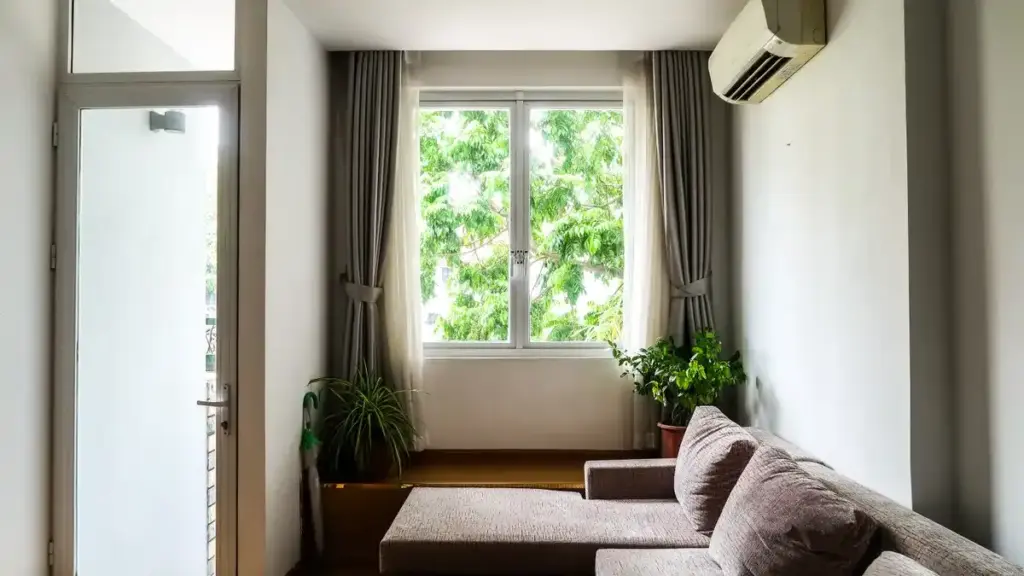
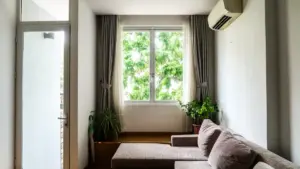
Living room with window, sofa, and wall air conditioner
Last updated: November 26, 2026
Quick answer: choose a HEPA purifier sized for the room, keep the room closed, and run it continuously during the smoke event. For wildfire smoke, prioritize a purifier with a true particulate filter, enough room coverage for the space, and a sealed room. Smoke is mostly a particle problem first and an odor problem second, so the quickest practical relief usually comes from trapping fine smoke particles with a HEPA filter and keeping the unit running in the room you sleep in or spend the most time in. For background on indoor air basics, see the site’s air quality problems and indoor air quality pages.
Key takeaways
- Wildfire smoke is harder to handle when the room leaks air, so the room setup matters as much as the machine.
- Fine smoke particles are the main target; odor needs activated carbon, but carbon alone does not clean the air.
- A purifier that is too small for the room can still help, but it will work slowly and leave more smoke behind.
- The most reliable setup is usually simple: close the room, run the purifier continuously, and keep doors and windows shut.
- If the smoke smell is the main complaint, do not ignore the particle filter; odor control without particle control leaves the real hazard in the room.
What should I prioritize first?
Prioritize particle removal first, then odor control, then room size. That order matters because wildfire smoke brings tiny particles that stay in the air longer than the smell does, and those particles are the main reason people use an air purifier during a smoke event.
The most important label to look for is HEPA or true HEPA. That standard is widely used for fine particles, which is exactly what wildfire smoke brings indoors. If a purifier also has activated carbon, that can help with the smell, but carbon is not the main job here. For a general reference, the U.S. EPA wildfire smoke guidance and the EPA’s Guide to air cleaners in the home explain the same basic split between particles and odor.
Room coverage matters next. A purifier built for a small bedroom will struggle in a large living room, even if the box looks impressive. The point is not to buy the biggest machine in the store; it is to match the unit to the room you will actually use. For room sizing, air purifier room coverage is a useful place to start.
Noise matters too, but only after the basics are covered. A purifier that is too loud often gets turned down or off, which defeats the whole purpose during a smoke episode. If you plan to sleep with it on, the lowest usable speed matters more than the flashiest setting.
For general indoor-air background, this guide sits under the site’s air quality problems and what to do hub, but wildfire smoke needs its own priorities because the problem is sudden and concentrated.
How do I set up a room for smoke?
Set up one sealed room and run the purifier there continuously. This is a practical way to get useful relief from wildfire smoke without trying to clean the whole house at once.
Here is the basic procedure:
- Choose one room to protect first, usually a bedroom or the room where you spend the most time. A smaller room gives the purifier less air to clean.
- Close windows and doors and keep them shut as much as possible. The goal is to stop outside smoke from replacing the air the purifier just cleaned.
- Place the purifier where air can move freely, not jammed against a wall or behind furniture. The unit needs space to pull in smoky air and push out cleaned air.
- Turn it on before the room smells bad if you can, then leave it running. If the room is already smoky, running it continuously helps lower particle levels over time.
- Keep the room closed during use. Every time the door opens, more smoke can drift in and undo some of the progress.
The result to expect is not instant perfection. The smell should fade before the room feels spotless, and the air should improve gradually rather than in one dramatic minute. That is normal.
If your home has multiple rooms and only one purifier, protect the sleeping room first. Smoke exposure during sleep is hard to avoid, and a closed bedroom often gives the best return for the same machine. If you can only make one room tolerable, that is still a win.
Which filter matters most for wildfire smoke?
HEPA matters most for smoke particles, and activated carbon matters most for odor. Those two jobs are different, and a generic “smoke filter” label can hide that difference.
| Filter type | What it helps with | What it does not solve | Best use during smoke |
|---|---|---|---|
| HEPA or true HEPA | Fine smoke particles | Odor | Main filter to prioritize |
| Activated carbon | Smoke smell and some gases | Particle removal | Helpful add-on, not the main filter |
| Basic dust filter | Larger dust and lint | Fine wildfire smoke | Not enough on its own |
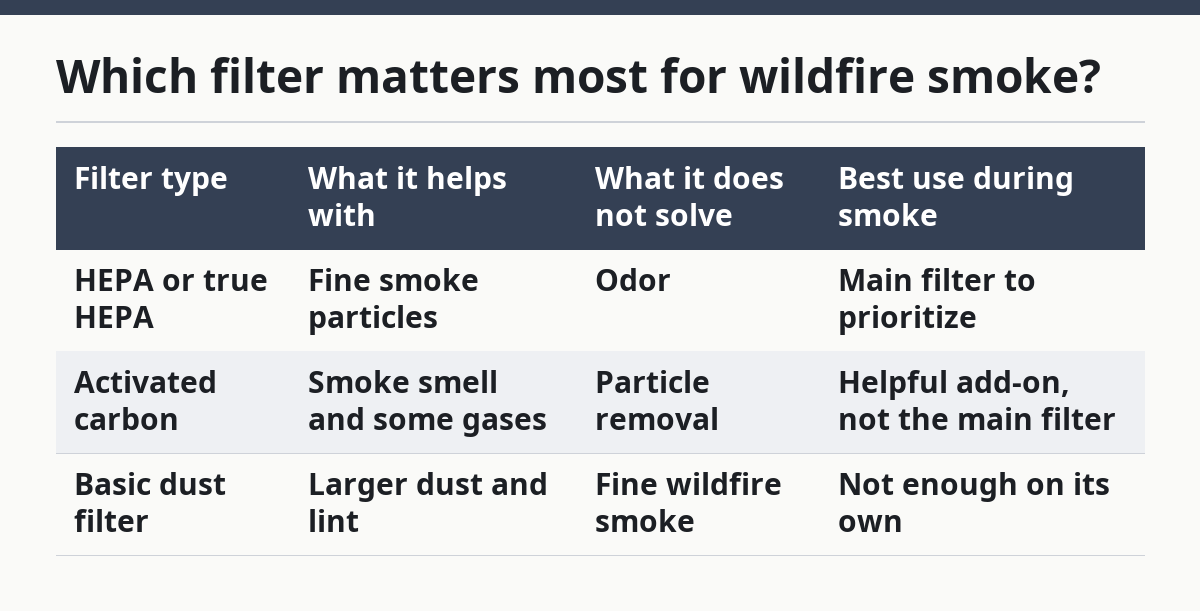
A generic article often gets this wrong by treating smell as the whole problem. It is not. The smell can bother you, but the fine particles are the reason a wildfire smoke purifier needs real particle filtration.
Activated carbon helps when the room smells like a campfire or ash. That said, not every carbon filter is equally useful, and some are thin layers that only make a small dent in odor. If the product page talks a lot about scent but not much about particle filtration, be cautious.
One useful way to think about it is this: HEPA is for the smoke you cannot see, and carbon is for the smoke you can smell. During a bad air day, it is reasonable to treat the invisible part as the main job, and the EPA’s wildfire smoke pages are a good place to verify the basics if you want a second check.
If you want a quick outside reference for smoke response, the U.S. Environmental Protection Agency has practical guidance on wildfire smoke and indoor air cleaners. The EPA’s wildfire smoke pages and “Guide to air cleaners in the home” are good places to cross-check the basics. For more on the room setup, see wildfire smoke cleanup and HEPA air purifier guide.
How long should I run it?
Run the purifier continuously during the smoke event. Turning it off and on costs you more air quality than it saves in comfort, because smoke keeps leaking into the room whenever the purifier stops.
A common mistake is to treat the purifier like a fan you switch on only when the smell gets strong. That approach lets smoke build up again and again. A steady run is more useful because the machine keeps pulling particles out of the air as new smoke enters.
If the unit has more than one fan speed, a higher setting can help at first, then you can lower it if noise becomes a problem. The best setting is the one you can keep on for hours, not the one that sounds strongest for five minutes. For many people, that means starting high, then dropping to a level that still runs all night.
The other reason to keep it on is simple: wildfire smoke is not a one-time spill. Wind shifts, doors open, and outdoor conditions change through the day. A purifier only helps while it is working.
If the room starts to feel stale because the windows stay shut, that is the trade-off. During a smoke episode, stale indoor air is usually the better problem to have. Smoke in the room is harder on comfort than a closed room.
What mistakes waste money?
The biggest mistakes are buying for the wrong room, ignoring odor-versus-particle differences, and expecting one purifier to clean an open house. Each mistake has a cost, and each has a clearer fix.
A purifier that is too small for the room can still do something, but it will take longer and may never keep up during a heavy smoke day. The cost is slow relief and a unit that feels disappointing. The fix is to match the purifier to the room you actually plan to use, not the square footage on the box you wish you needed.
A unit with only odor control also falls short. It may make the room smell less smoky while leaving too many particles in the air. The fix is to make HEPA-level particle filtration the first filter check and carbon the second.
Another mistake is opening windows because the room feels stuffy. That trades one discomfort for a bigger one. If the outdoor air is smoky, an open window can overwhelm the purifier in minutes. The EPA’s Guide to air cleaners in the home is useful here because it explains room air cleaners in plain terms and points back to smoke control without turning the subject into jargon.
The final mistake is trying to clean every room at once. One purifier in a house with open doors usually loses that battle. Pick one sealed room, usually the bedroom, and get that room clean first. If you need help planning a whole-home approach, the site’s smoke and indoor air page can help you compare options.
What should I look for on the box?
Look for HEPA, room size guidance, and a carbon stage if odor bothers you. Those are the practical clues that tell you whether the purifier is built for wildfire smoke or just for general dust.
A sensible box or product page should tell you what kind of particles the filter handles and what size room it is meant for. If the only claims are “fresh air,” “allergen relief,” or “odor control,” that is not enough detail for wildfire smoke. Smoke is a tougher problem than everyday dust.
Also pay attention to filter replacement language. Wildfire smoke can load a filter faster than normal household use, so a purifier that is hard to maintain can become less useful when you need it most. If the filter is awkward to replace, that inconvenience shows up at exactly the wrong time.
Do not get distracted by extra modes that sound impressive but do not change the basics. A purifier with a sleep mode, timer, or light is fine, but those features do not clean smoke by themselves. The core question stays the same: does it move enough air through a real particle filter for the room you want to protect?
If you are comparing products, the practical order is simple: filter type first, room fit second, odor support third, convenience features last. That order keeps the decision tied to smoke, not to marketing. For a related checklist, see best air purifier filters and air purifier maintenance.
FAQ
Do air purifiers help with wildfire smoke?
Yes, air purifiers can help with wildfire smoke when they use a proper particle filter and the room is kept closed. The biggest benefit comes from removing fine smoke particles from the air in one room, especially a bedroom. A purifier is less useful if windows are open or if the unit is too small for the space. The EPA’s wildfire smoke guidance and CDC wildfire smoke page both point readers toward cleaner indoor air and staying inside when outdoor smoke is bad.
What filter is best for smoke?
A HEPA or true HEPA filter is the main filter to look for, and activated carbon helps with odor. HEPA targets the fine particles in wildfire smoke, while carbon helps with the smell. A purifier that only focuses on odor is not a complete smoke solution. For a product comparison, HEPA air purifier guide is a good next step.
Should I run an air purifier continuously during smoke events?
Yes, continuous use is usually the right move during a smoke event. Smoke keeps entering the room as long as the air outside is bad and doors or windows open. Leaving the purifier on gives it a chance to keep particle levels lower instead of letting them build back up each time it stops.
Drafted with AI; not yet reviewed by a person.