How to Choose an Air Purifier: Specs That Actually Matter
Learn what air purifier specs actually matter: AHAM-verified CADR, true HEPA vs HEPA-type, ENERGY STAR and CARB certifications, noise, and running cost.
Image: user32212 via Pixabay
Choose an air purifier by checking five things on the spec sheet: an AHAM Verifide-certified CADR number sized to your room, a filter labeled “true HEPA” (99.97% efficient at 0.3 microns), an ENERGY STAR or CARB certification, a published decibel rating at the fan speed you’ll use, and the wattage that drives its running cost.
- CADR alone means nothing without the AHAM Verifide seal — that is what confirms a lab, not the manufacturer, measured the number.
- “True HEPA” has one technical definition (99.97% capture at 0.3 microns). “HEPA-type” and “HEPA-like” are marketing phrases with no capture-rate requirement behind them.
- ENERGY STAR and CARB certifications answer two different questions: ENERGY STAR is about energy efficiency, CARB is about ozone output and electrical safety.
- A printed decibel number at your intended fan speed tells you more than a word like “whisper-quiet” ever will.
- Running cost comes down to wattage and the hours per day you actually run the unit, not the sticker price.
Why does every spec sheet read differently?
Air purifier marketing copy is inconsistent because very little of it is independently checked. The U.S. Environmental Protection Agency’s consumer guide on portable air cleaners makes a point of noting that the agency does not certify or endorse specific air cleaner brands or models, and that no air cleaner or filter will remove all of the pollutants from a home. That leaves shoppers comparing claims from the manufacturers themselves — which is exactly why third-party certifications and standardized ratings matter more here than in most product categories.
The EPA’s guide also puts filtration in its proper place: the agency states that the most effective ways to improve indoor air are to reduce or remove pollutant sources and to ventilate with clean outdoor air, with air cleaning as a supplement to those two steps, not a replacement for them. A purifier with excellent specs still will not fix a damp basement or a leaking gas stove.

What is CADR, and why check it first?
CADR stands for Clean Air Delivery Rate. It is not a single number — a certified spec sheet lists three: one for tobacco smoke, one for dust, and one for pollen, each measured in cubic feet of filtered air per minute. The rating comes from the Association of Home Appliance Manufacturers (AHAM), whose ANSI/AHAM AC-1 standard defines how the test is run in a controlled chamber.
The number that matters is whether it carries the AHAM Verifide seal. Participation in the certification program is voluntary, but any model sold with that seal has had its CADR claims checked by an independent lab rather than taken on the manufacturer’s word. A higher CADR moves more filtered air through a room per minute; matching it to your room size is covered in detail in our CADR explainer, so this guide won’t repeat the room-sizing math here.
True HEPA vs. HEPA-type: which claim can you trust?
“HEPA” is a genuine technical filtration benchmark: a true HEPA filter captures at least 99.97% of particles at 0.3 microns, the particle size that is hardest for a filter to trap. This 99.97%-at-0.3-micron threshold is the commonly cited technical definition of HEPA filtration and is the bar that “true HEPA” or “HEPA H13” claims are meant to meet.
“HEPA-type,” “HEPA-like,” and “99% HEPA” are different. They are marketing phrases, not certifications, and products carrying them are not held to the 99.97% figure. A spec sheet that says only “HEPA-type filter” without a stated efficiency percentage is one to read twice. We go line by line through the exact wording to look for — and reject — in our true HEPA vs. HEPA-type guide.
HEPA media handles particles — dust, pollen, pet dander, smoke particles. It does very little against gases and odors on its own; that job falls to an activated carbon layer, and how much carbon a unit has changes what it can actually remove. Our HEPA vs. activated carbon comparison covers which filter stage handles which pollutant type.
What do AHAM, ENERGY STAR and CARB certifications actually confirm?
These three marks get used almost interchangeably in reviews, but they certify different things:
- AHAM Verifide confirms the three CADR numbers (smoke, dust, pollen) were independently lab-tested under the ANSI/AHAM AC-1 protocol, not just claimed by the manufacturer.
- ENERGY STAR certification for room air cleaners requires the model’s PM2.5 CADR to fall in an eligible range (roughly 30 to 600 cubic feet per minute) and the unit to meet a minimum energy-efficiency threshold for that CADR range, called the Integrated Energy Factor (IEF). The program’s own published criteria also caps ozone emissions on any model that emits ozone: measured ozone, tested to UL 867 Ed. 5.0, cannot exceed 50 parts per billion.
- CARB certification is California’s requirement, in effect since 2010, that indoor air cleaners sold or shipped into the state be tested for electrical safety and for ozone output, capped at 0.050 parts per million (50 ppb). Packaging on a certified unit should read “Meets California ozone emissions limit: CARB certified,” and the exact model should appear on CARB’s public list of certified devices.
CARB’s own consumer guidance is blunt about why this limit exists: even low concentrations of ozone are harmful, and it can irritate the respiratory tract and worsen asthma. The EPA guide makes the same point from the federal side — it specifically warns against air cleaners that intentionally generate ozone, noting that no federal agency has approved ozone generators for use in occupied spaces. Some ionizers and electrostatic precipitators can also produce ozone as an unintentional byproduct, which is exactly what the CARB and ENERGY STAR ozone limits are designed to catch. If you’re evaluating a unit that advertises ionization, air sanitizing, or “activated oxygen,” read our ozone generator safety guide before you buy.
Does noise level matter as much as filtration?
It matters for whether you’ll actually run the unit on the setting that cleans the room properly. A high CADR number is only useful at the fan speed you’re willing to tolerate — many people quietly turn a purifier down (or off) at night because the top speed is too loud, which erases the benefit of buying a high-CADR model in the first place. Look for a published decibel (dB(A)) rating at low, medium, and high fan speed rather than a marketing word like “whisper-quiet,” which has no fixed meaning. Our noise levels guide lines up typical dB(A) numbers against familiar everyday sounds so a spec sheet number actually means something before you buy.
What does an air purifier actually cost to run?
Running cost is a function of two things: the unit’s wattage at the speed you use, and how many hours a day it runs. ENERGY STAR’s efficiency requirement (the IEF mentioned above) is a useful shortcut here — a higher IEF means the unit moves more clean air per watt, so two purifiers with an identical CADR can still have different electricity costs over a year. If a listing doesn’t show ENERGY STAR certification or a wattage figure at each fan speed, that is a gap worth asking about before buying. Our running-cost guide walks through the math at light, continuous, and high-speed usage levels.
The spec decoder: a one-page checklist
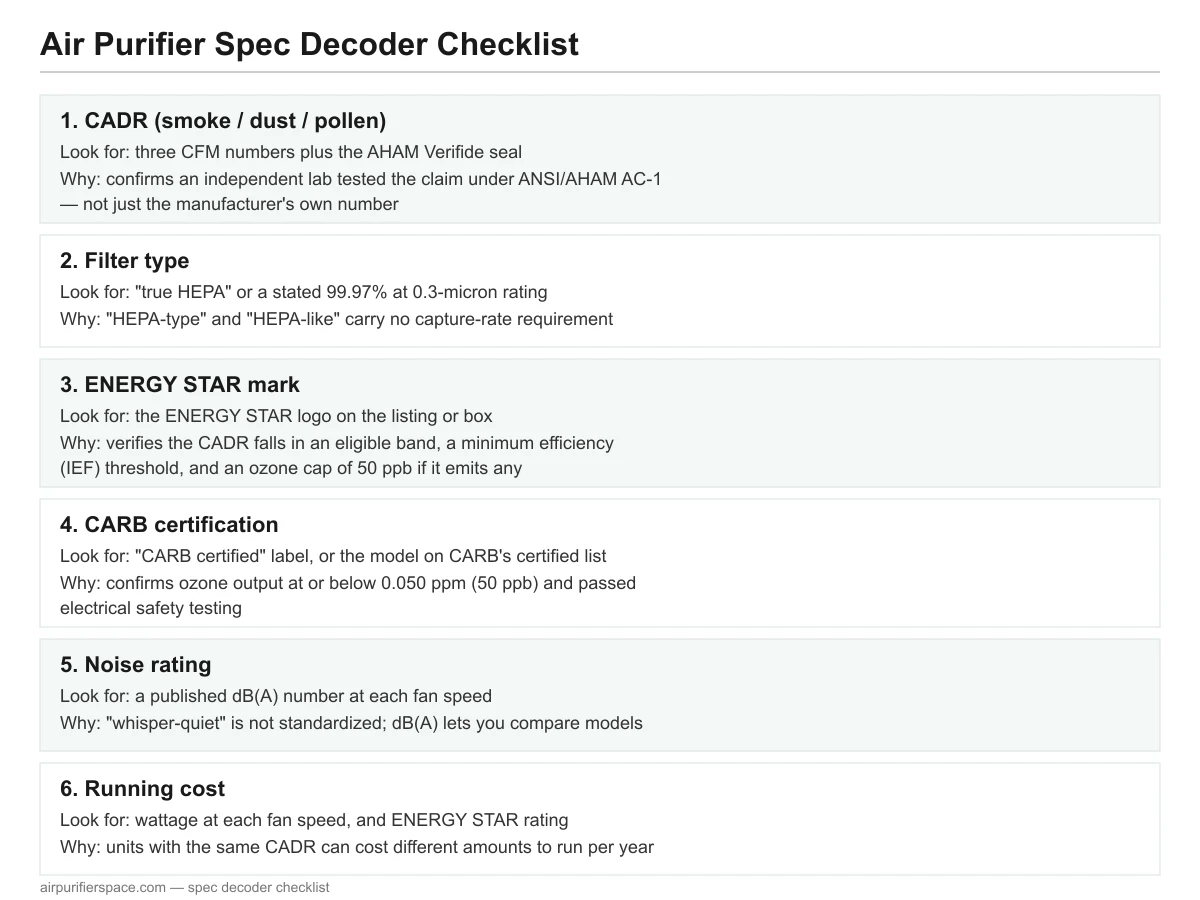
Use this table the way you’d use it standing in front of a shelf or a product listing. Each row is one thing to look for on the box or spec sheet, and why it’s there.
| Spec type | What to look for | Why it matters |
|---|---|---|
| CADR (smoke / dust / pollen) | Three separate CFM numbers, plus the AHAM Verifide seal | Confirms an independent lab tested the airflow claim under ANSI/AHAM AC-1, instead of trusting the manufacturer’s own number |
| Filter type | The words “true HEPA” or a stated 99.97% at 0.3-micron rating | “HEPA-type” and “HEPA-like” are marketing terms with no capture-rate requirement behind them |
| ENERGY STAR mark | ENERGY STAR logo on the listing or box | Means the PM2.5 CADR falls in an eligible band and the unit meets a minimum efficiency (IEF) threshold, plus an ozone cap of 50 ppb if it emits any |
| CARB certification | “Meets California ozone emissions limit: CARB certified” label, or the model listed on CARB’s certified-devices page | Confirms ozone output is at or below 0.050 ppm (50 ppb) and the unit passed electrical safety testing |
| Noise rating | A published dB(A) number at each fan speed, not a marketing word | “Whisper-quiet” isn’t standardized; a dB(A) figure lets you compare two models directly |
| Running cost | Wattage at each fan speed, and whether the unit is ENERGY STAR-rated | Two units with the same CADR can have different yearly electricity costs if their efficiency (IEF) differs |
How do I use this checklist while actually shopping?
Work through it in order. First, find the three CADR numbers and confirm the AHAM Verifide seal is present — without it, treat any CADR claim as unverified. Second, check the filter description for the specific 99.97%-at-0.3-micron wording rather than a vaguer “HEPA-type” label. Third, look for an ENERGY STAR mark or a CARB certification label (or both); either one means a third party has checked something the manufacturer alone did not. Fourth, find a decibel number — not a word — for the fan speed you plan to use daily. Fifth, note the wattage at that same fan speed so you can estimate what the unit will cost to run. A listing that’s missing two or more of these is one to research further before buying, not one to rule out automatically — some reputable units simply list specs in different places on the page.
Keep reading: the rest of this buying guide
This article covers the specs that apply across every room. For the deeper dives on each topic above, and for maintenance and troubleshooting once you own a unit, see:
- What Does CADR Rating Mean? How to Compare Air Purifier Specs
- True HEPA vs. HEPA-Type: How to Spot the Marketing Trick
- HEPA vs. Activated Carbon Filters: Which Removes What
- How Often to Replace Your Air Purifier Filter (By Usage)
- Where Not to Place an Air Purifier (and Why It Matters)
- Are Ozone-Generating Air Purifiers Safe? What CARB and EPA Say
- How Much Does It Cost to Run an Air Purifier?
- How Loud Is Too Loud? Air Purifier Noise Levels Explained
- Air Purifier Filter Light Won’t Reset? Step-by-Step Fix
Frequently asked questions
Does a higher CADR number always mean cleaner air?
Only if it’s matched to your room and backed by the AHAM Verifide seal. An unverified CADR claim on an uncertified unit tells you nothing reliable. A verified CADR number also only describes smoke, dust, and pollen removal — it says nothing about odors or gases, which depend on the activated carbon stage instead.
Is “HEPA-type” close enough to true HEPA?
No. “HEPA-type” and “HEPA-like” are marketing phrases, not certifications, and are not held to the 99.97%-at-0.3-micron benchmark that defines true HEPA. If the listing doesn’t state that specific efficiency and particle size, assume it does not meet it and look for a different model if filtering fine particles is your main reason for buying.
Do I need both an ENERGY STAR mark and a CARB certification?
They’re not interchangeable. ENERGY STAR addresses energy efficiency (and caps ozone on units that emit any). CARB addresses ozone output and electrical safety specifically, and is legally required for any unit sold or shipped into California. A unit can carry one, both, or neither.
Can an air purifier replace opening a window?
No. The EPA’s own guidance ranks removing pollutant sources and ventilating with outdoor air above air cleaning, treating filtration as a supplement rather than a replacement for those two steps. A purifier with excellent specs still will not fix the underlying cause of poor air, such as a moisture problem or an unvented combustion appliance.
What’s the single biggest red flag on a spec sheet?
A CADR number with no AHAM Verifide seal next to it, paired with a filter described only as “HEPA-type.” Neither claim has been independently checked, and together they suggest the rest of the listing’s specs weren’t either. Treat that combination as a starting point for more research, not a reason to buy on faith.
Sources
- U.S. EPA, Guide to Air Cleaners in the Home — read November 2026
- AHAM Verifide, Scope of Air Cleaner Certification — read November 2026
- ENERGY STAR, Room Air Cleaners Key Product Criteria — read November 2026
- California Air Resources Board, Air Cleaner Information for Consumers — read November 2026
airpurifierspace.com Editorial Team. Last updated: November 12, 2026.




1 thought on “How to Choose an Air Purifier: Specs That Actually Matter”