True HEPA vs HEPA-Type: How to Spot the Marketing Trick
True HEPA filters must capture 99.97% of particles at 0.3 microns. See the exact label wording that separates real HEPA from “HEPA-type” marketing terms.

Image: ErikaWittlieb via Pixabay
A true HEPA filter is tested to capture at least 99.97% of particles at 0.3 microns, a figure set by the U.S. Department of Energy and confirmed by the IEST-RP-CC001 standard. “HEPA-type,” “HEPA-like,” “HEPA-style,” and “99% HEPA” are marketing phrases — no federal agency or standards body defines a required efficiency for any of them.
- True HEPA has one specific technical definition: at least 99.97% capture at 0.3 microns, per the U.S. Department of Energy and the IEST-RP-CC001 standard.
- “HEPA-type,” “HEPA-like,” “HEPA-style,” and “99% HEPA” are marketing phrases. The government and standards-body sources that define “HEPA” don’t mention these other terms at all, let alone set a required efficiency for them.
- A genuine HEPA claim states two numbers together: 99.97% and 0.3 microns. A label with only one of those — or neither — hasn’t told you what you need to know.
- Use the label-reading checklist below while standing in front of a shelf or a product listing, before you buy anything.
Why does the exact wording matter?
Filter boxes and online listings use filtration language loosely, and almost none of it is independently checked before it reaches a shelf. “HEPA” itself is not a vague marketing word — it has a specific, published technical meaning. Once you know that exact meaning, you can tell whether a label is quoting it or borrowing its reputation with a similar-sounding phrase instead.
This matters most if you’re buying specifically because of allergies, asthma, wildfire smoke, or another reason fine-particle capture matters to you. This article explains what the words on a label mean — it is not medical advice. If you have a respiratory condition, talk to your doctor about what level of filtration your situation calls for.
What does “true HEPA” actually mean?
HEPA stands for high-efficiency particulate air filtration. According to the U.S. Environmental Protection Agency, HEPA is “officially defined by the U.S. Department of Energy” as a filter that can remove at least 99.97% of particles with a diameter of 0.3 microns. The EPA’s guidance also explains why 0.3 microns is the test size: it corresponds to the most penetrating particle size, the size that’s hardest for any filter to trap. Particles larger or smaller than 0.3 microns are caught at an even higher rate, so 99.97% is effectively the filter’s worst-case performance, not its best case.
The Institute of Environmental Sciences and Technology (IEST) publishes the recommended practice that the filtration industry uses to classify these filters, IEST-RP-CC001, covering HEPA and ULPA (ultra-low penetration air) filter units. That standard sets eleven filtration performance levels and confirms the same bar: a HEPA-level filter must stop at least 99.97% of submicron particles. Between them, these two sources — one federal, one from the standards body the filter industry itself relies on — are where the 99.97%-at-0.3-micron figure comes from. It isn’t a round number a marketing team picked; it’s a published test result requirement.
Why can a company still call a filter “HEPA-type”?
Because that specific phrase sits outside the definition entirely. The EPA and IEST sources above define one term — “HEPA” — tied to one number and one particle size. Neither source mentions, defines, or sets any required capture rate for “HEPA-type,” “HEPA-like,” “HEPA-style,” or “99% HEPA.” Those phrases simply don’t appear in the technical definition at all, which is exactly why they can be printed on a box without the filter inside ever being held to the 99.97%-at-0.3-micron figure.
That’s a meaningfully different situation from a rating like CADR, where a voluntary industry seal (AHAM Verifide) exists specifically so a shopper can confirm a number was independently checked — see our CADR explainer for how that works. There is no equivalent seal most shoppers can look up filter-by-filter to confirm a “true HEPA” claim either, which is one more reason the exact wording on the label is the main thing you have to go on.
What exact words prove real HEPA filtration?
Look for both numbers stated together, not just the word “HEPA” by itself:
- The percentage: 99.97% (not 99%, not “up to 99.97%” worded vaguely, and not a different number).
- The particle size: 0.3 microns (sometimes written 0.3 μm).
- Ideally, a reference to the test basis — language like “tested to the DOE HEPA standard” or “meets IEST-RP-CC001” is a stronger signal than the word “HEPA” with no source named.
If a listing states only one of the two numbers, or neither, that’s not automatically proof the filter is weak — but it does mean the label itself hasn’t given you the information the definition requires. Treat it as a question to ask before buying, not a claim to accept.
Which phrases are marketing terms to watch for?
These phrases show up constantly in listings and on packaging. None of them appear in the EPA, DOE or IEST definitions of HEPA:
- “HEPA-type” — the most common version. No percentage or particle size is implied by the word “type.”
- “HEPA-like” or “HEPA-style” — functionally the same claim as “HEPA-type,” worded differently.
- “99% HEPA” — sounds close to 99.97%, but it is a different, lower number presented to look like the real figure.
- A filter described only as “HEPA” with no percentage or micron size printed anywhere — the word alone, without the two numbers behind it, isn’t the full claim.
The label-reading checklist
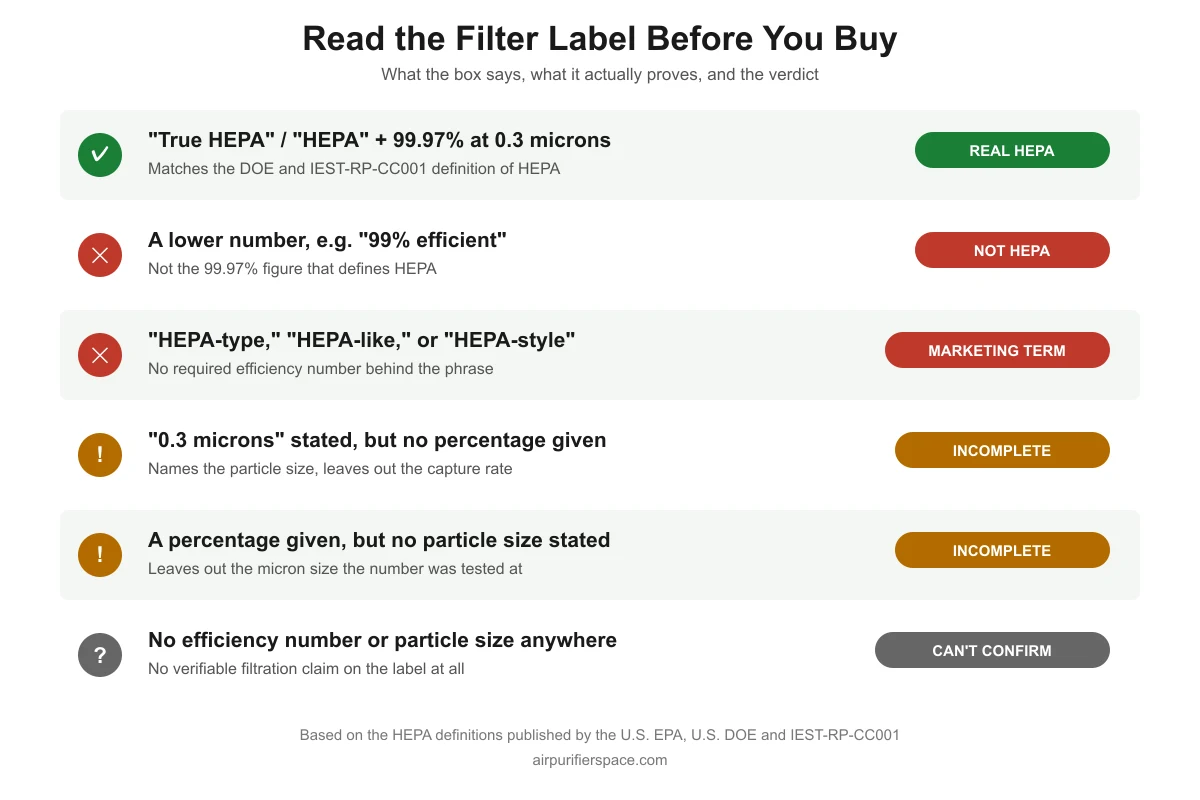
Use this table the way you’d use it standing in front of a shelf or reading a product listing online. Each row is a type of wording you might see, what it actually tells you, and the verdict.
| What the label says | What it actually tells you | Verdict |
|---|---|---|
| “True HEPA” or “HEPA” with 99.97% at 0.3 microns stated | Matches the DOE and IEST-RP-CC001 definition of HEPA exactly | Real HEPA |
| A lower stated efficiency, e.g. “99% efficient” | Not the 99.97% figure that defines HEPA — a different, lower number | Not HEPA |
| “HEPA-type,” “HEPA-like,” or “HEPA-style” | Not defined by the EPA, DOE or IEST — no required efficiency behind the phrase | Marketing term |
| “Captures particles down to 0.3 microns,” no percentage given | Names the hardest-to-trap particle size but leaves out the capture rate — the number that matters most | Incomplete |
| A stated percentage (even 99.97%) with no particle size given | Leaves out the micron size the number was tested at | Incomplete |
| No efficiency number or particle size anywhere on the label | No verifiable filtration claim at all | Can’t confirm |
Does a “HEPA-type” filter do nothing at all?
Not necessarily — but the phrase alone cannot tell you one way or the other. “HEPA-type” is not a performance claim with a number attached; it’s a name chosen because it sounds similar to a filter that has one. Without a stated percentage and particle size, there’s no way to know from the label whether a specific “HEPA-type” product performs close to true HEPA or well below it. That uncertainty is the actual problem with the term, not a guarantee that the filter underneath is poor.
If fine-particle capture is the reason you’re buying — rather than, say, basic dust and larger pollen — the simplest way to remove that uncertainty is to look for the two numbers from the checklist above directly on the listing or packaging, not to guess based on the product name or category.
Frequently asked questions
Is “HEPA-type” close enough to true HEPA for most people?
There’s no way to answer that from the label alone, because “HEPA-type” carries no stated efficiency or particle size. Some HEPA-type filters may perform well; the phrase itself just doesn’t tell you which ones do. If matching the 99.97%-at-0.3-micron figure specifically matters to you, look for a listing that states both numbers rather than relying on the word “type.”
What if the box just says “HEPA” with no percentage listed?
Treat it as incomplete rather than automatically fake. The technical definition requires both the 99.97% figure and the 0.3-micron particle size; a label that states neither hasn’t given you the information the definition is built on. It’s reasonable to look for a fuller spec sheet or contact the seller before assuming either way.
Is there a government agency that tests and certifies HEPA claims on home air purifiers?
The EPA points to the U.S. Department of Energy’s technical definition of HEPA, and the filtration industry uses the IEST-RP-CC001 standard to classify HEPA and ULPA filters. Neither source describes a program that certifies individual consumer air purifier models filter-by-filter the way AHAM Verifide does for CADR numbers, which is why the exact wording on the label is what you have to go on.
Does “99% HEPA” mean 99% of the way to true HEPA performance?
No — it states a different, lower capture percentage (99%) than the 99.97% figure that defines HEPA. The two numbers look similar at a glance, which is likely why the phrasing is used, but 99% and 99.97% are different stated efficiencies, not the same standard expressed two ways.
Related reading on this site
- How to Choose an Air Purifier: Specs That Actually Matter — the full spec-sheet checklist this article is part of.
- What Does CADR Rating Mean? How to Compare Air Purifier Specs — how the voluntary AHAM Verifide seal works for CADR numbers.
- Are Ozone-Generating Air Purifiers Safe? What CARB and EPA Say — label terms to watch for on a different kind of air-cleaning claim.
Sources
- U.S. EPA, What is a HEPA filter? — read November 2026
- IEST, IEST-RP-CC001: HEPA and ULPA Filters — read November 2026
airpurifierspace.com Editorial Team. Last updated: November 12, 2026.