How to Read airpurifierspace.com Faster
In about 30 seconds, you can usually get the main point of how to read airpurifierspace.com faster by checking the summary, scanning the table of…
How to Read airpurifierspace.com Faster
Last updated: November 18, 2026
Quick Answer: In about 30 seconds, you can usually get the main point of how to read airpurifierspace.com faster by checking the summary, scanning the table of contents, and opening one jump link. Read airpurifierspace.com faster by using the table of contents first, then jumping by section headings instead of reading every line. On most pages, the quickest path is: scan the article summary, pick one jump link, and read only the parts that answer your question.
Key takeaways
- Start with the table of contents so you can skip straight to the section you need.
- Read the article summary before the body; it tells you if the page is worth more time.
- Use section headings as stopping points, not decorations.
- Jump links save time on long pages because they cut out scrolling.
- Skimming works best when you know the exact question you want answered in under a minute.
What is the fastest reading path?
For many pages on airpurifierspace.com, the fastest reading path is the table of contents, then the headings, then the first sentence of each section. That order gives you the main point of a page in about 30 to 60 seconds, without forcing you to read every paragraph.
A clean reading flow usually works like this: open the page, check the article summary, scan the table of contents, and choose the section that matches your question. If the page has jump links, use them. A jump link takes you straight to a section heading, which is faster than scrolling through 10 or more paragraphs.
This is different from reading an article cover to cover. If the page is long, full reading can waste 5 minutes or more on material you may not need yet. Fast reading is not lazy reading; it is targeted reading. It works best when you only need one answer, one comparison, or one step.
A reader who wants the whole article can still go back later. The point here is to get to the useful part first, not to miss it. For broader guidance on scanning and structure, W3C’s Web Content Accessibility Guidelines and WebAIM both stress clear headings and organization as a way to help people find content faster. Related reading guides can help too.
How do I skim airpurifierspace.com articles?
Skim airpurifierspace.com articles by reading the title, the article summary, and every section heading before you read a full paragraph. That gives you the shape of the page in less than 1 minute and tells you where the useful details are.
Use this simple sequence:
- Open the page title and decide if it matches your question.
- Read the article summary in full so you catch the main point fast.
- Scan the table of contents for the section that answers your question.
- Tap the jump link for that section instead of scrolling.
- Read the first sentence under each heading, because it usually carries the answer.
- Stop when you have the fact, comparison, or step you needed.
- Return to the body only if you need a second detail.
The best part of this method is that it still helps when a page has 8 or 12 sections. You do not need to read all of them to get value from the page. If the article uses headings well, the headings do a lot of the work for you.
Skimming fails when the reader reads every line at the same speed. That turns a short answer into a long one. Skimming works when you treat the page like a menu, not a novel, and if the page involves a health or safety decision, check a qualified source before acting on it.
Which page parts should I read first?
You should read the article summary first, then the headings, then the first sentence of the section you opened. That order gives you the most information for the least effort, especially on long how-to pages.
Here is the most useful order for faster reading:
| Page part | What it tells you | Time to spend |
|---|---|---|
| Article summary | The main answer in one short block | 10 to 20 seconds |
| Table of contents | Where each section lives | 10 to 15 seconds |
| Section headings | What each section covers | 15 to 30 seconds |
| First sentence under a heading | The direct answer | 10 to 20 seconds |
| Full paragraph | Extra detail and trade-offs | Only if needed |
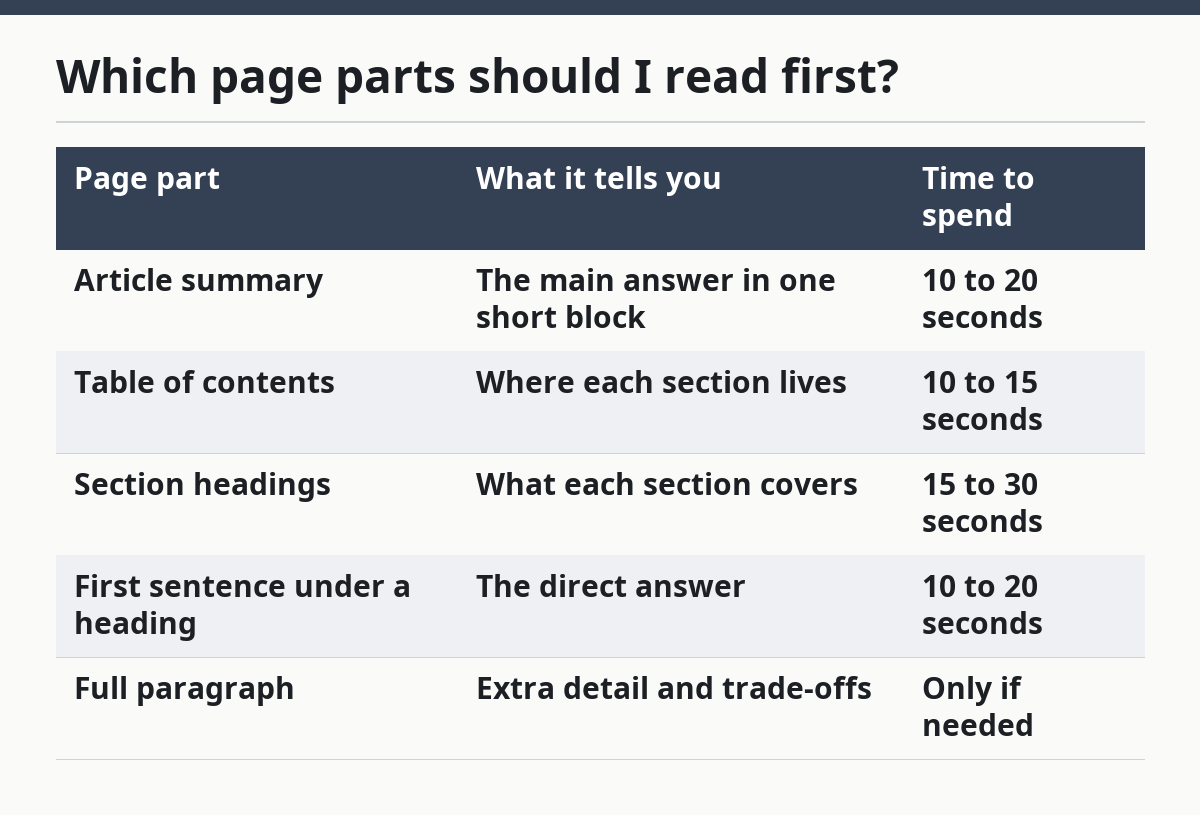
That order matters because not every line deserves equal attention. A table of contents can save several scrolls. A heading can tell you that a section is not relevant before you enter it. A first sentence can confirm whether the section gives a direct answer or just background.
A common mistake is starting in the middle of a paragraph and hoping the page will explain itself. That usually slows reading down, because you have to backtrack. Another mistake is ignoring the article summary, which often gives the main point in plain language.
This method is also the right choice for readers on a phone. Small screens make it easier to lose your place, and jump links reduce that problem. If the page is 1 long scroll, the summary and headings do most of the sorting for you. See also site navigation tips and accessibility basics for why structure matters.
How do jump links save time?
Jump links save time by taking you directly to the part of the page you want, instead of making you swipe through the whole article. On a long page, that can cut the reading path from many scrolls to one tap.
A jump link is most useful when the article has several sections and you only need one of them. For example, if you want the reading method but not the background, tap the section that matches the method. That is faster than reading from top to bottom and trying to remember where the useful part was.
The trade-off is simple: jump links are fast, but they can make the page feel fragmented if you use them too quickly. If you skip around without reading the headings, you may miss the logic of the article. The better approach is to scan first, then jump with purpose.
This also helps with return visits. If you already know the page structure, you can jump straight to the section you used before. On repeat visits, that can save another 1 or 2 full scrolls, which matters more than it sounds on a long page.
What should I ignore first?
You should ignore long background paragraphs first, because they usually cost the most time and give the least immediate value. If the page opens with general context, you can often skip past it until after you have your answer.
A better rule is to read in this order: summary, headings, first sentence, then supporting details. That means you do not need to treat every paragraph as equally important. If a section starts with setup, history, or broad context, move to the next line that names the actual point.
One mistake is getting stuck on a section just because it is there. On a practical how-to page, not every paragraph is part of the main job. Some lines explain why the topic matters, but your goal is usually a faster read, not a full lesson.
This is also where many readers waste 2 or 3 minutes: they keep reading because the text is present, not because it is useful. If the first sentence under a heading does not answer your question, skip ahead. That is not cheating; it is efficient reading, and the same idea shows up in guidance from the Nielsen Norman Group on scanning behavior.
When is fast reading the wrong choice?
Fast reading is the wrong choice when you need the full wording of a section, not just the main idea. If a page has a process, a comparison, or a caution you must follow closely, skim first and then slow down for the exact lines that matter.
That trade-off is important because fast reading can miss small details. A skipped qualifier, a condition, or a narrow exception can change the meaning of a section. If you are using airpurifierspace.com for a task that depends on exact wording, read the relevant paragraph twice instead of racing through the whole page.
A good rule is this: skim for direction, slow down for decisions. If you only need to know where a topic lives on the page, fast reading is enough. If you need to act on the instructions, read the full section before you move on.
This is one reason the page structure matters. Headings, table of contents, jump links, and article summary are not just layout features; they are speed tools. When they are clear, reading gets faster. When they are weak, every paragraph becomes harder work.
The same idea shows up in accessibility guidance from W3C and WebAIM: clear structure helps people find information faster, especially when they depend on headings to move through content. That is why section labels matter as much as the words below them.
How does this fit the airpurifierspace.com reading flow?
This fits the airpurifierspace.com reading flow by making the page easier to scan from top to bottom and easier to enter at the middle. If the page uses a table of contents, section headings, jump links, and an article summary, those parts can be the fastest route through it.
The simplest way to use the flow is this: open the page, read the summary, inspect the headings, tap the jump link that matches your goal, and then read the first sentence under that heading. That sequence works because each step reduces the amount of text you have to process.
A page built for fast reading does not ask you to guess where the answer is. It shows you. That is why headings and jump links are not extra decoration; they are part of the reading path itself.
This page belongs with the site’s user experience and accessibility topic because reading speed depends on structure, not just on attention. A well-labeled page is easier to scan, easier to jump through, and easier to return to later.
How do I skim airpurifierspace.com articles?
Skim airpurifierspace.com articles by starting with the article summary, then moving to the table of contents, then choosing the heading that matches your question. That keeps you from reading every paragraph when you only need one answer. If the page is long, this method usually gets you to the useful part faster than a top-to-bottom read.
What’s the fastest way to scan a page on airpurifierspace.com?
The fastest way to scan a page on airpurifierspace.com is to read the headings first and use jump links when they are available. That lets you skip unneeded sections and land on the part that matters. If the summary is clear, read that before anything else; it often gives the answer in one short block.
Drafted with AI; not yet reviewed by a person.