How Much Does It Cost to Run an Air Purifier?
A worked cost calculation for running an air purifier at 8 hrs/day, 24/7, and during a smoke event, using real EIA electricity rates and wattage.
Image: jillrose999 via Pixabay
Running a typical portable air purifier costs about one cent an hour. Using a real 54-watt nameplate rating and the current U.S. average residential electricity rate of 18.16 cents per kWh, that works out to roughly $28.63 a year running 8 hours a day, or $85.90 a year running nonstop, per EIA and manufacturer data.
- An air purifier’s running cost comes down to two numbers: its wattage (check the rating label or owner’s manual) and how many hours a day it runs.
- Using a real 54-watt nameplate rating (one widely sold model’s owner’s guide) and the EIA’s current U.S. average rate of 18.16 cents per kWh: about $0.08 a day, $2.35 a month, $28.63 a year at 8 hours a day.
- Running that same unit 24/7, year-round: about $0.24 a day, $7.06 a month, $85.90 a year — roughly three times the 8-hour figure.
- One continuous 5-day wildfire smoke event adds only about $1.18 in electricity for that example unit, since the cost scales with hours, not with the size of the air-quality problem.
- Across 248 ENERGY STAR-certified air purifier models, government data show annual electricity use ranging from 30 to 490 kWh a year — about $5 to $89 a year at the EIA rate. For help choosing the right size and specs in the first place, see our air purifier buying guide.
Why does an air purifier’s running cost vary so much?
Two things decide what an air purifier costs to run: how many watts it draws, and how many hours a day it’s on. Hours are mostly up to you. Wattage depends on the unit — bigger rooms generally need a higher Clean Air Delivery Rate (CADR), and a higher CADR generally means a more powerful motor pulling more watts, especially on higher fan speeds.
The spread between models is real and well documented. The U.S. EPA and Department of Energy’s ENERGY STAR program publishes a certified-products dataset for room air cleaners. Pulling that dataset in November 2026 showed 248 certified models with annual energy use ranging from 30 kWh a year on the lowest end to 490 kWh a year on the highest, and an average of about 186 kWh a year. That’s roughly a 16-fold spread between the most and least efficient certified models, which is why a generic “$X a month” number floating around online is close to meaningless without knowing your own unit’s wattage.
How do you calculate your own air purifier’s running cost?
The math only needs two inputs: your unit’s wattage and your electricity rate. The formula is:
Cost = (watts ÷ 1,000) × hours run × price per kWh
Dividing watts by 1,000 converts them to kilowatts, since electricity is billed in kilowatt-hours (kWh). Multiply by the hours the unit actually runs, then by what your utility charges per kWh, and the result is your cost in dollars.
Your unit’s wattage is usually printed on a rating label on the back or bottom of the unit, or listed in the specifications section of the owner’s manual. As one real example, the Shark HP300 Series Owner’s Guide lists its rated voltage (120V, 60Hz) and wattage (54W) in the technical specifications section on its back page. That 54-watt figure is what this article uses for the worked examples below — if your own unit’s label shows a different number, use that instead, since cost scales directly with wattage (half the watts means half the cost, and so on).
For the rate, your own utility bill gives the most accurate number, since electricity prices vary by state and even by utility. If you don’t have a bill handy, this article uses the U.S. average residential rate the EIA reported for August 2026: 18.16 cents per kWh. The EIA’s own state-by-state tables show this average covers a wide range — check the EIA’s electricity price pages directly if you want a number closer to your own region instead of the national average.
What does it cost to run an air purifier at 3 usage levels?
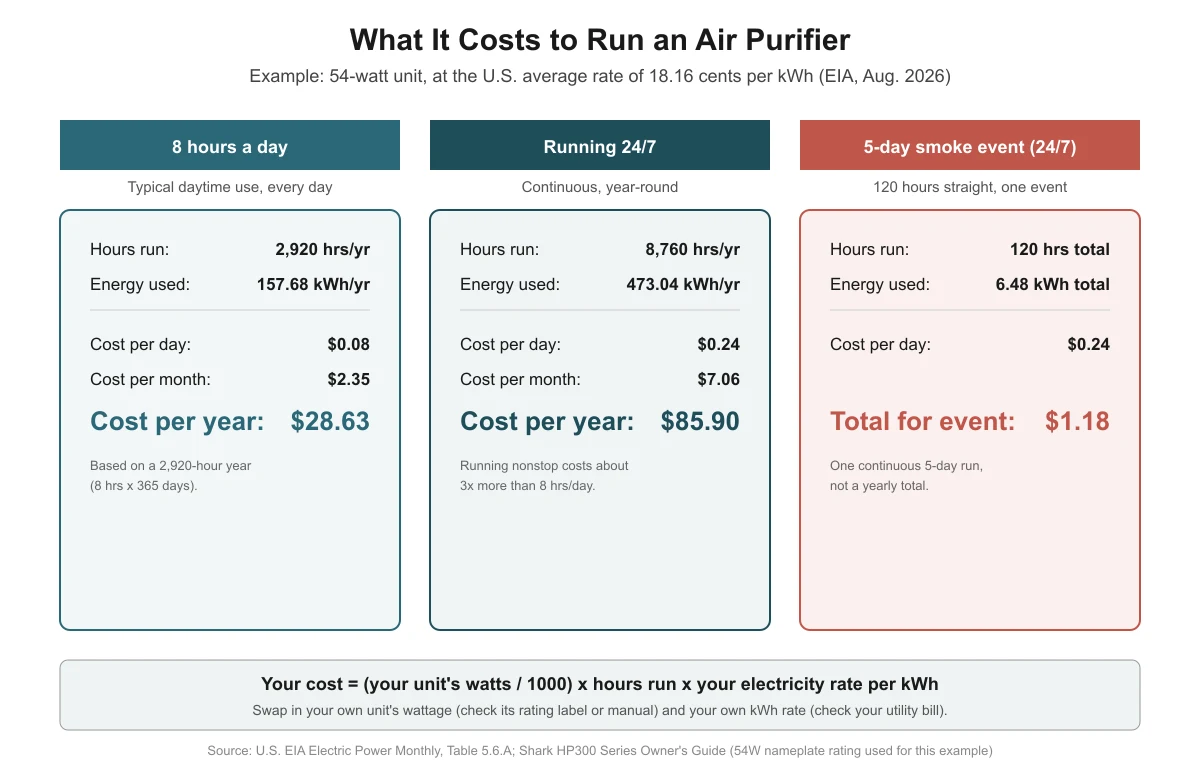
The table and chart below work the math for three realistic usage patterns, all using the same 54-watt example unit and the EIA’s 18.16-cents-per-kWh national average rate. Swap in your own unit’s wattage and your own rate to get your exact number — the formula and ratios between the three scenarios will stay the same.
| Usage level | Hours run | Energy used | Cost per day | Cost per month | Cost per year (or per event) |
|---|---|---|---|---|---|
| 8 hours a day (typical daytime use, every day) | 2,920 hrs/yr | 157.68 kWh/yr | $0.08 | $2.35 | $28.63/yr |
| 24/7 (continuous, year-round) | 8,760 hrs/yr | 473.04 kWh/yr | $0.24 | $7.06 | $85.90/yr |
| High-speed during a 5-day wildfire smoke event | 120 hrs total | 6.48 kWh total | $0.24 | — | $1.18 total for the event |
Two things stand out. First, running a unit nonstop for a full year costs about three times as much as running it 8 hours a day — a predictable result of tripling the hours. Second, even a multi-day wildfire smoke event, where most households would reasonably run a unit around the clock, adds only about a dollar in electricity, since five days is a small fraction of a year. For most households, the electricity itself is a minor cost next to the unit’s purchase price and its replacement filters.
What do real ENERGY STAR-certified air purifiers actually use?
The worked table above uses one real nameplate rating as a stand-in for “a typical unit.” For a broader, government-sourced picture of how much certified models actually use, ENERGY STAR’s own certified-products data (pulled November 2026) covers 248 current room air cleaner models and their annual energy use in kWh per year — a figure the program calculates using its own standard test method, which already accounts for a representative mix of fan speeds, not just one setting run nonstop.
| Group | Annual energy use | Annual cost at the EIA average rate (18.16¢/kWh) |
|---|---|---|
| Lowest-energy certified model in the dataset | 30 kWh/yr | $5.45/yr |
| Average of all 248 certified models | ~186 kWh/yr | $33.78/yr |
| Highest-energy certified model in the dataset | 490 kWh/yr | $88.98/yr |
Treat this table as a cross-model comparison, not a replacement for the hours-based formula above — ENERGY STAR’s annual figure assumes its own test duty cycle, while the worked table reflects however many hours you actually choose to run your unit. Models built for larger rooms, with higher CADR ratings, tend to sit toward the higher end of this range, since more airflow generally takes more power.
Does placement change what it costs to run?
Indirectly, yes. A unit forced to compensate for poor placement, such as being tucked in a corner or blocked by furniture, may need to run on a higher fan speed more often to reach the same air quality reading, which draws more watts for more hours. Our guide on where not to place an air purifier covers the specific spots that restrict airflow, and the reasons each one hurts performance.
How can you lower what it costs to run an air purifier?
A few practical steps keep the electricity cost down without compromising air quality:
- Use Auto Mode if your unit has it. Many units, including the Shark HP300 Series used in the example above, automatically lower fan speed as a room’s measured air quality improves and raise it again only when needed. The manufacturer’s own guide for that model notes fan speed “automatically adjusts based on real-time air quality readings,” which means the unit draws less power during the many hours when the air is already clean.
- Size the unit to the room, rather than buying the largest CADR available for a small space. Oversized units use more watts than a correctly sized one needs to. Our buying guide walks through matching CADR to room size.
- Fix poor placement so the unit isn’t working against blocked airflow, which can push it toward higher fan speeds than necessary.
- Look for the ENERGY STAR label when shopping. It’s a joint EPA/Department of Energy program, and certified models are required to meet minimum efficiency thresholds (CADR delivered per watt) that non-certified models don’t have to meet.

Frequently asked questions
How much does it cost to run an air purifier per month?
It depends entirely on wattage and hours run. For a real 54-watt example unit at the EIA’s current U.S. average rate (18.16 cents per kWh), running 8 hours a day costs about $2.35 a month, and running 24/7 costs about $7.06 a month. A lower-wattage or higher-wattage unit will cost proportionally less or more — use the formula above with your own unit’s rated watts.
Is it cheaper to run an air purifier on low speed all day or high speed for a few hours?
This depends on the exact wattage difference between fan speeds on your specific model, which isn’t the same across brands. As a general rule of thumb rather than a cited figure: since cost scales directly with watts times hours, a lower fan speed run for more hours can cost about the same as, or less than, a higher speed run for fewer hours — check your own unit’s per-speed wattage if its manual lists one.
Does running an air purifier 24/7 waste a lot of electricity?
Not dramatically, based on the worked example above. Running a 54-watt unit nonstop for a year costs about $85.90, versus about $28.63 running 8 hours a day — three times more, but still a modest add-on to a typical power bill for one appliance. Many owners run units continuously anyway, since indoor air quality can change throughout the day.
Do bigger air purifiers cost more to run?
Generally, yes. ENERGY STAR’s certified-products data shows annual energy use climbing alongside CADR (the airflow rating) across the 248 models in its November 2026 dataset, from 30 kWh a year on the smallest, lowest-CADR models up to 490 kWh a year on the largest. A unit sized correctly for your room, rather than oversized, avoids paying for CADR you don’t need.
Does my own electricity rate change these numbers?
Yes, significantly. This article uses the EIA’s U.S. average residential rate for August 2026 (18.16 cents per kWh), but the EIA’s own data shows rates vary a great deal by state and by season. Check your utility bill for your actual per-kWh rate, or the EIA’s electricity price pages for a number closer to your region, and swap it into the formula above in place of the national average.
Sources
- U.S. Energy Information Administration, Electric Power Monthly, Table 5.6.A (Average Price of Electricity to Ultimate Customers) — 18.16 cents per kWh, U.S. residential average, August 2026 data — read November 2026
- U.S. Energy Information Administration, Electricity Explained: Prices and factors affecting electricity prices — 17.30 cents per kWh, 2025 annual U.S. residential average — read November 2026
- ENERGY STAR Certified Room Air Cleaners V3.0 dataset (U.S. EPA / Department of Energy) — 248 certified models, annual energy use 30–490 kWh/yr, average ~186 kWh/yr — read November 2026
- Shark HP300 Series Air Purifier Owner’s Guide (SharkNinja Operating LLC) — technical specifications: 120V 60Hz, 54W — read November 2026
airpurifierspace.com Editorial Team. Last updated: November 12, 2026.