What Does CADR Rating Mean? Comparing Air Purifier Specs
CADR gives an air purifier three separate numbers for smoke, dust and pollen, verified by the AHAM seal. Learn to read and compare real spec sheets.
Image: Lucas23 via Pixabay
CADR (Clean Air Delivery Rate) is a measurement of how fast an air purifier filters three types of particles — tobacco smoke, dust, and pollen — expressed as a number of cubic feet of clean air delivered per minute (CFM) for each one. The number only means something when it carries the AHAM Verifide seal, which confirms an independent lab tested it instead of the manufacturer.
- CADR is not one score. A certified label shows three separate numbers — smoke, dust, and pollen — each in cubic feet per minute (CFM).
- The AHAM Verifide seal, not the CADR number itself, is what tells you the figure was independently lab-tested under the ANSI/AHAM AC-1 standard.
- Only compare certified-to-certified CADR numbers. An uncertified number with no seal may come straight from the manufacturer, with nothing to check it against.
- CADR measures particle removal only. It says nothing about a unit’s ability to remove odors, VOCs, or other gases.
- This guide covers what the numbers mean and how to compare two listings — sizing a CADR number to your specific room is covered in our main buying guide.
What do the three CADR numbers actually measure?
A certified spec sheet does not give you a single “CADR score.” It lists three separate ratings, one for each of the pollutant types the test covers: tobacco smoke, dust, and pollen. The U.S. Environmental Protection Agency’s consumer guide on air cleaners describes it this way: some air cleaner packaging will show CADR numbers “for removing three specific types of pollutants: tobacco smoke, dust, and pollen,” and in general, the higher the CADR, the more particles the unit removes and the larger the area it can serve.
Each number is reported in cubic feet per minute (CFM) — the volume of filtered air the unit delivers for that particular particle type. The three numbers are usually different from each other on the same unit, because smoke particles, dust particles, and pollen particles are different sizes, and a filter and fan combination does not necessarily perform identically against all three.

What does the AHAM Verifide seal actually confirm?
CADR itself is a test result, not a certification. The certification is a separate thing: the AHAM Verifide seal. The Association of Home Appliance Manufacturers (AHAM) runs the AHAM Verifide Air Cleaner Certification Program, under which manufacturers submit their models for CADR testing at an independent laboratory using the ANSI/AHAM AC-1 test procedure, and certified units are re-tested periodically to confirm their performance has not changed over time.
That distinction matters because nothing stops a manufacturer from printing a CADR-style number on a box without ever submitting it for independent testing. A number with the AHAM Verifide seal next to it has been checked by a third party. A number without that seal is, in effect, the manufacturer’s own claim about its own product — it may still be accurate, but there’s no independent check behind it the way there is for a certified number.
AHAM also maintains a searchable public directory of certified models at ahamverifide.org, where listings can be filtered by certified CADR rating, suggested room size, and manufacturer — a useful second check if a specific model’s certification status isn’t clear from the product listing itself.
How do you compare two real spec sheets side by side?
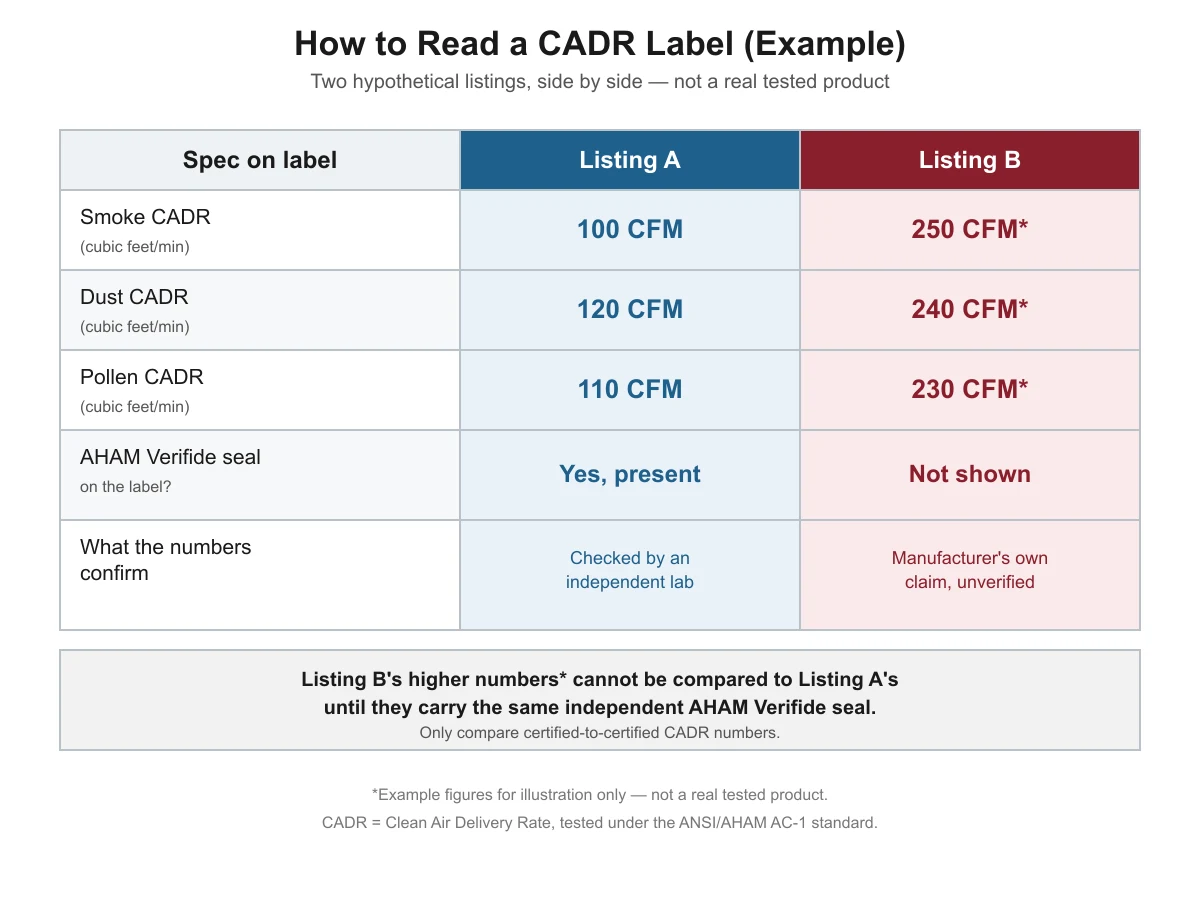
Here is a worked example using two hypothetical listings — not a real tested product — to show the comparison method. Listing A shows modest CADR numbers but carries the AHAM Verifide seal. Listing B shows much higher numbers but no seal is visible anywhere on the listing.
| Spec on label | Listing A | Listing B |
|---|---|---|
| Smoke CADR | 100 CFM | 250 CFM (claimed) |
| Dust CADR | 120 CFM | 240 CFM (claimed) |
| Pollen CADR | 110 CFM | 230 CFM (claimed) |
| AHAM Verifide seal on the label | Yes, present | Not shown |
| What the numbers confirm | Checked by an independent lab under ANSI/AHAM AC-1 | Manufacturer’s own claim, unverified |
Read on its own, Listing B looks like the stronger unit — every number is roughly double Listing A’s. But Listing B’s numbers have no independent check behind them, so they are not on the same footing as Listing A’s certified figures. The two sets of numbers are not actually comparable until Listing B’s claims carry the same seal. In practice, that means treating an uncertified “high CADR” claim the way you’d treat any unverified product claim: a reason to look for the AHAM directory listing or ask the seller directly, not a reason to assume the bigger number wins.
What does CADR not tell you?
CADR is a particle-only measurement. The EPA’s guide is direct about this limit, noting that there is no widely used performance rating system for portable air cleaners or filters designed to remove gases, since CADR testing covers particles alone. That means a CADR number — certified or not — says nothing about how well a unit handles cooking odors, VOCs, or other gas-phase pollutants. A separate activated carbon stage handles that job, and CADR testing does not evaluate it.
CADR also does not measure how long a filter keeps performing at that level. The rating describes short-term performance in a controlled test chamber at the time of testing, not how the number changes as a filter loads up with months of use. A filter nearing the end of its service life can have a lower real-world clean air delivery than its original certified number, even though the certified number itself hasn’t changed.

What’s the single biggest mistake people make reading a CADR number?
Treating an uncertified number as equivalent to a certified one. A listing that prints only a bare number — “CADR 250” — with no AHAM Verifide seal, no mention of ANSI/AHAM AC-1 testing, and no listing in AHAM’s directory, is giving you a marketing claim dressed up to look like a standardized rating. The fix is simple: before comparing two units on CADR, confirm both numbers came from the same independent testing program. If one did and the other didn’t, you’re not actually comparing like with like, no matter how official both labels look.

Keep reading: related guides on this site
For the full spec-sheet checklist — CADR plus filter type, certifications, noise, and running cost — see our air purifier buying guide. If the listing you’re comparing also uses the term “HEPA-type” or “HEPA-like,” read our true HEPA vs. HEPA-type guide before trusting that part of the label either.
Frequently asked questions
What do the three CADR numbers — smoke, dust, and pollen — each measure?
Each number reports how many cubic feet of filtered air the unit delivers per minute against that specific particle type, tested separately under the ANSI/AHAM AC-1 standard. The three numbers differ because smoke, dust, and pollen particles are different sizes, so the same filter and fan combination doesn’t necessarily perform identically against all three in testing.
What’s the difference between a certified and an uncertified CADR number?
A certified number carries the AHAM Verifide seal, meaning an independent laboratory tested it under the ANSI/AHAM AC-1 procedure and the model is re-tested periodically. An uncertified number is typically the manufacturer’s own claim about its own product, with no outside lab checking it. Both can appear on a listing, but only one has been independently verified.
Can I compare CADR numbers between two different brands?
Yes, as long as both numbers are AHAM Verifide-certified. Certification means both were tested under the same standardized procedure at an independent lab, which is what makes a direct number-to-number comparison meaningful across brands. Comparing a certified number from one brand to an uncertified claim from another is not a fair comparison, even if the uncertified number looks higher.
Does a higher CADR always mean better air quality in the room?
Not automatically. A higher certified CADR means the unit delivers more filtered air per minute for that pollutant type, which generally means faster clearing of that particle from the room’s air. But CADR doesn’t account for odors or gases, doesn’t predict how performance changes as the filter loads up over months of use, and an uncertified “high” number may simply be unverified.
Why does CADR only cover smoke, dust and pollen, and not things like VOCs or wildfire smoke odor?
The ANSI/AHAM AC-1 test procedure that produces CADR numbers was built around three standard test particulates — tobacco smoke, dust, and pollen — chosen because they cover a useful range of particle sizes. The EPA’s own guidance notes there’s no comparably widespread rating system for gas-phase pollutants, which is why odor and VOC removal depend on a separate activated carbon filter stage rather than a CADR number.
Sources
- U.S. EPA, Guide to Air Cleaners in the Home — read November 2026
- AHAM Verifide, How to Choose the Best Air Cleaner for Your Home — read November 2026
- AHAM Verifide, Frequently Asked Questions about Testing of Portable Air Cleaner Performance — read November 2026
airpurifierspace.com Editorial Team. Last updated: November 12, 2026.