How to find articles on airpurifierspace.com
Start with the search box, then move through 4 other tools if needed. For how to find articles on airpurifierspace.com, the usual order is search…

Magnifying glass on blue background
Last updated: November 17, 2026
Quick answer: start with the search box, then move through 4 other tools if needed. For how to find articles on airpurifierspace.com, the usual order is search, categories, tags, archives, and browser find. That gives you 5 options when you only remember a word like “filter” or “CADR.”
Key takeaways
- Start with the search box if you know one word from the title or topic.
- Use categories when you want a broader topic, not one exact article.
- Tags help when the site uses a narrower label that matches your query.
- Archive pages are best for older articles sorted by time, not subject.
- Ctrl+F on Windows or Command+F on a Mac helps only after a page is open.
How do I use the search box on airpurifierspace.com?

The search box can be the quickest way to find a specific article on airpurifierspace.com. Type one strong keyword, such as a model name, a feature, or a topic word, then open the result that matches the title or summary.
Start with 1 keyword if you are not sure of the full title. A short search like “HEPA” or “filter” usually gives a cleaner list than a long sentence, because a search box is built to match the words that appear in the article itself. If the site shows too many results, tighten the search with a second word.
Use the search box when you want speed, not browsing. It is the right tool if you already know what you are after, and the wrong tool if you only want to scan the site by theme. In that case, category pages or archive pages are a better fit.
- Open the search box on airpurifierspace.com.
- Type 1 to 2 keywords that match the article you want.
- Review the result titles for the closest match.
- Open the article that matches the topic, not just the first result.
- Refine the search with a second word if the first pass returns too many pages.
A common mistake is typing a full question into the box when a keyword would do better. That can hide the article you want behind wording that does not appear on the page. If the site has a result list, scan titles first and only use the excerpt as a backup.
How do I browse by topic on airpurifierspace.com?
You browse by topic on airpurifierspace.com by using categories and tags, not by guessing article titles. Categories give you the wider shelf, while tags help you narrow down to a specific angle inside that shelf.
In practice, categories act like a broad subject view and tags act like a narrower label. If the site groups articles by a subject like maintenance, room size, or filters, a category page can surface a cluster of related articles at once. Tags are useful when the same article belongs to more than one subject and you want a narrower path.
This is the better route when you do not remember a title but do remember the topic. It is also better than the search box when you want to scan 5 to 15 related articles instead of chasing one exact result. That can help readers who are still deciding what they need.
| Tool | Best for | What you type or click | Main limit |
|---|---|---|---|
| Search box | One article or one exact topic | 1 to 2 keywords | Can return too many mixed results |
| Categories | Broad subject browsing | A category name | May be wider than you want |
| Tags | Narrow topic filtering | A tag word | Only works if the site uses that tag |
| Archives | Older articles by time | A month or date range | Not arranged by subject |
| Browser find | Finding text on an open page | Ctrl+F or Command+F | Works only after a page is open |
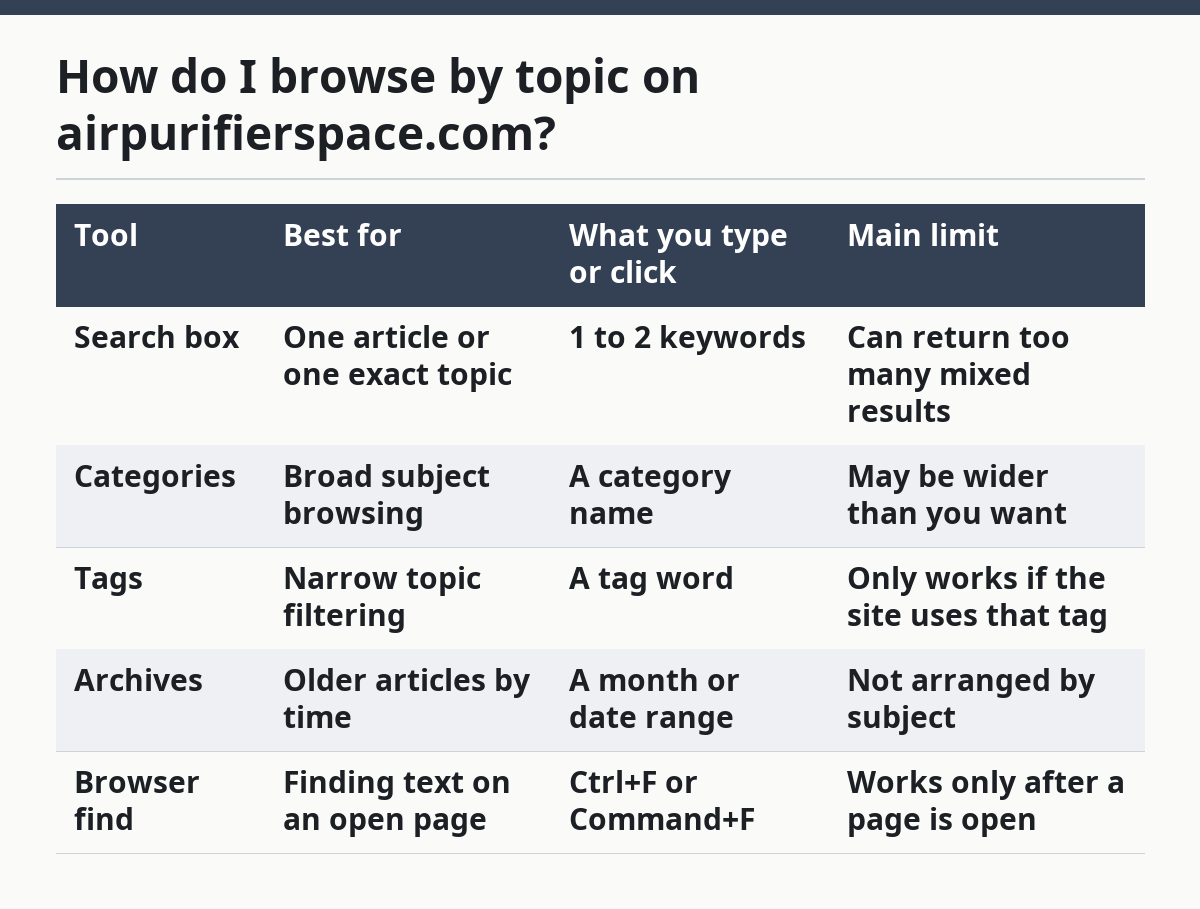
A generic article would stop here and call all these tools “navigation.” That misses the practical difference: categories help you browse, while tags help you refine. If you treat them as the same thing, you may waste time clicking through the wrong pages. When the topic affects a purchase or health-related decision, double-checking the article title and the page context is a safer habit; see Mozilla’s and Google’s guidance on finding text in pages for how page-level search works, and use a professional source if the topic requires medical or safety advice: https://support.mozilla.org/en-US/kb/find-text-webpage | https://support.google.com/chrome/answer/98451?hl=en
What if the article is buried in older posts?
Archive pages help when you think the article is older and the search box is not enough. They sort content by time, so they are useful when you remember a rough period rather than a subject label.
Use archives when you know the article is not new, or when a topic has been covered more than once. A monthly archive can be a clean shortcut if the site publishes regularly, while a broader archive page is better if you only know the general time frame. This is the tool for “I know I saw it before” searches.
Archives are not the fastest method for a fresh topic search, because they are organized by date rather than subject. That means you may have to scan several entries before you find the one you want. Still, for older content, they can save time that a broad site search wastes.
- Open the archive page for the site.
- Choose the month or date range that fits your memory.
- Scan the article titles for the topic you want.
- Open the matching article and confirm the subject.
- Go back one step if the date was close but not exact.
This method is weak if you only know a keyword and nothing about timing. In that case, the search box is faster. It is also weaker if the site publishes many articles in one month, because the list can get long enough to feel like a second search page.
How do I use the browser find function?
The browser find function helps you locate a word on a page that is already open. Press Ctrl+F on Windows or Command+F on a Mac, then type the word you want to spot on that page.
This is not a site search tool. It does not search the whole site; it only searches the text in the page you have in front of you. That makes it useful after you have opened a category page, an archive page, or a long article and want to jump to a term without reading line by line.
Use it for quick checking, not for discovery. If you are trying to find “filter” on a page with 20 article titles, browser find can save time. If you are trying to find where the site talks about filters across the whole site, you need the search box or category pages instead.
Mozilla’s help page on finding text in a webpage explains the same idea for desktop browsing: https://support.mozilla.org/en-US/kb/find-text-webpage
Google Chrome’s help page gives the same shortcut approach: https://support.google.com/chrome/answer/98451?hl=en
This tool is often overlooked because it feels too basic. It can still save time: one keystroke can turn a 2-minute scroll into a 2-second jump.
Which tool should I try first?
You should try the search box first if you know any exact word from the article, then move to categories, tags, archives, and browser find as needed. The best tool depends on how much you remember, not on which one looks easiest at first glance.
If you know a title fragment, use search. If you only know the subject area, use categories. If you know a narrow theme inside that subject, use tags. If you remember the article as “that older one from a while back,” use archives. If the page is already open and you just need one word, use browser find.
| If you remember… | Start with… | Why this works |
|---|---|---|
| One exact word | Search box | Fastest match to the page text |
| A broad topic | Categories | Shows related articles together |
| A narrow angle | Tags | Filters a topic more tightly |
| A rough date | Archives | Sorts articles by time |
| A word on the open page | Browser find | Jumps inside that page only |
The wrong choice costs time. Search is not ideal for vague browsing, and archives are not ideal for a precise title hunt. A lot of readers lose 5 to 10 minutes because they start with the wrong tool and keep forcing it to do a job it was never meant to do.
What mistakes slow down the search?
The biggest mistakes are using too many words, choosing the wrong page type, and stopping at the first near-match. Those mistakes make the site feel harder than it is.
Typing a full sentence into the search box often hides the result you want. One or two strong keywords usually work better than a long phrase. Picking a category when you want one exact article can also slow you down, because categories are built for browsing, not precision.
Another common mistake is using browser find on a page you have not opened yet. Ctrl+F and Command+F only search the current page, so they cannot replace site search. They help after you have already landed on a category page, archive page, or article page.
A final mistake is assuming the first result is always the best result. It may be close, but close is not the same as right. Scan the title, check the topic, and open the result that matches the need you had in mind.
When should I stop searching one way and switch tools?
You should switch tools after one failed pass, not after five. If the search box returns nothing useful after 1 or 2 keyword changes, move to categories or archives instead of repeating the same query.
That habit matters because each tool handles a different job. Search finds a known item. Categories show related items. Archives sort by time. Browser find locates text inside one page. If you keep using one tool for all four jobs, the site will feel incomplete when the problem is really the method.
This is the main trade-off on a content site: the faster the method, the narrower the result. Search is quick but unforgiving. Categories are forgiving but broader. Archives are orderly but time-based. Browser find is precise but local to one page.
If you want the shortest path, start narrow and widen only once. That usually saves more time than trying to be clever on the first move.
How do I search airpurifierspace.com?
Use the search box with 1 or 2 keywords, then scan the titles before opening a result. That is the fastest way to find a specific article on airpurifierspace.com when you already know part of the name or topic.
If the first search is too broad, add one more word instead of rewriting the whole phrase. The goal is to match the article’s own wording, not to type a full question into the box.
How do I browse by topic on airpurifierspace.com?
Use categories first, then tags if you want a narrower topic inside that category. Categories are the broader path, while tags are the finer filter.
If you only know the general subject and not the title, this is often easier than search. It lets you scan related articles together and pick the one that fits your need.
Drafted with AI; not yet reviewed by a person.