How airpurifierspace.com Handles Page Speed
How airpurifierspace.com handles page speed: airpurifierspace.com handles page speed like a content site that depends on image weight, script load, and…
How airpurifierspace.com Handles Page Speed
Last updated: November 16, 2026
airpurifierspace.com handles page speed like a content site that depends on image weight, script load, and browser cache more than on flashy effects. Quick answer: its speed usually comes down to 4 things — page load, image size, script behavior, and your connection. A slow page is not always a broken page; sometimes it is waiting on a heavy file or another large asset. On a first visit, the first 3 to 5 seconds matter most.
Key takeaways
- Page speed on airpurifierspace.com is shaped most by page load behavior, image size, script behavior, and your connection.
- The same page can feel fast on a second visit because browser cache may reduce what needs to load again.
- Large images usually slow first load more than plain text does.
- Some delays are site-side, but some come from the device, browser, or network.
- A slow page is not always a broken page; sometimes it is waiting on a heavy file or a large image.
What does page speed mean here?
Page speed here means how quickly airpurifierspace.com becomes useful, not just how quickly the first byte appears. A page can show text early and still feel slow if images, fonts, or scripts keep loading for another few seconds.
That matters because readers usually judge speed by the time it takes to read, scroll, and click, not by a lab metric alone. Google’s PageSpeed Insights and Web Vitals guidance both focus on user-facing load behavior, especially the Largest Contentful Paint and related load signals; see PageSpeed Insights and web.dev’s LCP guidance.
For airpurifierspace.com, the main question is simple: does the page start fast enough that a reader can move through it without waiting on heavy media? If the answer is yes, the site feels responsive even when it is not perfect. If the answer is no, the reader notices every pause.
Therefore, page speed is not one switch. It is the sum of the page load, the image files, the browser’s cached files, and the connection between the server and the user. That is why a page can feel quick on one device and sticky on another.
Why can airpurifierspace.com feel slow sometimes?
airpurifierspace.com can feel slow sometimes because one part of the load chain is taking longer than the rest. A large image, a third-party script, or a weak internet connection can hold up the page even if the rest of the content is ready.
The biggest clue is inconsistency. If one visit feels normal and the next feels slow, that often points to cache differences, network speed, or a temporary delay in script behavior. A cached page and an uncached page are not the same thing.
Here is the simplest way to think about it:
| Factor | What it does to load | What the reader notices |
|---|---|---|
| Image size | Bigger files take longer to fetch | Hero images appear late or pop in after text |
| Script behavior | Scripts can block or delay rendering | Buttons or sections appear after a pause |
| Browser cache | Stored files load from the device on repeat visits | The second visit often feels faster |
| Internet connection | Slow or unstable lines stretch every request | The whole page drags, not just one section |
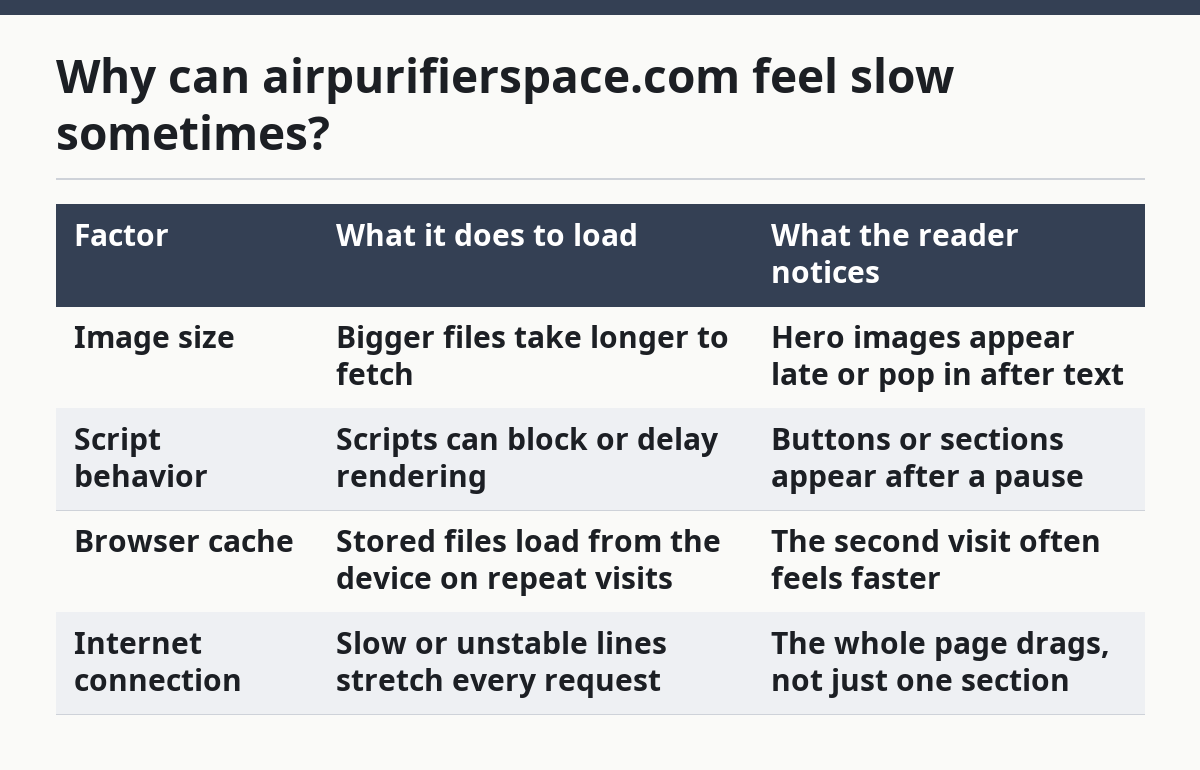
For example, a single oversized file can delay the first visible screen by several seconds. A text-only section may still load quickly. If the delay is from script behavior, the page may look blank longer than expected. If the delay is the internet connection, the site may not be the main problem at all.
A common mistake is blaming the site for every pause. That costs time because the fix changes depending on the cause. The right response is to separate page-side load from device-side or network-side delay before deciding what is actually wrong.
Which parts of the page usually matter most?
The parts that usually matter most are the page load path, the main image files, and any scripts that wait before the page can show useful content. On a content site, those three often affect speed more than the wording on the page itself.
Page load is the first gate. If the browser has to pull too many files before it can draw the page, the reader waits even if the text is light. Image size is the next common drag, because a single oversized image can outweigh a whole block of copy. Script behavior matters because scripts can pause rendering or request more files after the first load starts.
A plain text page can still be slow if its images are heavy. A page with modest images can still feel sluggish if scripts do too much before the screen is ready. That is the trade-off most readers miss: speed is not only about page length; it is about what the page asks the browser to do.
For airpurifierspace.com, the most useful habit is to look at the first visible content. If the title and text appear quickly, the page may already be usable even while other files finish in the background. If the screen stays empty or jumps around, the load path is likely doing too much up front.
That distinction matters because it separates a visual delay from a true usability problem. A page that is readable in a few seconds but still finishes background work is not the same as a page that blocks the reader from starting.
How do I check page speed on airpurifierspace.com?
You check page speed on airpurifierspace.com by loading a page, watching what appears first, and comparing the first visit with a second visit after the browser cache has had a chance to store files. That simple check usually tells you whether the slowdown is broad, image-based, or tied to repeat-load behavior.
Use this basic procedure:
- Open one page from airpurifierspace.com in a desktop browser with no other heavy tabs open. The result you want is a clean read on page load without extra browser strain.
- Watch the first 3 to 5 seconds of the page. If text appears quickly but images lag, the issue is probably file weight rather than total page failure.
- Refresh the same page once. On the second load, browser cache may reduce repeat requests, so the page should feel faster if caching is working well.
- Try the same page on a different internet connection, such as another Wi‑Fi network or mobile data. If the delay changes a lot, the connection is a major factor.
- Compare one image-heavy page with one lighter page. If the lighter page loads faster, image size is part of the slowdown.
- Look for delayed movement or late-appearing buttons. That often points to script behavior, not just large images.
This kind of check does not need a lab tool to be useful. It tells you whether the site is slow in a steady way or only under certain conditions. If the second load is much faster than the first, browser cache is doing work for you. If both loads are slow on different networks, the page itself may be heavy.
The mistake to avoid here is assuming one slow refresh proves a permanent problem. A single test can be distorted by a weak connection, a busy device, or a one-off script delay. A short pattern check is more useful than a single number.
What makes a page feel fast even if it is not perfect?
A page feels fast when the first useful content appears quickly and stays stable while the rest finishes loading. That means the reader can start reading before every image or script has finished.
This is where the idea of perceived speed matters. A page that shows the heading, the first paragraph, and the main structure early often feels better than a page that waits to show everything at once. The reader cares about progress, not just completion.
On airpurifierspace.com, that means the site handles speed best when it avoids loading too much at the top of the page. A single large image can slow the first screen more than several smaller files lower down. Scripts that wait too long can make the page feel stuck even when the content is already there.
This is also why browser cache helps so much on a second visit. If the browser already has parts of the page, the site does less work and the reader gets to the content sooner. The difference can be enough to make a page feel entirely different on the second load.
A lot of generic speed advice says to “optimize everything,” which is vague and not useful. The real question is whether the reader can start reading in one smooth motion. On a content site like this, that is the standard that matters.
What should I expect from airpurifierspace.com page speed?
You should expect airpurifierspace.com to behave like a normal content site whose speed rises or falls with file weight, cache, and connection quality. That means the page may feel fine on a strong connection and less comfortable on a slower one.
The honest trade-off is that pages with images and scripts almost never feel identical on every device. A desktop on fast Wi‑Fi and a phone on a weaker connection will not show the same result. That is not a failure by itself; it is how the web works.
This is also where airpurifierspace.com is not for readers who want instant, bare-bones text only. If a page includes image-heavy content or extra front-end behavior, the site may load a little more slowly than a stripped-down text page. The upside is that the content can be easier to scan when it is fully loaded.
Two outside references are useful if you want the technical frame behind this: Google’s PageSpeed Insights documentation explains the tool’s focus, and web.dev’s Largest Contentful Paint article explains why the main visible content matters so much. Those pages do not describe airpurifierspace.com itself, but they do explain the standard that speed tools use.
The practical takeaway is simple. If the site loads its first visible content quickly, then the rest is mostly about polish. If the first visible content stalls, then page speed becomes a real barrier to reading.
Why is airpurifierspace.com slow sometimes?
airpurifierspace.com is slow sometimes because page load is affected by more than one moving part. A large image, a script that blocks rendering, or a weaker internet connection can slow the same page on one visit and not another.
Browser cache can also change the result. A first visit may need more files, while a second visit may reuse stored pieces and feel quicker.
How can I make airpurifierspace.com load faster?
airpurifierspace.com usually feels faster when the browser cache can help, the internet connection is stable, and the page does not have to fetch heavy images before showing useful content. A second visit often loads faster than the first for that reason.
If the page still feels slow, the issue may be the page itself rather than the device. In that case, the useful check is to compare different pages and different connections before deciding what is causing the delay.
Drafted with AI; not yet reviewed by a person.